

1. The Reserve Bank of Australia keeps its benchmark interest rate unchanged.
At its regular meeting in December 2025, the Reserve Bank of Australia (RBA) decided to keep its benchmark interest rate unchanged at 3.6%. This decision was made after the RBA's Governing Board assessed that inflation had shown signs of rising again in recent months.
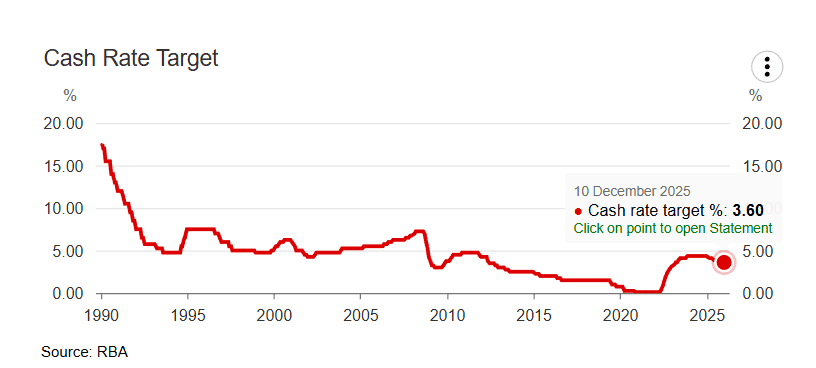
Chart of the RBA's policy interest rate over time.
Inflation in Australia rose to 3.8% in October 2025, higher than the central bank's target of 2-3%. Therefore, experts believe this is one of the factors that prevented the RBA from cutting interest rates at its recent policy meeting, and that the prospect of further interest rate cuts in early 2026 is relatively difficult.
2. The unemployment rate in Australia remained stable in November 2025.
The unemployment rate in Australia in November 2025 remained at 4.3% (the same as in October 2025), with approximately 14.7 million people employed, an increase of over 180,000 people (+1.3%) compared to the same period in 2024; the number of unemployed people was over 662,000, an increase of 69,100 people compared to the same period in 2024, equivalent to an 11.7% increase.
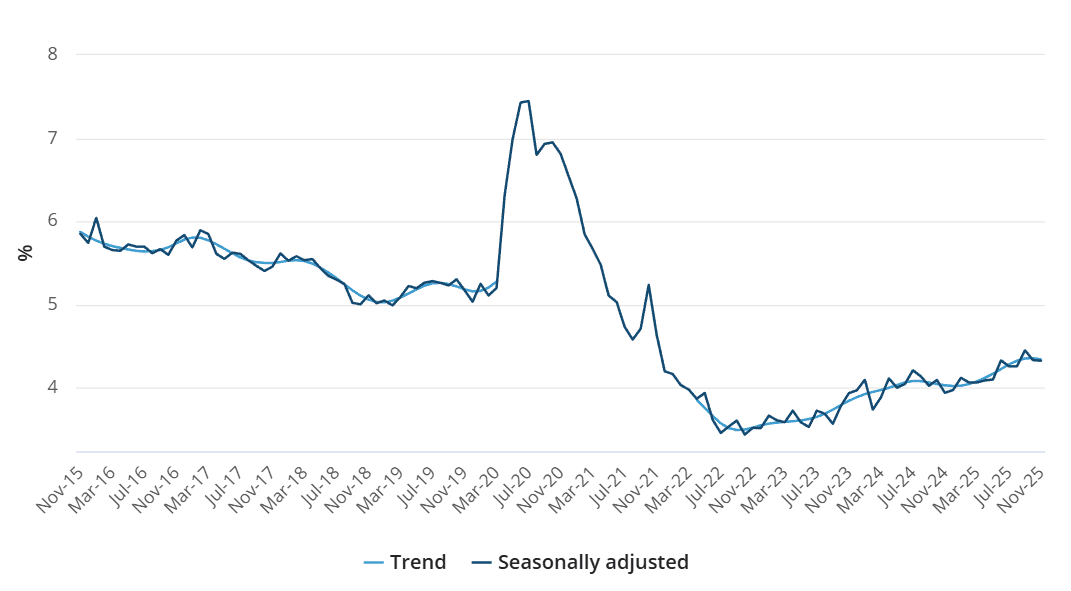
Unemployment rate chart in Australia over time
Experts predict that the unemployment rate may rise again in the near future due to challenging economic conditions. However, if this rate increases, it could also force the Reserve Bank of Australia to reconsider the possibility of maintaining high interest rates.
3. International visitor numbers to Australia continue to recover positively.
According to the latest figures from the Australian Bureau of Statistics (ABS), the total number of overseas visitors to Australia in October 2025 reached 2.1 million, an increase of 8.3% compared to the same period in 2024. Of these, 1.3 million were Australian citizens returning home for short-term stays (+7.9%); and 740,600 were international visitors to Australia for short-term stays (compared to 696,500 the previous month), an increase of over 63,000, equivalent to +9.3% compared to the same period in 2024.
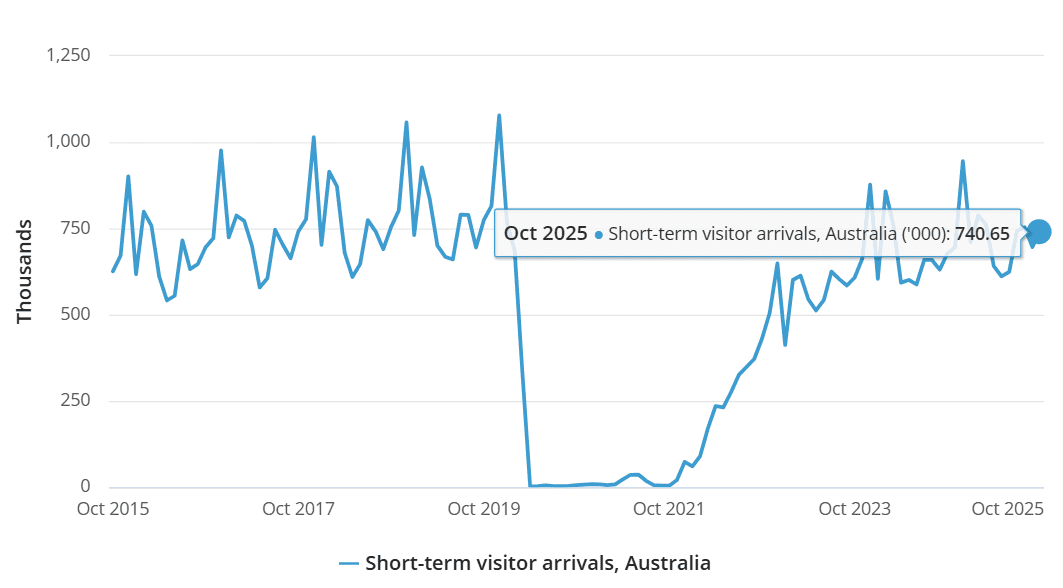
Short-term international visitor chart to Australia by month
New Zealanders continued to lead the number of international visitors to Australia with nearly 141,000, followed by China with over 78,000, and the United Kingdom with 59,700... By state/territory, New South Wales attracted the most international visitors with 284,000 (+11.3% compared to the same period in 2024); followed by Victoria with 180,000 (+8.1%), Queensland with 153,000 (+3.1%)...
4. Victoria's new gas exploration project faces opposition due to environmental concerns.
The Victorian government has recently approved exploration licenses for two new gas projects in the Otway and Gippsland areas off the coast of Victoria, with the Gippsland exploration area alone covering 199 square kilometers. The state government invited private companies to bid on these projects.

A gas exploration project in Victoria. (Illustrative image)
However, the projects are currently facing strong opposition from local communities and environmental organizations. Several environmental groups, such as Friends of the Earth and Environment Victoria, have condemned the decision of the Victorian government, arguing that these projects will have negative impacts on groundwater, the environment, and marine ecosystems.
5. BHP Group reaches A$3 billion infrastructure investment agreement with BlackRock.
Australia's largest mining company, BHP, has reached an agreement for A$3 billion (approximately US$2 billion) worth of infrastructure in Western Australia with Global Infrastructure Partners (GIP), an investor owned by the US-based Blackrock Group. Western Australia is the region where BHP mines and produces the majority of its iron ore and generates significant revenue and profits.

A mining project by BHP. (Illustrative image)
According to the agreement, a new legal entity will be established for the partnership, in which BHP will own 51%, while GIP will hold 49%. Kaan Peker, a mining industry analyst at RBC Capital Markets, believes this agreement will improve the capital efficiency of a large mining group like BHP.
6. Australia needs an additional 200,000 hectares of forest per year to reach net zero.
A new study by academics at the University of Melbourne and the University of Queensland (Australia) indicates that Australia may need to develop around 200,000 hectares of new or regenerated forest each year to achieve its net-zero emissions target by 2050. This model shows the scale of economic transformation and the enormous resources required to meet this ambitious climate goal.

Reforestation reduces emissions in Australia. (Illustrative image)
According to experts, these new planting areas require long-term capital, coordination, and regional planning to avoid major disruptions to agriculture . Research also shows that large-scale reforestation or forest regeneration will be Australia's main source of emissions reduction over the next two decades, but needs to increase at least 100-fold from current levels to meet the government's targets.
7. Australian blueberries officially launched in the Vietnamese market.
On the afternoon of December 10, 2025, in Ho Chi Minh City, the Australian Government's Trade and Investment Agency (Austrade) held an event to welcome Australian blueberries to Vietnam. Speaking at the event, Ms. Emma McDonald, Senior Trade and Investment Counsellor of the Australian Government in Vietnam and Cambodia, emphasized: “Vietnam continues to be one of the most dynamic and promising markets for premium Australian fresh produce. The official introduction of Australian blueberries in Vietnam opens a new and promising chapter for Australia's fruit and vegetable industry, and demonstrates the strong confidence of Australian blueberry growers in this market. Vietnamese consumers are increasingly interested in high-quality and nutritious food, and Australian blueberries fully meet that demand with top standards of quality, safety, and sustainability.”

Photo from the event
The event also featured vibrant networking sessions, bringing together Australian importers, retailers, distributors, and suppliers, creating a favorable environment for establishing partnerships and planning the next steps for the blueberry industry.
Source: https://moit.gov.vn/tin-tuc/ban-tin-thi-truong-uc-tu-5-12-2025-den-12-12-2025-.html













![[Photo] Prime Minister Pham Minh Chinh holds a phone call with the CEO of Russia's Rosatom Corporation.](/_next/image?url=https%3A%2F%2Fvphoto.vietnam.vn%2Fthumb%2F1200x675%2Fvietnam%2Fresource%2FIMAGE%2F2025%2F12%2F11%2F1765464552365_dsc-5295-jpg.webp&w=3840&q=75)










































Comment (0)