

Starting to develop the model in 2018, at that time, Thuy's family only raised a few hundred hens in simple coops. Due to lack of experience, insufficient capital, and the constant risk of disease outbreaks, the early years of farming were very difficult.
Refusing to give up, Thuy and her husband were determined to pursue egg-laying chicken farming in a more systematic and large-scale manner. The couple proactively participated in technical training courses, researched through books and specialized documents, and learned directly from advanced farming models both within and outside the province, especially in Phu Tho province – a region with a strong development of high-tech egg-laying chicken farming.
|
Ms. Duong Thi Thuy is harvesting chicken eggs. |
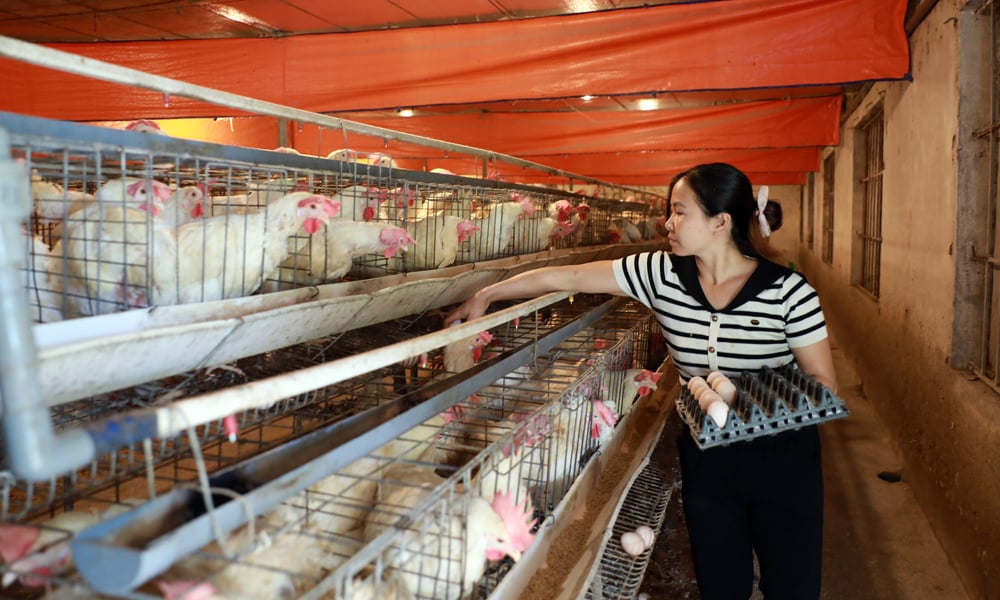
In the early days of expanding their operation, the flock suffered from disease, egg production was unstable, and there were times when they incurred losses. But it was these failures that helped her and her husband accumulate valuable experience in poultry farming: from selecting healthy breeds and arranging appropriate stocking densities to mixing feed and controlling water quality.
Ms. Thuy shared that, to ensure the chickens grow well and yield high productivity, the most important thing is to keep the coop clean and well-ventilated, regularly disinfect, vaccinate on schedule, and monitor the flock daily to detect any abnormalities early. The feed must be nutritious, and vitamins should be added on days with changing weather to boost immunity.
Through perseverance and a willingness to learn, Thuy's family farm has now grown to approximately 10,000 laying hens, including traditional native chickens and the H'Mong black chicken breed that produces green-shelled eggs – a type of egg favored by the market for its high nutritional value and good selling price. Each day, the farm supplies 7,000 eggs, providing a stable income. After deducting expenses, the family earns nearly 1 billion VND per year, becoming one of the exemplary successful livestock farming households in Nha Nam commune.
A key factor in the model's success is Thuy's family's bold investment in a closed-system poultry farm with cooling systems, automatic feeders, and waterers, ensuring a safe breeding environment, minimizing bacteria, and limiting disease outbreaks. Thanks to the proper temperature and humidity control, the flock remains healthy, and egg production is maintained consistently throughout the year.


![[Image] Shipbuilders exposed to steel and record-breaking heat.](https://vphoto.vietnam.vn/thumb/1200x675/vietnam/resource/IMAGE/2026/06/04/1780545781745_ndo_br_img-5402-4683-jpg.webp)








































![[Video] Sunset at Lap An Lagoon – Where the sun sets over the fishing nets](https://vphoto.vietnam.vn/thumb/1200x675/vietnam/resource/IMAGE/2026/05/31/1780192137701_beach-landscape-sea-water-nature-grass-745871-pxhere-com.jpeg)


































Comment (0)