

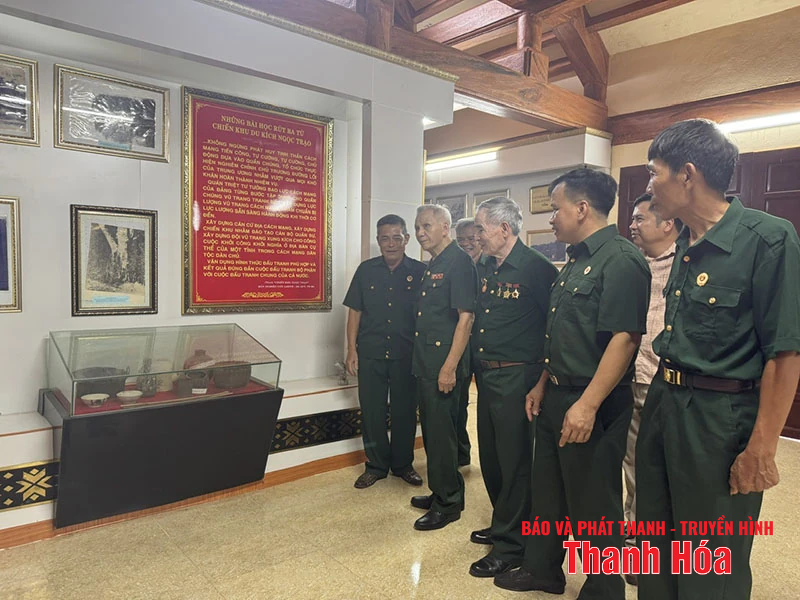
Veterans from Ngoc Trao commune visit the Ngoc Trao War Zone Traditional House.
Earth-shattering
Thanh Hoa, located in Central Vietnam, was a French colonial protectorate, and the lives of the majority of its people were filled with misery. Although numerous patriotic movements against the French took place, they all failed due to a lack of leadership.
The founding of the Communist Party of Vietnam on February 3, 1930, was a historical inevitability, ending the crisis regarding the path to national salvation and opening the correct revolutionary path: national liberation along the lines of a proletarian revolution. Just over five months later, the Thanh Hoa Provincial Party Committee was established on July 29, 1930. To prepare for a general uprising when the opportunity arose, along with building and developing the political forces of the masses, the Thanh Hoa government and Party Committee quickly recognized the importance of building armed forces.
During the period of 1936-1939, the Party Committee of Thanh Hoa province established many worker-peasant self-defense units, "making the self-defense units large, courageous, calm, skillful, and willing to sacrifice to protect the masses." In particular, at the Thanh Hoa Provincial Party Committee's delegate conference held in Phong Coc village in February 1941, it was decided to continue promoting the revolutionary movement in the province, in response to the Bac Son (September 1939) and Southern Vietnam (November 1940) uprisings. At the same time, one of the key tasks was identified as establishing and developing self-defense units and guerrilla units, leading to armed struggle.
In accordance with the Resolution of the Party Congress, the revolutionary movement developed strongly in districts such as Tho Xuan, Thieu Hoa, Yen Dinh, Vinh Loc, Thach Thanh, Ha Trung, and Hoang Hoa (formerly). Most villages and communes had established national salvation self-defense units. In many places, at night, the self-defense units raised the red flag with a yellow star, divided into small squads for training, and organized military exercises. Based on these self-defense units, communist fighters selected individuals with a suicidal spirit, absolute respect for discipline, and the ability to organize and mobilize the people to build guerrilla groups. Many villages established the first guerrilla squads in the province.
Political struggle alone is not enough; armed struggle is the most effective method. The emergence of guerrilla squads marked a new stage in the development of the revolutionary armed forces of Thanh Hoa.
The first guerrilla war zone in the country.
Responding to the demands of revolutionary practice, in June 1941, the Thanh Hoa Provincial Party Committee convened a conference in Phuc Tinh village, Yen Thinh commune (now Yen Ninh commune) to discuss the promotion of revolutionary base construction. The conference assigned Provincial Party Committee members to oversee the construction of revolutionary bases in various districts. Accordingly, “Comrades Tran Bao, Hoang Si Oanh, Nguyen Mau Sung... were assigned to the Tho Xuan, Nong Cong, and Nhu Xuan (formerly) areas, to build a revolutionary base at the Yen My plantation and establish contact with the Central Vietnam Regional Party Committee; Comrades Dang Chau Tue, Dang Van Hy, and Trinh Huy Lan were assigned to build a revolutionary base in the Vinh Loc, Thach Thanh, and Ha Trung (formerly) areas and establish contact with the Northern Vietnam Regional Party Committee; Comrades Le Huy Toan and Trinh Ngoc Phoc were assigned to build a rear area, ready to provide support for the revolutionary base.”
Ngoc Trao village possessed many favorable conditions for establishing a revolutionary base, serving as the first guerrilla war zone in the country. Its strategic location, though far from the provincial capital, allowed for both offensive and defensive maneuvers. The area was strategically important, with gently sloping hills, rocky mountains, and dense forests. It was also the location chosen by leader Tong Duy Tan as a base for his resistance against the French in the late 19th century.
From its founding date (September 19, 1941), the Ngoc Trao guerrilla unit had 21 members, organized into 3 platoots, with Comrade Dang Chau Tue as Commander. This was the first detached armed force, tightly organized and structured, wearing peasant clothing, with added woven bags and green leggings; each soldier was equipped with a sharp knife, and officers were equipped with flintlock rifles... All members swore an oath to be ready to sacrifice themselves and fight to the end for the cause of national liberation.
After its establishment, the command of the war zone decided to strengthen the guerrilla forces, increasing the number of soldiers to 500. Therefore, a number of young students were recommended by revolutionary organizations to join the guerrilla forces in the war zone. Many young people from the provinces of Ninh Binh, Nghe An, Ha Tinh, Thai Binh (formerly),... came to Ngoc Trao to join the forces.
The establishment of the Ngoc Trao guerrilla unit marked the next stage of development for the Thanh Hoa armed forces. With its tight organization and thorough training, the Ngoc Trao guerrilla unit "deserved to be the first worker-peasant armed force of the Party Committee and People of Thanh Hoa" (History of the Party Committee and revolutionary movement of Ngoc Trao commune, 1930-2017).
However, after discovering the activities of the Ngoc Trao guerrilla team, the French colonialists and the puppet government launched a crackdown, causing the guerrilla team and the Ngoc Trao war zone to disintegrate, and the revolutionary movement in Thanh Hoa faced many difficulties.
"Despite the failure, the establishment of the Ngoc Trao revolutionary base clearly affirmed that the Vietnamese revolution had entered a new phase. Previously, the people resigned themselves to slavery, but in this phase, they rose up to seize the enemy's offices to regain power," affirmed veteran Do Van Bon, former Secretary of the Party Committee of Ngoc Trao commune.
The failure of the Ngoc Trao resistance zone did not dampen our spirits; on the contrary, "Their chains cannot lock us/ The sky is full of birds and the earth is full of flowers/ Their guns and bullets cannot shoot/ Our people's hearts are full of love for their country and home" (Nguyen Dinh Thi). Under the leadership of the Party Committee and the Provincial Viet Minh Committee, the entire province rose up in a very vibrant movement to fight the enemy and save the country. Viet Minh fronts were successively established in the districts, counties, and towns, and national salvation organizations developed extensively. In particular, to turn the Provincial Party Committee's Resolution into reality, on September 15, 1944, the General Headquarters of the Viet Minh issued the directive "Prepare for Uprising" to urge localities to quickly build, consolidate, and develop self-defense teams and guerrilla units, and to acquire weapons...
Entering 1945, in preparation for the general uprising, the movement to build revolutionary armed forces in the localities became a widespread movement. All districts in the province established self-defense teams to combat terrorism and protect the revolution, and the revolutionary armed forces advanced to a new level. Besides the directive "Acquire weapons to drive out the common enemy" to equip the self-defense teams, military training (martial arts, shooting, guerrilla warfare, etc.) took place continuously day and night in almost all localities; the armed forces actively patrolled and guarded, supporting movements against forced labor, conscription, and the uprooting of rice plants for jute cultivation...
On July 24, 1945, under the leadership of the Provincial Party Committee and the Hoang Hoa District Party Branch, the self-defense forces, along with the masses, rose up to seize power. This was the first successful partial uprising in Thanh Hoa, strongly encouraging other localities in the province to seize revolutionary power throughout the province.
On the night of August 18th and the early morning of August 19th, 1945, the Provincial Party Committee launched a general uprising to seize power. In accordance with this spirit, the self-defense forces and the people of various localities rose up to fight and overthrow the pro-Japanese government, reclaiming power for the people. By the end of August 1945, a revolutionary government system had been established throughout the province.
Recalling this time 80 years ago, Mr. Dinh Ngoc Mai, born in 1925, a pre-revolution cadre from Sao Vang commune, Thanh Hoa province, originally from Trung Chinh commune, Nong Cong district (formerly), remembers very clearly: “Nong Cong had made thorough preparations for the general uprising. From March 1945, three self-defense platoons from Minh Khoi, Tan Ninh, and Trung Chinh communes were established and systematically trained. On the evening of August 20, 1945, the three self-defense platoons, fully equipped with swords and knives, along with a large number of people, marched to liberate the Nong Cong district capital. The local officials had to surrender, handing over books and documents to the revolutionary forces. On the morning of August 21, 1945, the people, joyful and excited, planted red flags with yellow stars around the Nong Cong district capital.”
"Guns roared, shaking the heavens with fury / People rose up like a flood breaking the banks / Vietnam, from blood and fire / Shakes off the mud and stands up brilliantly" (The Country, Nguyen Dinh Thi). The August Revolution ushered in a new era - the era of freedom, independence, and the birth of the Democratic Republic of Vietnam. The August Revolution lasted only "twenty days," but it took more than 20 years of preparation to ensure every citizen was free and the country independent. Eighty autumns have passed; rereading the golden pages of our nation's history and meeting the pre-revolution cadres, we feel as if we are living in that heroic atmosphere, continuing to multiply our pride in being children of Vietnam.
Text and photos: Chi Anh
Source: https://baothanhhoa.vn/dau-tranh-vu-trang-nbsp-con-duong-de-ru-bun-dung-day-sang-loa-258676.htm























































![[Photo] Hue: Admire the 2.4 trillion VND sea bridge, the longest in Central Vietnam.](https://vphoto.vietnam.vn/thumb/402x226/vietnam/resource/IMAGE/2026/05/24/1779614018347_anh-man-hinh-2026-05-24-luc-16-13-29.png)






























Comment (0)