A symbol of rebirth
Professor Dao Van Luong, former Director of the Ho Chi Minh City Department of Science, Technology and Environment (2000-2006), recalled that when the department was first established, the old research and education facilities were almost empty, the equipment was outdated, and there was a large gap in highly qualified personnel.
Amidst international sanctions and a shortage of foreign currency, scientific institutions in Ho Chi Minh City had to resort to manual research methods and outdated equipment to develop the city's science and technology. During the period 1976-1999, Ho Chi Minh City made extraordinary efforts to gather scattered intellectuals to restore production.
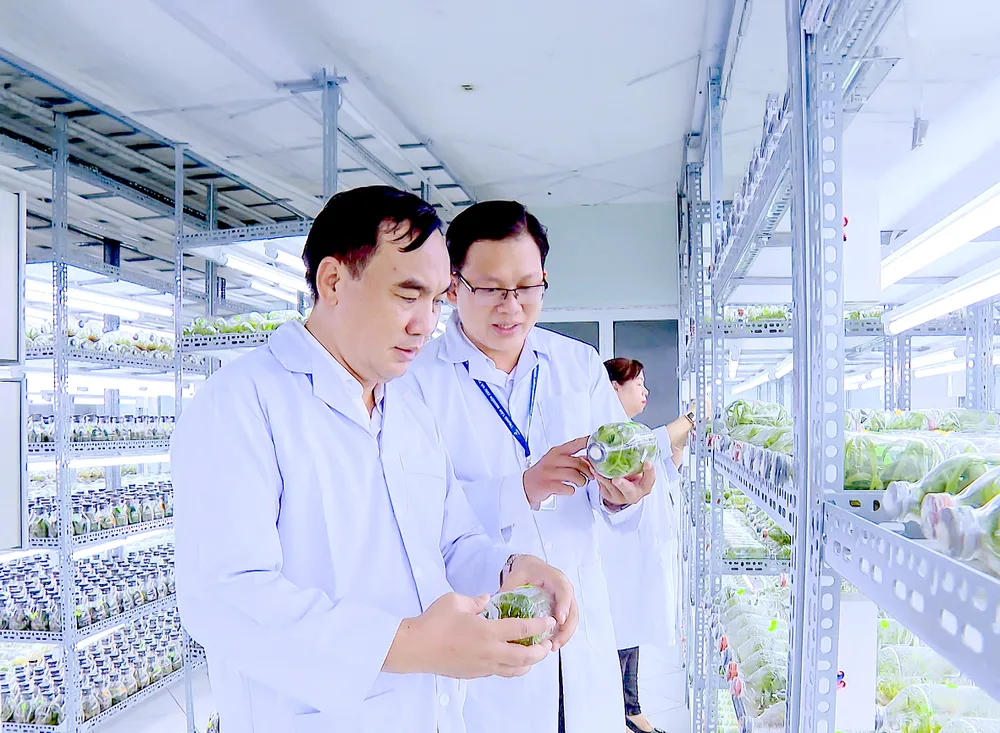
Leading universities such as the University of Ho Chi Minh City (now the University of Science - Vietnam National University Ho Chi Minh City) gradually restructured their facilities, laying the foundation for basic science. By 1999, the Faculty of Biology opened a Biotechnology major. In 2004, the People's Committee of Ho Chi Minh City established the Ho Chi Minh City Biotechnology Center (HCMBiotech) and the High-Tech Agricultural Zone… marking a shift towards practical applied research in agriculture, medicine, and the environment.
To fully unleash the potential of scientists, including young scientists, in 1996, the Ho Chi Minh City Department of Science, Technology and Environment, in collaboration with the Ho Chi Minh City Youth Union, established the "Young Scientists and Technologists Innovation Incubator" to create an environment for nurturing, providing financial and professional support to young scientists, and transforming creative ideas into practical projects. This field attracts diverse talents from natural sciences and engineering to social sciences.
Over the 25 years since its formation, development, and implementation, the program has received 1,937 preliminary applications from 2,265 authors and groups of authors, including lecturers, researchers, and young staff members from universities, colleges, academies, centers, and research institutes in Ho Chi Minh City; 389 research projects have been completed and the research results have been transferred and applied to real-life situations.
Dr. Pham Dinh Dung, Head of the Management Board of the Ho Chi Minh City High-Tech Agricultural Zone, shared: “The city's high-tech agriculture is not only an economic solution but truly a symbol of rebirth, innovation, and the aspiration for advancement of urban agriculture. The city has successfully transformed from traditional production thinking to knowledge-based agriculture, applying breakthrough technologies to optimize productivity and quality.”
A brand that has reached global prominence.
Ho Chi Minh City is currently home to hundreds of outstanding experts and scientists in the field of biotechnology. This is the core force that will help the city realize its goal of making biotechnology a leading economic and technical sector by 2045, contributing 10%-15% to the city's GRDP.
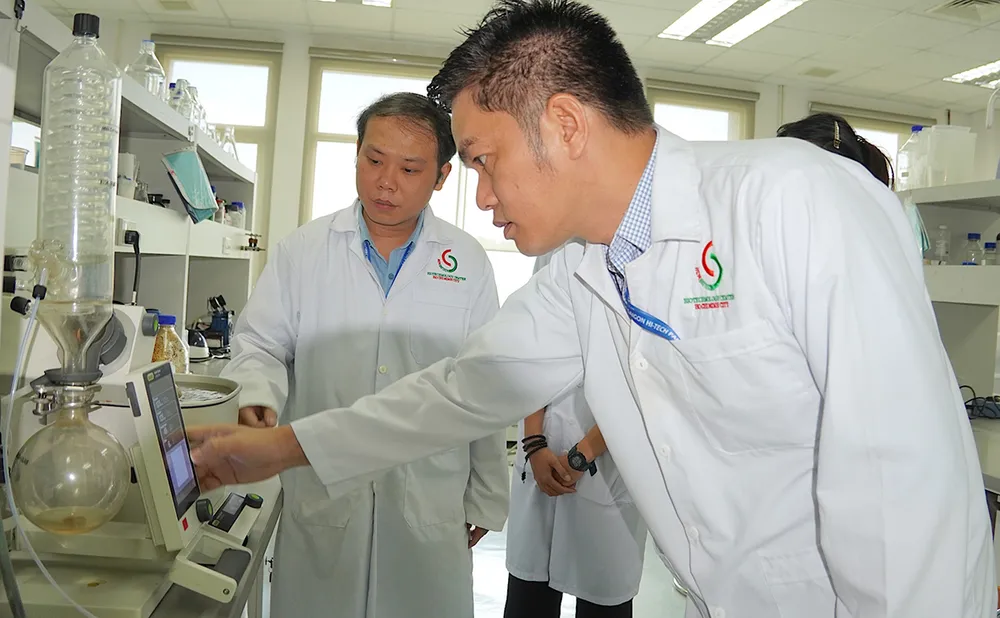
One of the outstanding scientists is Professor Tran Van Hieu, currently the Head of the Biosensor Laboratory, Faculty of Biology - Biotechnology (University of Science, Vietnam National University Ho Chi Minh City). In over 20 years of teaching and scientific research, he and his colleagues have published nearly 100 scientific papers, many of which are highly applicable. A notable example is the publication "Research on the Production of Cancer Treatment Support Drugs in Vietnam," which showed an effectiveness 300 times greater than previously published products.
He began this research in 2013 as part of a project by the Ho Chi Minh City Department of Science and Technology, opening up opportunities to produce expired patented drugs or bioequivalent drugs for other therapeutic proteins in general and GM-CSF in particular.
The next scientist worth mentioning is Dr. Nguyen Thi Dung (Head of Food Biotechnology Department, HCMBiotech) - who has dozens of biotechnology research projects applied to life, most notably the project "Application of Earthworms," which has been adopted by many domestic and international cosmetic companies.
According to Dr. Nguyen Thi Dung, earthworms are known for their ability to recycle organic waste, producing nutrient-rich fertilizer for agriculture. She has discovered and exploited another hidden value of this organism: a source of protein and essential amino acids for the cosmetics industry. Using this high-quality raw material, Dr. Nguyen Thi Dung and her colleagues have researched and developed an efficient extraction process on a laboratory scale.
After numerous trials, the resulting extract powder showed stable performance, with a protein content exceeding 70%, and notably, it contained no heavy metals, meeting the cosmetic safety standards set by the Ministry of Health. Earthworm extract powder can be used in various natural beauty products such as topical cosmetics, dietary supplements for beauty enhancement from within, and skincare products.
Developing a research ecosystem
Ho Chi Minh City currently boasts the largest biotechnology research and application ecosystem in the country. The Vietnam National University Ho Chi Minh City (VNU-HCM) possesses a network of laboratories and research groups in the fields of molecular biology, gene technology, stem cells, regenerative biomedicine, microbiology, protein technology, biomaterials, and bioinformatics. HCMBiotech (part of the Ho Chi Minh City High-Tech Park - SHTP) plays a key role in applied research and development of technological processes in the fields of gene technology, microbiology, plant cell technology, enzymes, and proteins, successfully commercializing numerous products.
Dr. Nguyen Hai An, Director of HCMBiotech, said that the center has achieved many outstanding accomplishments in implementing three important tasks: developing human resources - building organizational structure, building technical infrastructure, and researching and applying biotechnology.
In its inception in 2004, the center had only 9 staff members; today it has 193, including 19 PhDs (1 Associate Professor), 78 Master's degree holders, and 69 Bachelor's degree holders and engineers. The center currently has 16 departments, divisions, and specialized professional teams; and has established a modern technical infrastructure.
In particular, the center has published nearly 700 scientific papers, including 129 in international journals; presented 213 reports at scientific conferences and seminars; obtained 2 patents, 1 industrial design patent, and 3 utility model patents; received 7 national-level scientific and technological advancements recognized by the Ministry of Agriculture and Environment; been granted new variety protection certificates for 12 orchid varieties and 2 melon varieties; and won 15 science and technology awards…
Furthermore, promoting the development of high-tech agriculture through the application of AI (artificial intelligence), IoT (Internet of Things), digital transformation, and biotechnology to increase productivity and quality has brought high incomes to farmers, with the average production value reaching nearly 700 million VND/hectare/year by 2025, clearly reflecting the effectiveness of the strategy of transforming into a high-tech urban agriculture model.



“We are effectively promoting the ‘three-party’ model and the R&D (research and development) alliance. In this model, the State creates shared infrastructure and commissions large-scale projects; universities conduct research and evaluation; and businesses co-invest from the R&D stage. At the same time, we are building a model of a regional-scale biological research-testing-production center, integrating shared laboratories, biological data centers, and preclinical testing systems… This helps to form an ecosystem for research and application of biotechnology, gradually mastering biotechnology and biomedical technologies,” emphasized Associate Professor Dr. Truong Hai Nhung, Head of the Department of Biology - Biotechnology, Faculty of Science, Vietnam National University Ho Chi Minh City.
Biotechnology development with a vision for 2045.
Ho Chi Minh City has issued a decision approving the Program for the Development and Application of Biotechnology in the High-Tech Park until 2030, with a vision to 2045. This program selects the Ho Chi Minh City High-Tech Park (SHTP) as the "nucleus" for implementing the biotechnology development program, linked to the long-term goal of building a smart innovation space that meets international standards.
According to this plan, by 2030, SHTP aims to commercialize more than 50 biotechnology products, publish nearly 400 scientific articles domestically and internationally, and register intellectual property for approximately 90 research products. In particular, the city aims to form strong research groups in the fields of biomaterials for healthcare and gene technology in agriculture – areas with significant market potential and suitable for the development conditions of a special urban area.
Source: https://www.sggp.org.vn/dau-tu-mui-nhon-cong-nghe-sinh-hoc-post859003.html



![[Photo] "Hanoi Lotus Festival" honors the lotus flower that has been associated with Vietnam for thousands of years.](https://vphoto.vietnam.vn/thumb/1200x675/vietnam/resource/IMAGE/2026/06/27/1782516943048_sen-ha-noi-2026-minh-duy-1-jpg.webp)