

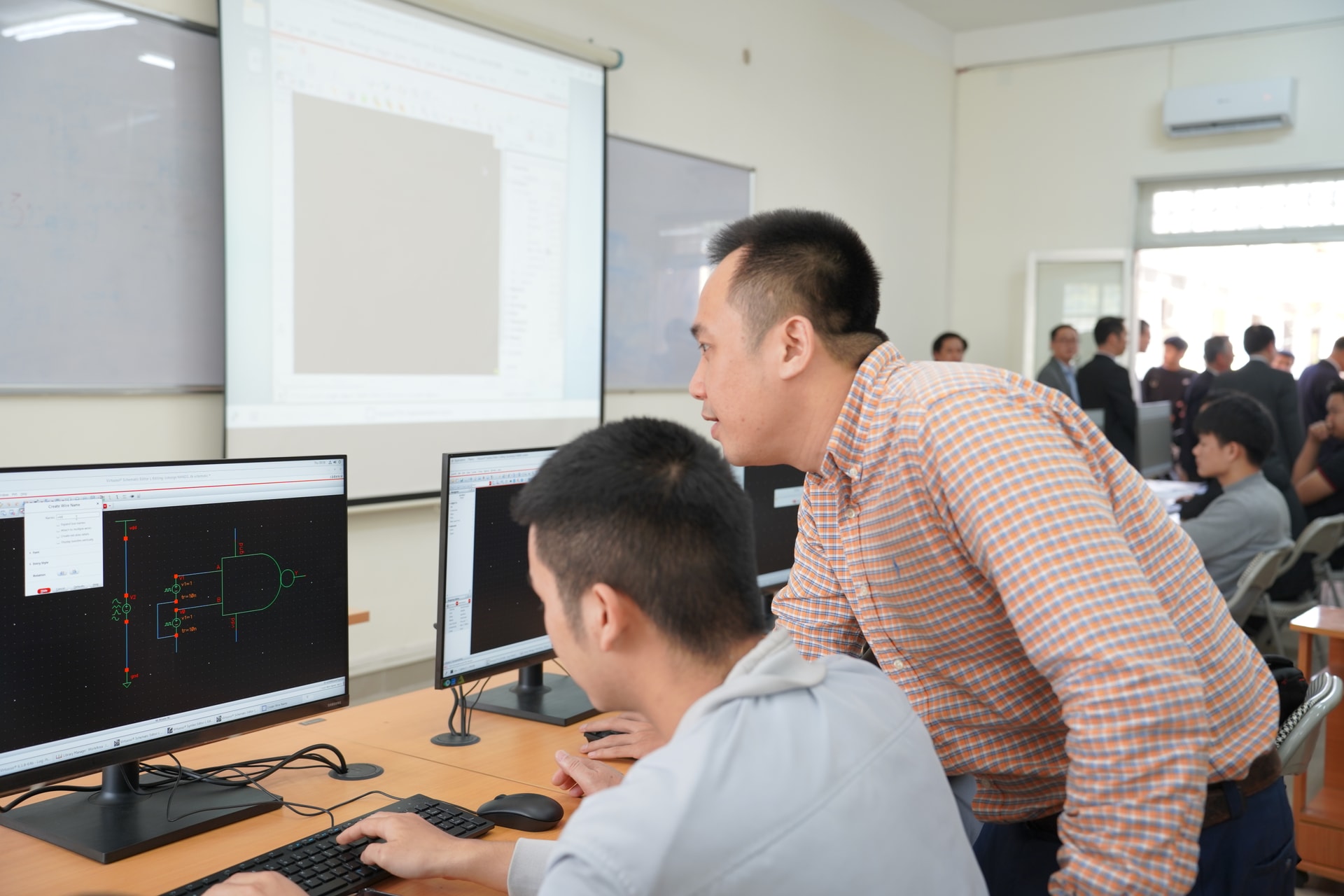
There is a need for manpower to meet the demands of new professions.
Currently, Da Nang city is implementing policies for development such as Conclusion No. 79-KL/TW of the Politburo on continuing to implement Resolution No. 43-NQ/TW of the Politburo on building and developing Da Nang city until 2030, with a vision to 2045; Resolution No. 136/2024/QH15 on the organization of urban government and some specific mechanisms and policies for the development of Da Nang city.
In 2024, the digital economy contributed 20.69% to the city's GRDP. The University of Economics (Da Nang University) is keeping pace with the training needs of businesses, both now and in the future, by pioneering training in related fields such as: E-commerce, Digital Marketing, Digital Business, and Financial Technology.
The University of Technology (Da Nang University) currently offers many relevant majors in semiconductor microchips, with a total of 1,500-1,600 students enrolling each year. However, there is still a risk of a shortage of high-quality labor in the semiconductor microchip field. This is because, in the past, students in this field were mainly trained through basic disciplines such as electronics and telecommunications engineering. While graduates can still work in the semiconductor microchip field, they lack the in-depth expertise offered by current training programs.
Currently, the demand for human resources is increasing rapidly due to the shift in global supply chains and the government's investment attraction policies, but the domestic training system has only caught up in recent years. The supply and demand for human resources are unbalanced; while the demand from businesses is increasing, the number of engineers with specialized training has not kept pace. Furthermore, previous training programs were heavily theoretical and not closely linked to the practical requirements of businesses. The lack of internationally standardized laboratories and internship opportunities in industrial environments also limits the practical skills of graduates…
According to Associate Professor Dr. Nguyen Huu Hieu, Rector of the University of Technology, the university has been adjusting its training program to increase the proportion of practical and project-based courses, adding in-depth content on semiconductor integrated circuits, building specialized laboratories using industry-standard software, and signing cooperation agreements with businesses to give students early exposure to real-world situations. “Our goal is not only to train a sufficient number of students, but also to ensure quality, so that graduates can immediately participate in the global semiconductor value chain,” Associate Professor Dr. Hieu emphasized.
Associate Professor Dr. Nguyen Gia Nhu, Rector of the University of Technology and Engineering (Duy Tan University), shared that universities are facing a major challenge in the face of AI development. The market is demanding skills in AI, machine learning, big data, and automation, leaving graduates often lacking the practical skills to work with the new technologies that businesses are adopting.
AI is automating traditional tasks such as data entry, basic data analysis, and even design and programming, leading to students lacking new skills and struggling to compete with machines and more highly skilled colleagues. Therefore, universities need to develop updated training programs and integrate interdisciplinary skills, such as combining technology with economics, healthcare, and education, so that students understand how to apply AI in practice. Furthermore, increased collaboration with businesses is necessary to provide students with internships in real-world AI projects, organize workshops, or guide final-year projects. This will help students not only learn theory but also grasp real-world needs, reducing the risk of unemployment.
Strategic orientation
Da Nang is currently one of the leading centers for higher education in Central and Western Vietnam, comprising both public and private universities. These institutions focus on improving the quality of education and updating curricula to meet the growing demands of society and the labor market.
Associate Professor Dr. Nguyen Huu Hieu stated that in 2025, the University of Technology will open new majors in energy management and railway/metro construction. In the period up to 2030, the university will focus on high-tech fields such as information technology and semiconductor microchips, aiming to provide a stable supply of highly qualified human resources to serve the semiconductor industry according to the needs of businesses; creating a foundation to attract many large enterprises and companies operating in the semiconductor and chip design fields to invest and expand production in Da Nang.
The policy of merging Da Nang city and Quang Nam province is a historic milestone, opening the door to a new phase of breakthrough development with expanded resources and opportunities, requiring the city to make many changes in leadership, direction, management, and operation of its apparatus.
To realize the above goal, at the end of 2024, the City People's Council issued Resolution No. 57/2024/NQ-HĐND stipulating policies for developing human resources in the field of semiconductor microchips and artificial intelligence in the city. Accordingly, to attract experts, scientists, and human resources in the field of semiconductor microchips, the City People's Committee has proposed many outstanding support policies with a total estimated budget of approximately 873 billion VND. Recently, the City People's Council issued Resolution No. 15/2025/NQ-HĐND stipulating policies for developing high-quality human resources in the public sector.
All policies on human resource development in the public sector or the private sector in key industries and fields, as targeted for 2030 and with a vision to 2045, stem from the expectation of developing a workforce with digital knowledge and skills to boost productivity. The goal is to achieve an average annual growth rate of 10% in the digital economy/digital transformation, as set out at the 23rd Congress of the City Party Committee.
Source: https://baodanang.vn/dau-tu-nguon-nhan-luc-mui-nhon-3301229.html




![[Photo] General Secretary and President visit the China-ASEAN AI Application Cooperation Center](https://vphoto.vietnam.vn/thumb/1200x675/vietnam/resource/IMAGE/2026/04/17/1776404277677_vna-potal-tong-bi-thu-chu-tich-nuoc-tham-trung-tam-hop-tac-ung-dung-ai-trung-quoc-asean-8706616-2286-jpg.webp)





















![[Photo] National Assembly Chairman Tran Thanh Man attends the policy seminar to promote Vietnam-Türkiye cooperation.](https://vphoto.vietnam.vn/thumb/1200x675/vietnam/resource/IMAGE/2026/04/16/1776351415367_vna-potal-chu-tich-quoc-hoi-tran-thanh-man-du-toa-dam-chinh-sach-thuc-day-hop-tac-viet-nam-tho-nhi-ky-8705791-jpg.webp)

























































Comment (0)