

If Lam Kinh was the "spiritual capital" of the Le dynasty kings, then before that, Van Lai was the frontier of Lam Son village, a place where human and material resources were concentrated to serve the Lam Son uprising to victory, and later became the "resistance capital" in the restoration of the Le dynasty.
 The pair of Dragon's Eye wells remain in the ancient capital of Van Lai - Yen Truong.
The advantage of Van Lai was its strategic location as a gateway to Lam Kinh by both land and river. Therefore, a folk legend recounts that in a battle against the Ming army, Le Loi, facing a small number of generals and troops while surrounded and pursued by the Ming forces, relied on the strategic terrain of rivers, streams, mountains, and hills, as well as the protection of the people of Van Lai and the surrounding areas, to evade the Ming encirclement and pursuit, preserving his forces and allowing them to retreat to the Pu Rinh mountain range.
Lord Trịnh Kiểm, from a strategic perspective, believed that: "Establishing a nation must be based in a strategically advantageous location. The mountains of Vạn Lại stand majestically, the waters meander, truly a beautiful landscape. This is a divine arrangement to establish an imperial dynasty" (Khâm định Việt sử thông giám cương mục). A geography book from the late Nguyễn dynasty wrote: "The land of Vạn Lại is towering; this is a natural landscape. The shape of the rivers and mountains here is very beautiful; this mountain range runs from Laos. Inside, it resembles a bat, with a flock of phoenixes displaying their beauty, signifying good fortune..." (According to the History of Xuân Châu Commune, Thanh Hóa Publishing House, 2014).
Because of the unique shape of the river and mountains, the ancestors who founded the village named it Van Lai, meaning "relying on the land of our ancestors," cleverly conveying a message to future generations. The folk song: "No matter where one goes or lives, one should always remember the land of our ancestors" is still passed down among the people of Van Lai.
"A land imbued with spiritual energy gives birth to heroic descendants." Since the 15th century, this area has been densely populated, a land of meritorious officials, and a gathering place for many patriots and heroes who rallied under the banner of righteousness of King Le Loi of Binh Dinh. Among them, we cannot fail to mention Van Thai Ba Le Bon; Nghi Quan Cong Le Hoi; Duong Trung Hau Le Ha Vien... who voluntarily brought their children from Van Lai village to join Le Loi in the Lam Son uprising, driving out the Ming invaders.
 The pair of stone elephant and horse statues are located beneath the rubber forest belonging to local residents.
Like Van Lai, Yen Truong is an ancient land, inhabited since the 10th century, with many people concentrated along the banks of the Chu River. Yen Truong is located in a rare and auspicious area known as "Three Peaceful Fronts, Five Blessings Behind." According to legend, when Le Hoan ascended the throne and prepared to launch an attack against the Song invaders, that night, at An Truong Pagoda, the monk Cu Lam received a dream from a deity who recited two lines of poetry: "An Truong, a strategically important land, is blessed by divine spirits / Protecting the nation, helping to repel the Song invaders." Immediately afterward, the monk personally went to Hoa Lu capital to report the situation. Le Hoan then returned to An Truong Pagoda to pray for divine intervention, and indeed, in the spring of 981, Le Hoan decisively defeated the Song army.
The two places, Van Lai and Yen Truong, though separate, share a common dragon vein. From a feng shui perspective, it shows: "Van Lai is in a higher position. This is the supporting position, the black tortoise position of Yen Truong, while Yen Truong is in a lower position, but spacious, creating the bright hall of water accumulation (yin-yang combination) of the Van Lai capital, with the Chu River as a barrier. These elements have given the Van Lai capital a reasonable front and depth, with sufficient topographical space to form a solid, interconnected Van Lai - Yen Truong capital" (Van Lai - Yen Truong Capital, Le Quoc Am, Thanh Hoa Publishing House, 2021).
The books "Lich Trieu Hien Chuong Loai Chi" and "Dai Nam Nhat Thong Chi" both clearly state that, over a period of nearly 50 years, due to the complex historical situation, the capital was moved between the two locations of Van Lai and Yen Truong almost alternately. Specifically, from 1546 to 1553 in Van Lai; from June 1553 to April 1570 moved to Yen Truong; from April 1570 to August 1577 moved to Van Lai; from September 1557 to June 1578 moved to Yen Truong; from July 1578 to March 1593 in Van Lai until the king moved to Thang Long capital.
It must be affirmed that the "resistance capital" against the Mac army existed in Van Lai for nearly half a century, through four reigns; heroes and scholars from all directions flocked there, all united in contributing their strength. The Le dynasty's army grew stronger and stronger, winning every battle. A majestic court with full civil and military officials was established. From here, many imperial decrees and orders were issued throughout the land. It was also here that three kings of the Later Le dynasty, Le Trung Tong, Le Anh Tong, and Le The Tong, ascended the throne. After their deaths, Le Trang Tong and Le Trung Tong chose Van Lai as their final resting place.
This shows that, while Van Lai served as a solid base during wartime, a vital location closely linked to the restoration of the Le dynasty, Yen Truong held a crucial strategic position in protecting the capital of Van Lai, ensuring the safety of the royal palace, and attracting heroes from all directions who gathered with admiration. Indeed, even after the king moved to Thang Long, for several decades afterward, Van Lai - Yen Truong retained its value as a base whenever the Le dynasty's throne was threatened...
While the Le dynasty was concentrating all its forces on the war against the Mac dynasty, it paid great attention to selecting talented individuals to serve the country. Seven examinations were held in Van Lai - Yen Truong from 1554 to 1592. Scholars flocked to the Van Lai royal palace to seek opportunities for advancement. This place, along with Thang Long and Hue, became the three main locations for doctoral examinations nationwide.
 These pottery fragments are believed to be remnants of the former resistance capital of the Later Le Dynasty.
Of the 45 people who passed the doctoral examinations in 7 different periods, more than 30 became high-ranking officials, and many were appointed by the king as envoys. Some of those who passed the doctoral examinations and became officials are still mentioned in historical records today, such as Phùng Khắc Khoan, Nguyễn Thực, Lê Trạc Tú, Lê Nhữ Bật, Nguyễn Văn Giai...
At the Temple of Literature in Hanoi today, there are 82 doctoral steles, including 7 steles recording the doctoral graduates from the examinations in Van Lai. The doctoral stele from the year Canh Thin, Quang Hung 3rd year (1580) reads: “Talent is the lifeblood of the State, and it cannot be left uncultivated. Our system is the legacy of the State, and it cannot be left unrecorded. Now, the Emperor, in his place of honor, holds the power to create and reform the system, and cultivate talent. He erects stone steles for future generations to use as models, inscribing names so that the world may observe and admire them. Above, it is to promote the loyalty and righteousness of our predecessors; below, it is to express gratitude to the heroes of our time, and within it, it implicitly praises and encourages them...” (History of Xuan Chau Commune, Thanh Hoa Publishing House, 2004).
Forty-one years have passed since King Le The Tong moved the capital to Thang Long in 1593, and the former capital of Van Lai - Yen Truong now only retains a few traces. The site of the royal palace is now overgrown with weeds, with two stone elephants and horses standing isolated on the steps. Scattered around are fragments of bricks, tiles, and broken pottery mixed in with the earth and stones. The strip of land surrounding the village, once called the city wall, has faded in shape as the villagers have leveled it to make roads. The high mound 1km west of the royal palace, where the Le dynasty built a sacrificial altar, is now a deserted garden... According to some historians and documents, the Tay Son army, upon their first advance northward, destroyed Lam Kinh and Van Lai to erase all traces of the Le dynasty. This may be one reason, but it is known that time and the vicissitudes of history have swept away all the palaces, temples, tombs, and royal residences. Other historical sites such as the Dragon's Eye Well, the Nam Giao Altar, and the examination grounds are now surrounded by vegetation or overgrown with houses and schools.
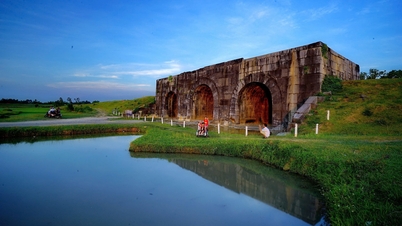
In late 2021, following decisions by the Thanh Hoa Provincial People's Committee and the Ministry of Culture, Sports and Tourism, the Thanh Hoa Department of Culture, Sports and Tourism, in collaboration with the Hanoi University of Social Sciences and Humanities and other relevant units, conducted investigations, explorations, and excavations of the Van Lai - Yen Truong Royal Palace site at multiple locations, covering a total area of 294 square meters. The artifacts recovered at the Van Lai Royal Palace site were relatively diverse in type. Following this, the Thanh Hoa Department of Culture, Sports and Tourism, in coordination with the Vietnam Historical Science Association, organized a national scientific conference on "The Van Lai - Yen Truong Capital in the History of the Le Dynasty." At this conference, researchers proposed the early completion of the dossier for recognizing the site as a special national historical monument, on par with the Lam Kinh Special National Monument and the Le Hoan Temple, and suggested developing a spiritual tourism chain encompassing the Ho Dynasty Citadel - Le Hoan - Van Lai - Yen Truong - Lam Kinh. Most recently, in July 2023, the Thanh Hoa Historical Science Association, in collaboration with the Tho Xuan District People's Committee, organized a scientific conference titled "The Kings and Meritorious Officials of the Early Le Trung Hung Period and the Van Lai - Yen Truong Festival".
The ancient capital may no longer exist, but after more than 400 years, the stone elephants still shed tears, reminding future generations of a golden age and urging us to quickly solve the "problem" of preserving and restoring the historical site.
This article uses material from the book "The Capital of Van Lai - Yen Truong" by Le Quoc Am, Thanh Hoa Publishing House, 2021, and other sources.
KIEU HUYEN
Source: https://baothanhhoa.vn/dau-xua-kinh-thanh-van-lai-yen-truong-222513.htm

![[Photo] General Secretary and President To Lam receives Amazon's Senior Vice President David Zapolsky](https://vphoto.vietnam.vn/thumb/1200x675/vietnam/resource/IMAGE/2026/05/22/1779466547770_a1-bnd-3513-6601-jpg.webp)






















































Comment (0)