Nvidia's ambitions extend beyond simply supplying GPUs—the heart of AI systems—to shaping the future of robotics, autonomous vehicles, and even global manufacturing practices.
From an AI ecosystem builder.
Nvidia has been very successful in leveraging the AI revolution, especially since the launch of OpenAI's ChatGPT application more than two years ago. The company's revenue, profits, and market value have skyrocketed, taking Nvidia from a valuation of $8 billion in 2009 to nearly $3 trillion in 2025.
The secret lies not only in powerful GPU chips but also in a smart investment strategy, transforming Nvidia into a "market maker" in the AI field. According to the financial data platform PitchBook, in 2024 alone, Nvidia participated in 49 funding rounds for AI startups, a significant increase from 34 rounds in 2023 and far exceeding the total of 38 deals in the previous four years.
These investments come not only from the company's budget but also through the NVentures fund, which has invested in 24 deals in 2024. From industry giants like OpenAI with its $6.6 billion funding round, Elon Musk's xAI with $6 billion, to emerging players like Scale AI, Mistral AI, and Perplexity, Nvidia is not only providing capital but also creating an ecosystem dependent on its own GPUs.
"We want to expand the AI ecosystem by supporting game-changers," Nvidia stated, and the company is proving that it is turning words into action.
Visiting the "incubator of innovation" for the automotive industry.
Not content with just software, Nvidia is venturing deeper into the automotive industry – a fertile ground for AI. Its expanding partnership with GM is the clearest evidence of this.
GM has chosen Nvidia to be at the heart of its AI transformation, integrating Nvidia's entire technology ecosystem—from DGX for model training, Omniverse and Cosmos for factory simulation, to DRIVE AGX for autonomous vehicles. This agreement not only helps GM create smarter cars but also transforms its production lines into AI-optimized "digital clones."


"AI is not only optimizing the manufacturing process but also helping us build smarter cars," said GM CEO Mary Barra. Meanwhile, billionaire Jensen Huang emphasized: "The era of physical AI has arrived, and we are transforming transportation – from vehicles to the factories where they are manufactured."
The launch of Halos—a comprehensive safety system for autonomous vehicles incorporating AI verification—further solidifies Nvidia's leading position in the four-wheel drive technology race. Introduced at the same time as an expanded partnership with GM, Halos not only demonstrates Nvidia's commitment to safety but also poses a direct challenge to rivals like Intel's Mobileye, which has long dominated the advanced driver assistance systems (ADAS) market.
Not only GM, but Toyota, Hyundai, and many other major automakers are also adopting Nvidia's technology, reflecting a broad industry shift toward AI solutions. For consumers, this promises vehicles with advanced driver assistance features in the near future, and possibly fully autonomous vehicles within the next decade.
"AI Super Cup" and the vision for the future.
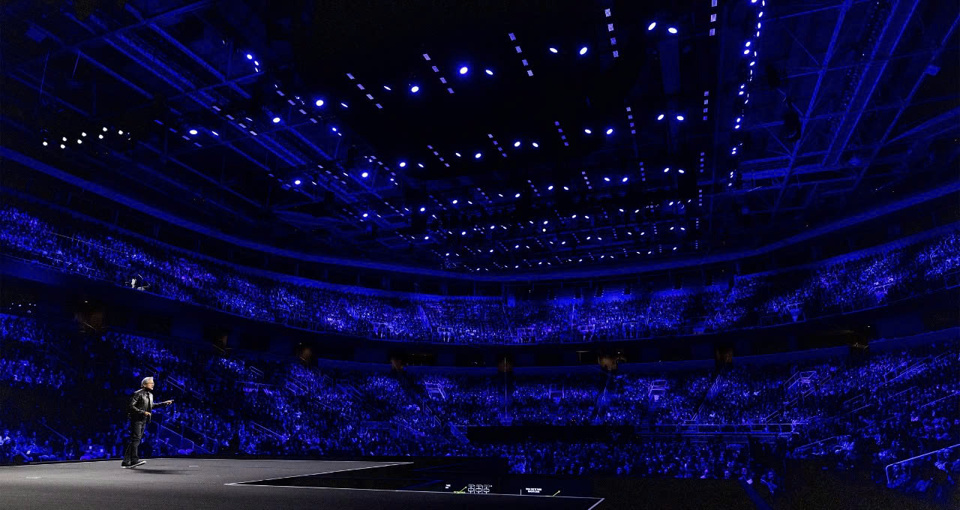
GTC 2025, held in San Jose, California (USA) from March 17-21, is no longer a modest science fair with white banners like in 2009, but has become a dazzling stage with neon lights, where technology leaders like Michael Dell and Jeffrey Katzenberg gather.
However, the highlight of the event was the afternoon of March 18th, when more than 25,000 tech enthusiasts filled the San Jose McEnery Convention Center to listen to groundbreaking ideas from Jensen Huang, dubbed the "God of AI".
At GTC, the Nvidia boss announced the Blackwell Ultra chip line, expected to launch in late 2025, followed by the Vera Rubin and Rubin Ultra chip lines, which will be available in 2026 and 2027, respectively. These chips, along with the supercomputer and Dynamo software, are designed to meet the growing computing demands of AI.
"The more you buy, the more you save," billionaire Jesen Huang stated, referring to the data center market projected to reach $1 trillion by 2028. He also introduced Isaac GR00T N1 – an open-source platform for humanoid robots – and the Newton system, a collaboration with Google DeepMind and Disney Research, marking a step into the field of "physical AI."
"The age of generalized robotics has arrived," the 62-year-old billionaire declared, as a small robot named Blue appeared on stage, following his commands. This was not just a technological demonstration, but an affirmation that Nvidia aims to lead not only in chips but also in robotics and automation.
Maintaining a leading position.
However, Nvidia's AI empire is not without its challenges. The rise of rivals like DeepSeek—a Chinese company developing advanced AI models with fewer resources—caused Nvidia to lose $600 billion in market value in just one day in January 2025.



Nvidia's major clients, such as Amazon, Google, and Meta, are also developing their own AI chips, threatening the company's reliance on GPUs. Furthermore, concerns about the enormous cost of AI infrastructure and the potential for an economic downturn are leading Wall Street to question: Is the AI craze sustainable?
However, Nvidia remains undeterred. The four leading cloud providers—Amazon, Microsoft, Google, and Oracle—have purchased 3.6 million Blackwell chips in 2025, a significant increase from the 1.3 million Hopper chips purchased last year. These commitments from these "mega-giants," projected to reach $371 billion for AI by 2025 according to Bloomberg Intelligence, demonstrate their confidence in Nvidia's product roadmap.
From a gaming chip company, Nvidia has transformed itself into a center of the AI revolution, expanding from hardware to software, from data centers to factories and streets. The company's ambition is not just to provide tools, but to shape how the world operates in the AI era. Despite facing competition and skepticism, the vision of Chairman and CEO Jensen Huang – combining powerful chips, strategic investments, and relentless innovation – is bringing Nvidia closer to its goal of complete dominance.
Standing on the GTC 2025 stage, with the robot Blue by his side, Jensen Huang spoke not just about technology, but about a future where AI and humans coexist. This is Nvidia's ambitious expansion – an empire that is not only large but also far-reaching, touching every aspect of modern life. Will the company continue to succeed? Time will tell, but for now, Nvidia is undeniably the leader.
Source: https://kinhtedothi.vn/de-che-nvidia-va-tham-vongmo-rong-lanh-dia-ai.html