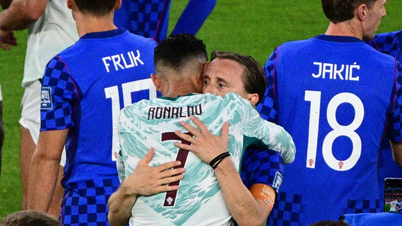
In the 68th minute at the Toronto stadium, Ronaldo successfully converted a penalty, helping Portugal equalize 1-1 against Croatia in the Round of 32 of the 2026 World Cup on the morning of July 3rd. This goal marked the first time CR7 had scored in a knockout round match of the most prestigious tournament on the planet.
Notably, prior to this penalty kick, statistics from Ronaldo's last five penalty kicks showed that he had chosen to shoot close to the left post four times and to the right once.
However, this time the Portuguese superstar surprised goalkeeper Dominik Livakovic with a shot straight into the middle of the goal.
Risky but reasonable.
In fact, CR7's choice of penalty angle wasn't entirely unreasonable. Livakovic's dive towards Ronaldo's preferred angle demonstrates that the Croatian coaching staff had thoroughly studied their opponent's penalty-taking habits.
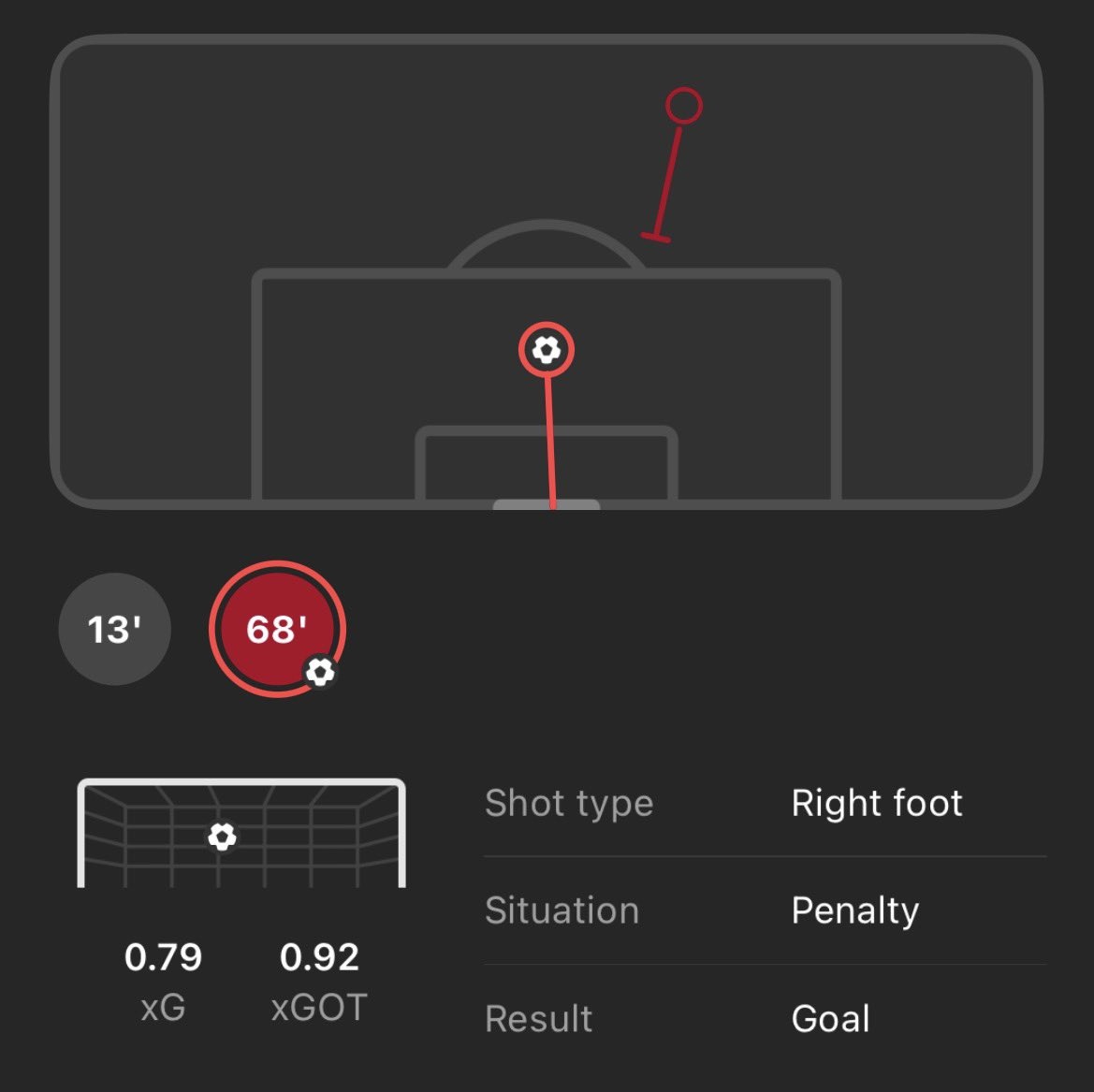 |
Ronaldo surprised everyone with a shot straight into the middle of the goal. Photo: FotMob. |
Furthermore, the Guardian cited a 2009 article analyzing 311 penalty kicks from various professional leagues around the world, which showed that shots aimed at the center of the goal were less likely to be saved than shots aimed at the corners.
Opta statistics from the Premier League show that shots into the bottom left corner have a success rate of 77.2%, while those into the right corner have a success rate of 80%. Meanwhile, shots aimed at the center and towards the top corner have a success rate of 97.8%.
With the speed of penalty kicks, goalkeepers rarely have time to wait and react to the direction of the shot.
Instead, goalkeepers will guess which direction the player will shoot based on body language and their knowledge of the opponent's past penalty results.
Since then, many studies have shown that goalkeepers are often forced to dive to the left or right when facing a penalty.



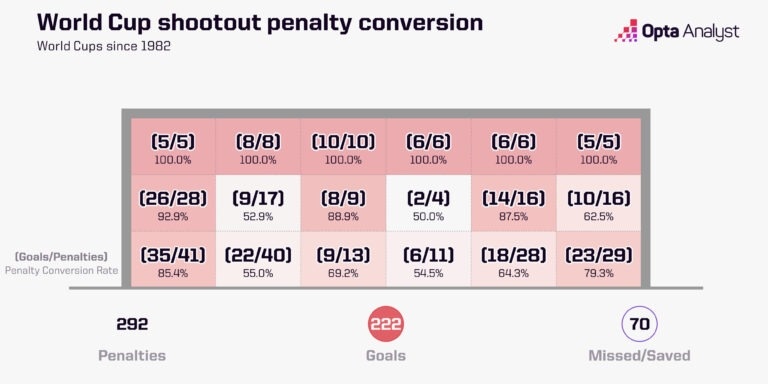 |
Statistics on penalty kicks at the World Cup . Photo: Opta. |
Specifically, although nearly one-third of penalties are taken aimed at the center of the goal, goalkeepers rarely choose to stand still to save them (6.3%), but mostly prefer to dive to the left (44.4%) or right (49.3%).
This stems from the fact that goalkeepers want to demonstrate that they are trying to save the ball, meaning that inaction—that is, standing in the middle of the goal—is rarely the preferred option.
However, at the World Cup, shots to the center of the goal are still quite risky. Statistically, if shot slightly to the right, the success rate is only about 50%. With a low shot slightly to the right of the center of the goal, 11 players attempted it but only succeeded 6 times (54.5%).
A perfect penalty kick.
There are two key factors in executing a perfect penalty kick: the speed and direction of the ball. According to author John Wesson in his book *The Science of Soccer* , taking into account air resistance, a ball traveling at approximately 35.7 m/s, heading towards the top corner of the goal, could theoretically beat the goalkeeper from a distance of 32 meters.
The closer you get to the goal, the higher your chances of success, and at a distance of about 3 meters, the success rate will be almost 100%.
When the ball travels at a speed of 35.7 m/s, the goalkeeper will only have about 1/3 of a second to make a save. This means there is only one way for the goalkeeper to save the shot: they must guess the correct direction before diving.
That's also why most goalkeepers at the World Cup will choose to dive based on calculations from available statistics.
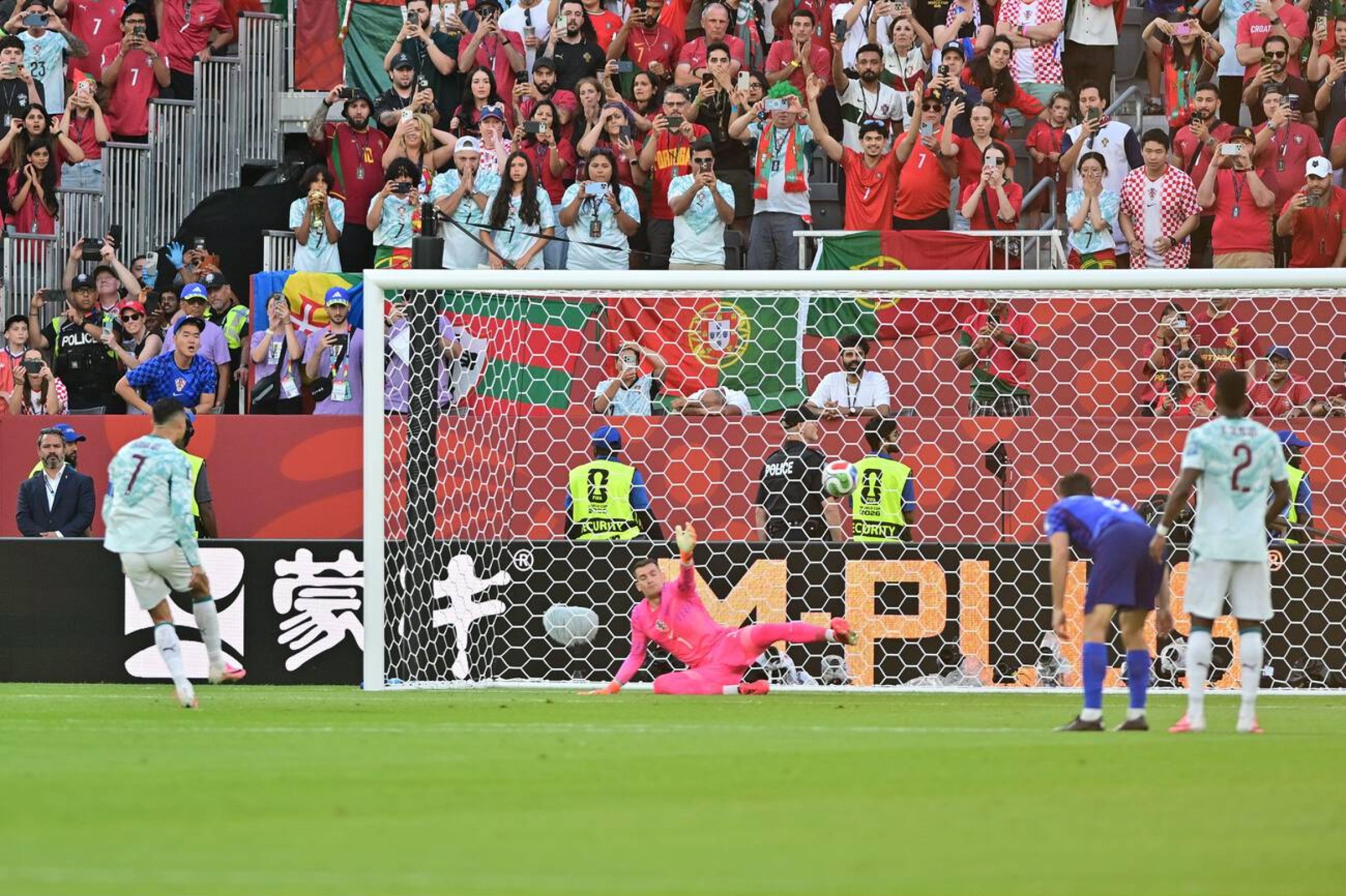 |
Cristiano Ronaldo may have changed his shooting angle to counter the fact that goalkeepers at this year's World Cup are using data to make predictions. Photo: Alamy. |
Another crucial factor lies in the data. Over the years, Europeans have built massive databases of set-piece situations. From video analysis software to artificial intelligence, all information is digitized to provide goalkeepers with a guide to making crucial decisions.



With a paid Opta account, teams can easily see who prefers to shoot with their left or right foot, and how they take penalties. In other words, opposing goalkeepers will practically know what penalty specialists like CR7 will do.
That could be the reason Ronaldo decided to change his shooting angle. However, this change is also a gamble.
In the tense penalty shootout between the Netherlands and Morocco, Quinten Timber also chose to change his shooting angle as soon as he saw goalkeeper Yassine Bono moving towards his preferred direction. As a result, the Dutch player sent the ball wide of the goal.
Although each player usually has their own style when taking penalties, The Athletic notes that inconsistency with the initial kicking direction, attempting to add too much finesse or movement during the run-up often increases the likelihood of a player missing.
Source: https://znews.vn/ronaldo-mao-hiem-post1665744.html














![[Video] Weather forecast for tonight and tomorrow, July 4, 2026: The remnants of Typhoon No. 1 will cause widespread and prolonged heavy rain in Northern Vietnam.](https://vphoto.vietnam.vn/thumb/402x226/vietnam/resource/IMAGE/2026/07/03/1783083905760_thum-dem-png.webp)