

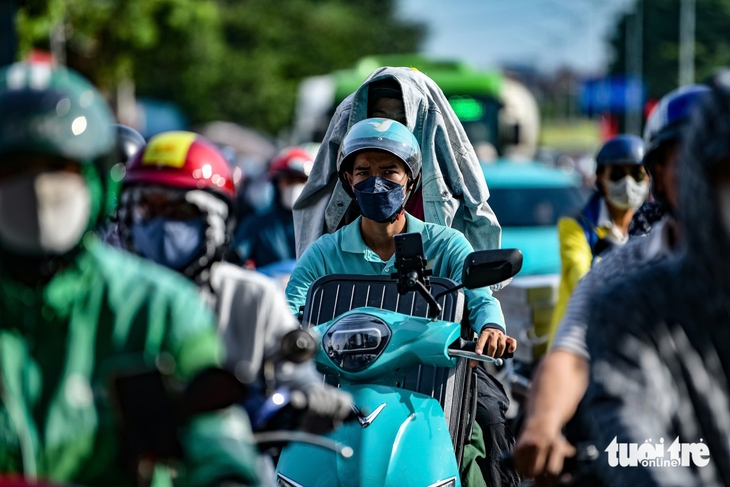
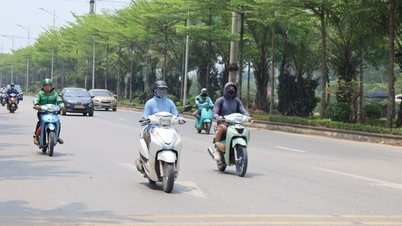
Hanoi encourages ride-hailing motorbike drivers to switch from gasoline-powered motorbikes to electric ones - Photo: NAM TRAN
Therefore, the decision by the Hanoi City People's Council (on June 2nd) to postpone its approval in order to conduct a thorough and comprehensive evaluation and gather more information is entirely appropriate at this time.
Accordingly, the Hanoi City People's Council requested the Hanoi City People's Committee to direct relevant agencies to continue researching and refining the contents, incorporating discussion points to finalize the draft for submission to the Hanoi City People's Council at its fourth session, scheduled to take place in mid-June 2026.
Everyone hopes to make the city green, clean, and beautiful as soon as possible, improve the living environment, develop tourism , and move towards the sustainable development goals that many countries have successfully achieved...
But in reality, when introducing any policy, it is necessary to clarify its impact on people's lives, social welfare issues, etc.
Therefore, a comprehensive and holistic assessment of the shortcomings and limitations of the project and resolution must continue when it is implemented.
Questions arise such as: are there people who use motorbikes but don't have enough money to switch, or is public transportation adequate, including charging stations for the public?
Knowing that the above options have been specifically calculated by the Hanoi People's Committee, for example, the support level for each individual converting to a motorbike is 5 million VND... while currently on the market, depending on the type, these vehicles cost tens of millions of VND.
How will families receiving government assistance, those who have contributed to the revolution, and impoverished households be supported in their transition? The level of support must be carefully calculated to encourage active participation and create high levels of consensus among the people.
Furthermore, implementing this project would require the city to spend a very large sum of money, while these resources are already being allocated to other equally important development goals.
To successfully reduce emissions and improve the environment as desired, based on the experience of many countries, a long-term roadmap and clear scenarios are necessary.
This roadmap is similar to the Nationally Determined Contribution (NDC) that Vietnam submitted to the United Nations after the 26th Conference of Parties to the United Nations Framework Convention on Climate Change (COP26).
In its NDC, Vietnam has outlined emission reduction solutions, along with a roadmap for each year and specific scenarios. Having scenarios to apply significantly increases feasibility. Not only Hanoi, but all localities should develop such scenarios.
Besides developing highly feasible scenarios, it is necessary to continue investigating and evaluating, and to gather complete data on the state of urban pollution and its causes in order to make adjustments that are appropriate to the actual situation.
In short, to build strong consensus, it is necessary to present the right policies that are persuasive to scientists , government agencies, the public, and other stakeholders; only then will communication be effective.
Conversely, if policies are not comprehensive, not evaluated from multiple perspectives, and only focus on aspects such as state management, energy saving, and tourism attraction without fully assessing the impact on people and businesses, they will not be sustainable and will not receive strong support.
Source: https://tuoitre.vn/de-chinh-sach-tao-duoc-dong-thuan-cao-20260604075421008.htm













































![[Video] Sunset at Lap An Lagoon – Where the sun sets over the fishing nets](https://vphoto.vietnam.vn/thumb/1200x675/vietnam/resource/IMAGE/2026/05/31/1780192137701_beach-landscape-sea-water-nature-grass-745871-pxhere-com.jpeg)























Comment (0)