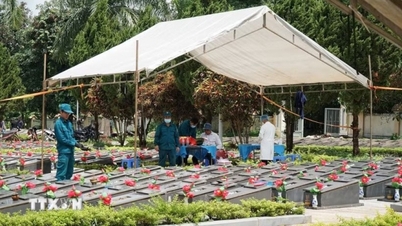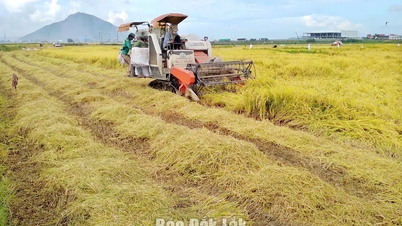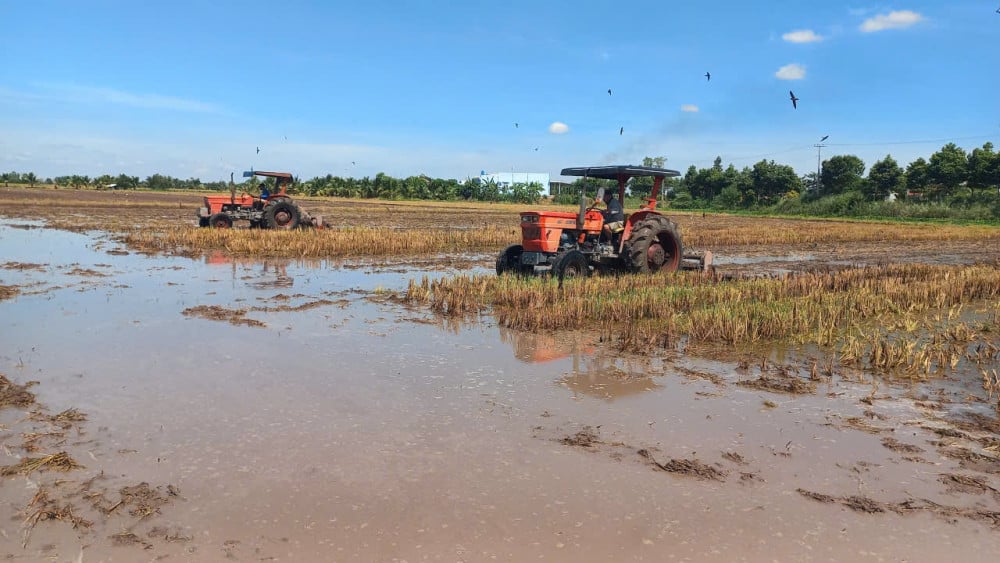
Farmers in the Dong Thap Muoi region are preparing the land and cleaning the fields in preparation for planting the winter-spring crop.
Floods are affecting production.
In previous years, at this time, members of the Vinh Thuan Agricultural Service Cooperative in Vinh Hung commune would have already planted over 500 hectares of winter-spring rice. However, this year, the floodwaters receded slowly, causing farmers in the cooperative to delay their planting by nearly a month.
According to Nguyen Thi Dieu Ngan, Director of Vinh Thuan Agricultural Services Cooperative: “To date, the cooperative has only sown about 15% of the area. On average, farmers sow 80-100 kg of seeds per hectare, but this year they had to soak an additional 20 kg of seeds because after the flood receded, rats caused a lot of damage, so farmers had to soak the seeds to replant in the areas damaged by rats. Now, the cooperative is most concerned about the remaining area to be sown in the next phase, fearing that it will not be able to avoid the rice stem borer infestation. If the rice stem borer appears, it will greatly affect the yield.”
In Tuyen Binh commune, one of the areas affected by the 2025 floods, farmers are lacking investment capital for the 2025-2026 winter-spring rice crop. Mr. Le Van Loi (residing in Trung Mon hamlet) confided: “My family cultivated 5 hectares of rice in the autumn-winter season, but the yield was only 1 ton/ha. This rice doesn't sell well; we mainly dry it and sell it as duck feed. On average, farmers lose about 20 million VND/ha. Currently, rice prices are low, while agricultural input prices are increasing. Now, we only hope that the authorities will have a plan to support farmers with capital so they can confidently produce the new rice crop.”
Focus on planting.
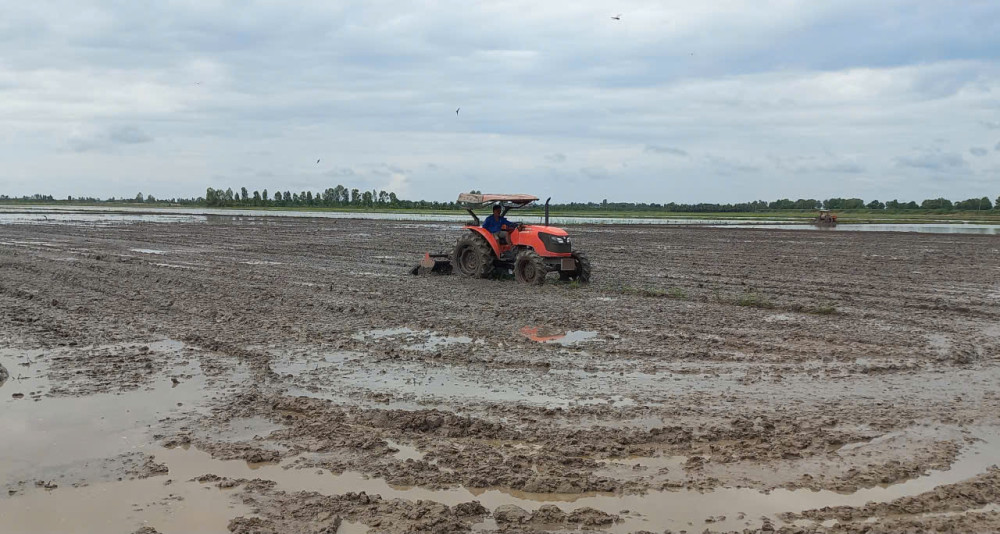
Farmers in the Dong Thap Muoi region are preparing the land and cleaning the fields in preparation for planting the winter-spring crop.
According to the plan, the 2025-2026 winter-spring crop season will see 289,600 hectares planted throughout the province, with an average yield of 66.19 quintals/hectare and a total production of 1,917,113 tons. To ensure a successful winter-spring crop season, the Department of Agriculture has issued a three-phase planting schedule. The first planting phase is scheduled from October 10th to 20th, 2025 (corresponding to August 19th to 29th in the lunar calendar) for communes in the border hilly areas; some communes may experience water shortages at the end of the season. Planting winter-spring rice in October will face some disadvantages during the heading and flowering stages and usually results in lower yields; however, it is relatively safe for areas affected by drought and saltwater intrusion.
The second sowing period is from November 8th to 18th, 2025 (corresponding to September 19th to 29th in the Lunar calendar) for communes in medium-sized areas and areas with dikes. Sowing winter-spring rice in November usually yields high productivity; however, flexible sowing times are needed to avoid the harvest coinciding with the Lunar New Year. The third sowing period is from December 5th to 20th, 2025 (corresponding to October 16th to November 1st in the Lunar calendar) for communes in areas with incomplete dikes and the remaining communes of the province.
In addition, localities should base their decisions on the actual harvest seasons of the 2025 Autumn-Winter crop and the 2025 Summer rice crop, focusing on completing the sowing of the 2025-2026 Winter-Spring rice crop by December 2025. The 2025-2026 Winter-Spring rice crop should only be planted in areas with sufficient freshwater supply for at least 3 months, and a minimum of 2.5 months of freshwater until the rice plants reach the milky stage.


Vo Thanh Bao, Chairman of the Tan Tay Commune Farmers' Association, shared: “Farmers in the commune will complete planting in the second phase of the provincial planting schedule. Before planting, farmers proactively clean the fields, eliminate all disease pathogens, and choose quality rice varieties such as IR4625, OM18, Dai Thom 8, etc. For areas where rice crops were completely destroyed by floods, the Association also advises farmers to use biological products to treat straw to avoid organic poisoning, which affects yield.”
Synchronize solutions
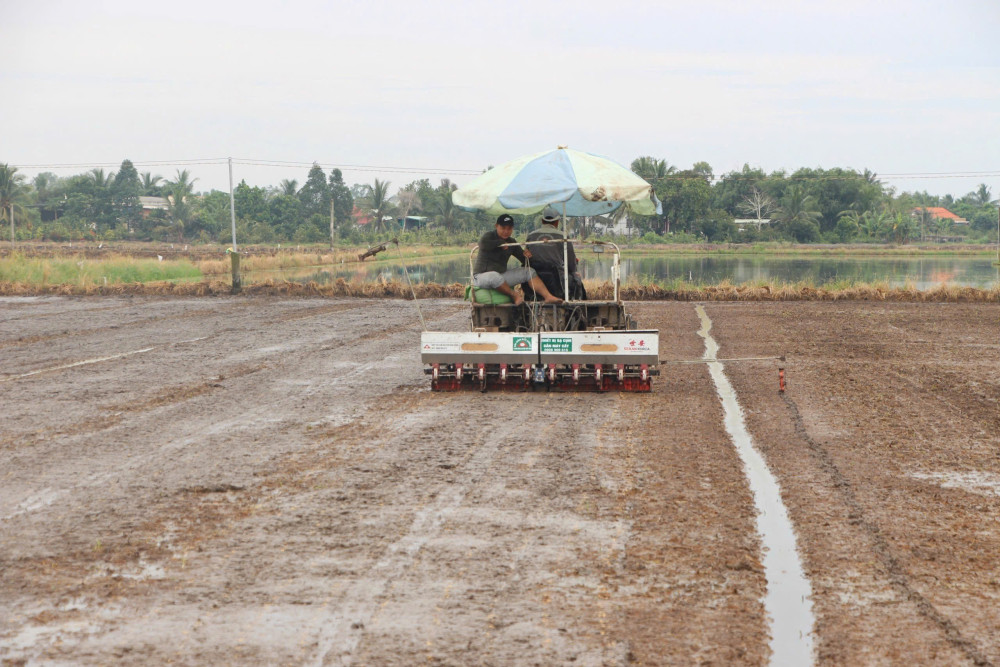
The entire province has sown 59,800 hectares, reaching 20.7% of the plan.
According to the Department of Agriculture's report, as of December 9th, the entire province had sown 59,800 hectares, reaching 20.7% of the plan. The sown area is concentrated in the communes of Tan Thanh, Moc Hoa, Kien Tuong, Can Duoc, Can Giuoc, Chau Thanh, and Ben Cau. Recently, the main pests and diseases affecting the 2025-2026 winter-spring rice crop include rice blast, leaf blight, golden apple snails, and rats. These pests mainly appear on rice plants in the seedling and tillering stages, primarily in the communes of Tan Hung, Vinh Hung, Kien Tuong, Tan Thanh, and Duc Hue.
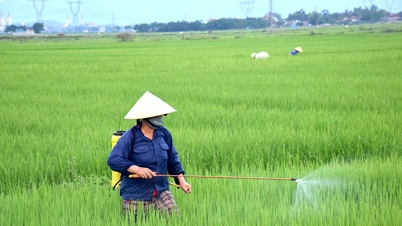
The head of the Thạnh Hóa area's Agricultural Extension Station, Lê Hữu Tàu, said: “The Thạnh Hóa area includes the communes of Thạnh Hóa, Thủy Tây, Thạnh Phước, and Bình Thành. Currently, these areas have sown over 1,300 hectares for the winter-spring crop. Thanks to the synchronized application of technical solutions in the fields, pests have appeared on rice crops, but at a low rate, not yet affecting rice yield and production. To control pests, the Station advises farmers to regularly inspect their fields and adhere to the "four correct principles" when using pesticides.”
Specifically for rice blast and grain discoloration, farmers need to spray preventively 7-10 days before and after flowering. In addition, the station will strengthen coordination in disseminating information about the current pest situation on crops so that farmers can understand and proactively control them in a timely and effective manner.”
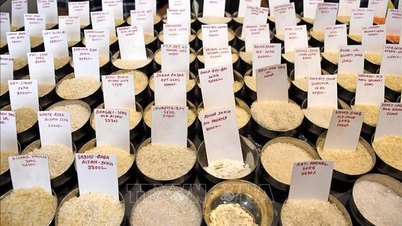
Regarding recommended rice varieties for the winter-spring crop, high-quality, fragrant, specialty varieties are preferred to meet market demands. Specifically, farmers should use fragrant and glutinous rice varieties such as ST25, ST24, RVT, VD20, and other glutinous rice varieties; high-yield, high-quality, and mildly fragrant rice varieties such as OM4900, OM5451, OM7347, Dai Thom 8, and Nang Hoa 9; and rice varieties with good drought and salinity tolerance such as OM6976 and OM576.
According to Deputy Director of the Department of Agriculture and Environment, Dinh Thi Phuong Khanh: “When using certified seeds and sowing at a rate of about 80kg/ha, the rice plants will develop well from the beginning of the season, limiting pest attacks and reducing production costs. Therefore, localities need to strengthen propaganda about the effectiveness and benefits of using certified seeds, sparse sowing, and the synchronized application of technical measures such as "3 reductions - 3 increases," "1 must - 6 reductions" in the fields,... Currently, rice prices are low, so farmers need to reduce production costs to increase profits on the same cultivated area.”
Production linkages are a crucial "key" to helping farmers increase profits on the same cultivated area, especially in mitigating the situation of "bumper harvest, low prices" or vice versa. Therefore, for the 2025-2026 winter-spring crop, the Cay Trom Agricultural Service Cooperative (Khanh Hung commune) will not only guarantee the purchase of over 500 hectares of rice from its members but also expand its linkage area.
According to Bui Van Tuan, Director of the Cay Trom Agricultural Service Cooperative: “For the 2025-2026 winter-spring crop, the cooperative will link up with farmers to purchase rice from outside the cooperative on approximately 700 hectares. The purchase price will be at least 200 VND/kg higher than the market price, but farmers must apply safe farming practices, use the correct active ingredients and dosages, and avoid pesticide residue after harvesting. Priority rice varieties for this linkage include Dai Thom 8, OM18, Nang Hoa Nhat, etc.”
The winter-spring rice crop accounts for approximately 70% of the year's food production. Therefore, this crop plays a crucial role in the growth of the agricultural sector. It is believed that, with proactive measures and the existing foundation of high-tech agriculture, the 2025-2026 winter-spring rice crop will continue to be successful, and farmers will reap a bountiful harvest.


"The remaining months of 2025 and 2026 will present many challenges and difficulties. The Provincial People's Committee requests the Department of Agriculture and Environment to coordinate well with relevant departments, agencies, and localities to regularly monitor and inspect the agricultural production situation in localities; inspect drought and salinity intrusion response projects during the 2025-2026 dry season; coordinate with relevant sectors to strengthen trade promotion, encourage businesses to participate in investment, and link agricultural product procurement, especially participating in the Sustainable Development Project of 1 million hectares of high-quality and low-emission rice cultivation associated with green growth in the Mekong Delta region by 2030; and promote and encourage farmers to apply advanced techniques in agricultural production to reduce production costs and improve agricultural production efficiency,..." Vice Chairman of the Provincial People's Committee Nguyen Minh Lam |
Le Ngoc
Source: https://baolongan.vn/de-co-vu-lua-dong-xuan-thang-loi-a208621.html