"Preservation" rather than "modernization"
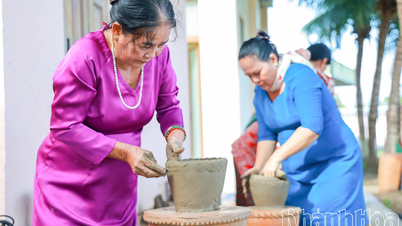
Cham pottery art is celebrated for its unique technique, which has remained unchanged for thousands of years: no potter's wheel, no glazing, no molds, and completely open-air firing. However, the designation "in need of urgent protection" is a worrying warning. The number of elderly artisans is decreasing, young people are not interested in the craft, and the unique clay resources in the Quao River are becoming increasingly depleted. Currently, the Bau Truc village no longer has many artisans with the health and experience to teach, creating an urgent need to preserve and pass on the craft in a context where time waits for no one.
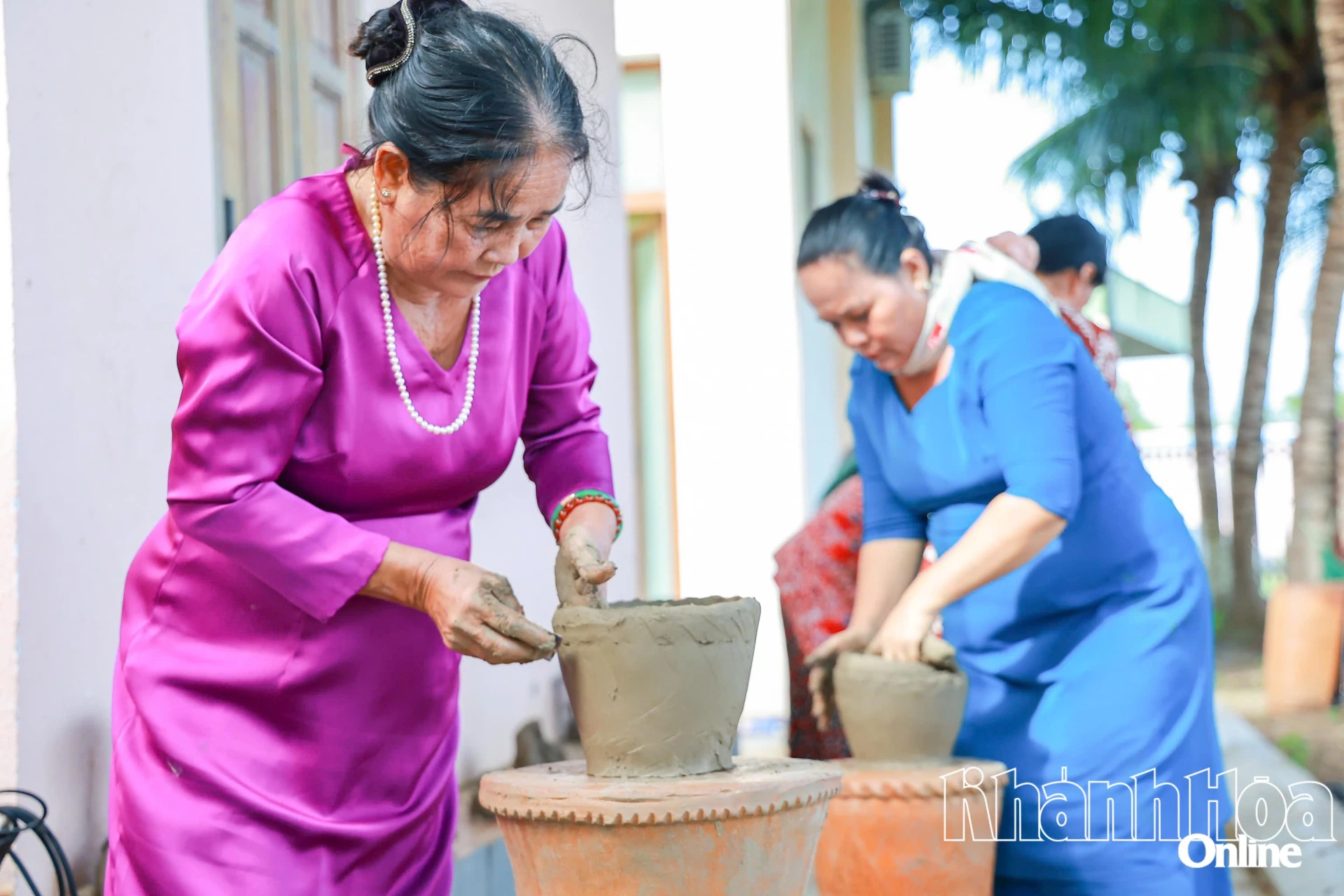 |
| Artisans in Bau Truc pottery village are carrying out the production process of traditional pottery products. Photo: NHAN TAM |
To remove the pottery heritage from the list of urgently needed protection, Vietnam must demonstrate to UNESCO that the vitality of the pottery craft has been genuinely restored. Khanh Hoa province has approved the Project for the Management, Protection, and Promotion of Heritage Values for the period 2025-2030 with a considerable budget. However, as of 2026, the specific budget for implementation has yet to be allocated. This gap places significant pressure on the cultural sector as the deadline for the international report approaches.
The key point to emphasize is that Cham pottery possesses high intangible cultural value and uniqueness, not commercial value in terms of the quantity of products sold. Applying technology such as introducing potter's wheels, building modern kilns, or mass production would inadvertently destroy the very values already recognized by UNESCO. Furthermore, industrial production would push the natural clay resources – which are scarce and form very slowly – into a dead end. If the "art of pottery making" process is modernized, it will certainly lead to its removal from UNESCO's list of representative cultural heritage of humanity.
A sustainable path for the Bau Truc craft village is not about chasing production volume, but about clearly separating the core: preserving the original traditional process and developing experiential tourism based on that very cultural space. Instead of focusing on selling raw, heavy, fragile, and difficult-to-transport pottery products, the community tourism model needs to position the craft village as a true "living museum." There, the tourism product "sold" is the cultural experience. Tourists come to Bau Truc not just to buy pottery, but to participate in a comprehensive cultural journey. This includes hands-on experiences: witnessing artisans shaping pottery backward and molding products themselves; Cham homestay: staying in traditional houses, enjoying local cuisine , and interacting with the people; art and spirituality: listening to traditional dances and musical instruments, and immersing themselves in the legends of the founder of the craft, Po Klaong Can, and Hindu deities, as recounted by local guides.


Functional zoning in Bau Truc village also needs to be implemented systematically: a raw material conservation area, a traditional production area, and a homestay and service area. The province has set a target to complete this spatial planning by 2027.
Substantive action for the 2026 milestone.
To resolve the funding bottleneck and prepare the UNESCO report in time, the urgent solution is to restructure resources by prioritizing key and urgent tasks. Low-cost but highly effective conservation activities (such as vocational training using the "one artisan, one apprentice" model, documenting the techniques of elderly artisans, and homestay training) should be separated from large infrastructure projects. Construction projects can be postponed or public-private partnerships can be encouraged.
Furthermore, mobilizing social resources is of particular importance. The Department of Culture, Sports and Tourism needs to coordinate with the Khanh Hoa Tourism Association to connect large businesses and resorts throughout the province to sign agreements for the consumption of fine art ceramics as gifts, thereby creating sustainable livelihoods for the people and spreading the image of the heritage. At the same time, it is necessary to encourage some resorts, cafes, etc., to design models bearing the hallmarks of Cham architectural and sculptural art.
 |
| Household ceramics. Photo by PQA |
Furthermore, promoting social participation is of particular importance. The Khanh Hoa Department of Culture, Sports and Tourism needs to coordinate with the Khanh Hoa Tourism Association to connect businesses and large resorts in the area to sign cooperation agreements for the consumption of fine art ceramic products as gifts. This is both a solution to create sustainable livelihoods for the people and contributes to promoting the image and value of the heritage.
The goal of the 2026 report is to demonstrate that the vitality of the heritage has improved, with the community actively participating in its protection and tourism developing as a supporting channel, without distorting the heritage. Small but substantial actions, rooted in the internal strength of the Cham community today, will be the strongest affirmation to UNESCO: Cham pottery art does not just live on in written form, but is truly breathing and developing sustainably in the contemporary world.


2026 is a significant milestone in the roadmap for protecting and promoting heritage values. Therefore, management agencies, local authorities, and the community need to prioritize the implementation of practical solutions, focusing on supporting artisans, maintaining the transmission of knowledge, and promoting cultural values associated with community livelihoods, thereby preserving and promoting Cham pottery art as a "living museum" in the heart of Khanh Hoa.
PHAN QUOC ANH
Source: https://baokhanhhoa.vn/van-hoa/202607/de-gom-cham-mai-la-bao-tang-song-95b7497/