

As the person directly inspecting the scene of the mini-apartment building fire on Khuong Ha Street (Thanh Xuan District, Hanoi), Mr. Vu Ngoc Anh, Director of the Department of Science, Technology and Environment ( Ministry of Construction ), had an exchange with a reporter from Nguoi Lao Dong Newspaper about the violations in construction and fire safety at this particular building and nationwide in general.
Reporter: After the fire at the mini-apartment building on Khuong Ha Street (Thanh Xuan District, Hanoi ), you personally went to the scene. So, what is your assessment of the building's design?
- Mr. VU NGOC ANH: First of all, it must be affirmed that the term "mini-apartment building" is not found in any legal documents, and construction projects under this name are not recognized or evaluated. In reality, when applying for construction permits, selling, or renting, the owners of this type of building always name it as a private residential building. However, a private house with multiple floors and apartments is technically an apartment building – despite the different name.

According to the construction permit issued by the Thanh Xuan District People's Committee, this is a detached house with a ground floor construction area (including a mezzanine) of over 167 m2 and a construction density of 70%. The permitted building has a height of 6 floors, with a mezzanine and stairwell containing technical space. The total construction floor area is over 1,165 m2 with a total building height of over 20 m (excluding the stairwell).
Based on my on-site survey and the documents I have, it's not specified how many rooms are divided within this detached house. In reality, however, it's a 9-story apartment building (commonly referred to as a mini-apartment building) with a penthouse. As an apartment building, it must be designed to comply with relevant standards and regulations, including fire safety standards and regulations.
The stairwell, which also serves as an emergency exit, in this apartment building is located in the middle of the building. According to QCVN 06:2022/BXD, the National Technical Standard on Fire Safety for Buildings and Structures issued by the Ministry of Construction, emergency stairwells must be enclosed stairwells to allow residents to escape in case of fire (meaning that when the doors are opened, they automatically retract, remaining closed at all times, preventing smoke and flames from entering in the event of a fire, and allowing residents to exit through them).
Furthermore, upon reaching the first floor, there should have been a safe escape corridor, but this apartment building lacks one. The space that should have been used as a safe corridor on the first floor is instead used for motorbike parking, so in case of fire, even if residents reach the first floor, they cannot escape.
Because this apartment building has a floor area of less than 500 m2, a second external staircase is not necessary. However, emergency exits must be provided in each occupied apartment leading to the outside (via balconies or loggias) so that in case of fire, residents can escape to a neighboring apartment or use ropes to descend to safety. However, in this building, most apartments have enclosed metal bars, some with emergency exits; some apartments are equipped with rope ladders, others not, making it difficult to escape to a neighboring apartment in case of fire.
The apartment building on Khuong Ha Street has a ventilation shaft (also known as a skylight), but it was not constructed properly. When the building caught fire, smoke and flames from the first floor rose to the upper floors through the ventilation shaft. Around the ventilation shafts, the apartments all had open windows, so when a fire broke out, smoke and flames rose from below and spread through the curtains.
It can be confirmed that this apartment building does not comply with fire safety standards and regulations, nor with requirements for building evacuation design.
Are the current legal regulations regarding construction and fire safety for mini-apartment buildings like the one on Khuong Ha Street complete?
- Housing laws stipulate that detached houses designed and built with two or more self-contained units (each with a separate living room, kitchen, toilet, and bathroom) must have a minimum floor area of 30 m2 or more, and the construction, repair, and renovation of such houses must comply with the regulations of construction law.
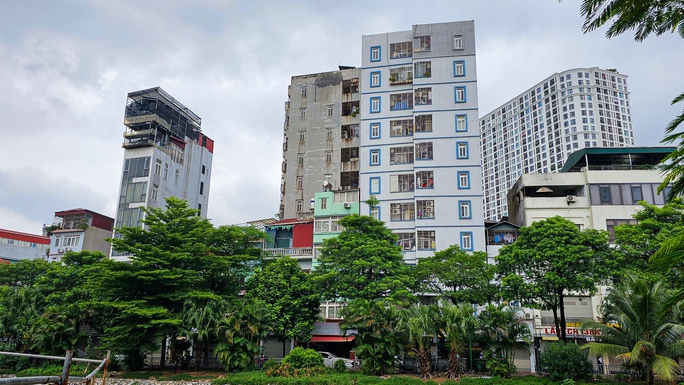
Regulations regarding construction and fire safety for mini-apartment buildings already exist; whether developers comply depends largely on the supervision and inspection of relevant authorities. (In the photo: Mini-apartment buildings in Hanoi. Photo: Huu Hung)
The 2014 Construction Law stipulates that construction projects, including individual houses in urban areas, must be strictly managed and controlled by central and local state construction management agencies through the issuance of construction permits and construction quality management, depending on the scale and class of the project.
A building permit for a private house is granted when it meets the following conditions: it conforms to the land use purpose according to the land use plan; it ensures the safety of the structure; it meets environmental requirements, fire prevention and control requirements, and ensures the safety of technical infrastructure; its design complies with standards and regulations, meets functional requirements, ensures structural safety, and ensures safety during use...
Currently, according to Article 9 of Government Decree No. 06/2021/ND-CP, the construction of individual houses by households and individuals must comply with the following regulations: If constructing a house with 7 floors or more, or with 2 or more basements, the design documents must undergo a safety review before applying for a construction permit. The design and review must be carried out by organizations or individuals with the necessary qualifications and capabilities as prescribed by law.
According to Section 1.1.13 of the Ministry of Construction's Regulation 06:2021/BXD, detached houses for households with a height of 6 floors or less, or with no more than 1 basement floor, are not required to comply with this regulation but must follow separate guidelines appropriate to each type of house and residential area. In cases of conversion to other purposes, the regulations of this regulation must be followed, and approval from the competent Fire Prevention and Rescue Police agency is required, similar to projects subject to fire safety design approval.
The government has also issued Decree No. 121/2013/ND-CP; Decree No. 139/2017/ND-CP and now Decree No. 16/2022/ND-CP on administrative sanctions in the field of construction activities, which specifically stipulate violations and penalties.
Thus, the laws on construction and housing have created a legal framework to fully regulate related activities in the field of construction in general, and the construction of individual houses in particular, including multi-story, multi-family individual houses in urban areas.
However, recently, in some localities, particularly in urban areas or residential areas near industrial parks, export processing zones, and economic zones, there has been a situation where individuals have taken advantage of lax management by authorities to construct multi-story, multi-apartment private houses for personal use or to build houses with partitioned rooms for rent, without complying with construction and fire safety regulations. This leads to a high risk of fire and explosions, exemplified by the recent apartment building fire on Khuong Ha Street, which caused very serious damage to both people and property.
Currently, in Hanoi, Ho Chi Minh City, and industrial parks and export processing zones in major cities, thousands of mini-apartment buildings are being constructed for sale and rent. What advice do you have for local authorities and residents regarding compliance with construction and fire safety regulations?
- In June 2020, the Ministry of Construction sent a document to the People's Committees of localities regarding strengthening the implementation of legal regulations on construction and controlling construction order for multi-story, multi-apartment detached houses. Most recently, following the fire on Khuong Ha Street on September 15th, the Ministry continued to send a document to the People's Committees of provinces and centrally-governed cities on this matter.
Accordingly, the Ministry of Construction requests the People's Committees of provinces and centrally-administered cities to direct their Departments of Construction to coordinate with local functional agencies to continue implementing the contents mentioned in Document No. 2937/BXD-QLN dated June 18, 2020, of the Ministry of Construction.
For completed construction projects, a thorough review must be conducted urgently to promptly detect violations of construction regulations, especially fire safety violations. Accordingly, these projects must implement solutions to separate parking areas from residential areas and provide separate escape routes; invest in appropriate fire safety equipment; assign healthy and experienced personnel to manage and operate the building; and strictly handle violations by relevant organizations and individuals in accordance with the law.
For the aforementioned new construction projects, local authorities must strictly control compliance with legal regulations on planning, construction, and fire safety; and manage the issuance of construction permits in accordance with regulations.
In addition, inspection and supervision work must be strengthened to detect and strictly handle violations of construction regulations and fire safety by relevant organizations and individuals.
Mr. LE HOANG CHAU, Chairman of the Ho Chi Minh City Real Estate Association (HoREA):
Preventing the distortion of "mini-apartment buildings" at the root.
Over the past 10 years, HoREA has submitted numerous documents and proposals regarding "mini-apartments," including research reports and reviews of some "inadequate" regulations in the 2014 Housing Law.
Specifically, Clause 2, Article 46 of the 2014 Housing Law stipulates: In cases where a household or individual is permitted to build a house with two or more floors, and each floor is designed and constructed with two or more self-contained apartments, meeting the minimum floor area standards for each apartment according to construction regulations and standards, and having a portion of the area under private ownership and a portion under common ownership of the apartment building as prescribed by this law, then the State shall recognize the ownership rights of each apartment in that house.
This regulation has led to the proliferation of distorted mini-apartment buildings in urban areas, with 100% of the units being mini-apartments or rooms. Furthermore, the rampant construction of these mini-apartments, often involving "cut-out" spaces, easily creates slums and fails to protect the legitimate rights and interests of homebuyers.
Mini-apartment buildings disrupt urban development planning, increase pressure on the area's infrastructure, detract from the aesthetics, fail to ensure fire safety, and lack amenities and services for residents. Ideally, this type of building should only be permitted for residential rental purposes.
The above regulation also leads to mini-apartment buildings with 100% mini-apartments not conforming to the "National Technical Standard on Apartment Buildings," which stipulates that apartment units in apartment buildings must have a minimum usable area of 25 m2 and the number of small apartments with an area under 45 m2 must not exceed 25% of the total number of apartments in the project.
HoREA has proposed that the Ministry of Construction submit to the Government for consideration a proposal for the Standing Committee of the National Assembly to submit to the National Assembly for consideration an amendment to Clause 2, Article 46 of the 2014 Housing Law to prevent and control the situation of constructing disguised mini-apartment buildings for the sale and transfer of mini-rooms in urban areas.
Specifically, Clause 2 of Article 46 of the 2014 Housing Law could be amended as follows: In cases where a household or individual is permitted to build a house with two or more floors, and each floor is designed and constructed with two or more self-contained apartments in accordance with national technical standards for apartment buildings, and there is a portion of the area under private ownership and a portion under common ownership of the apartment building as stipulated in this law, then the State shall recognize the ownership rights of each apartment in that house.
In the case of apartment buildings where all apartments meet the minimum usable area and room size requirements stipulated by the Ministry of Construction, they may only be rented out, not sold or transferred individually.
Q.Anh wrote
Status of the victims: One case remains in critical condition and requires mechanical ventilation.
At 8:00 AM today (September 18th), agencies and units in Hanoi will observe a minute of silence for the victims who died in the fire at the mini-apartment building at 37, alley 29/70, Khuong Ha Street (Khuong Dinh Ward, Thanh Xuan District).
As of the afternoon of September 17th, numerous organizations, individuals, and businesses had provided cash assistance to the victims of the fire totaling nearly 55.5 billion VND.
Associate Professor Dr. Dao Xuan Co, Director of Bach Mai Hospital, said that out of the 27 patients the hospital received for treatment related to the incident (in Hanoi), only one case remains in critical condition requiring mechanical ventilation. The female patient VTN (39 years old, working at Bach Mai Hospital) has passed the critical stage.
In the mini-apartment building fire, Bach Mai Hospital received a total of 27 patients; including 8 children, the youngest being 8 months old. Hospital leaders stated that, apart from the two patients mentioned above, the remaining cases are conscious and can be discharged. However, they will continue to be monitored at the hospital for hyperbaric oxygen therapy, carbon monoxide detoxification, and to prevent future neurological complications.
Other hospitals treating victims of the fire also reported that patients' health is improving and stabilizing. However, some patients are still experiencing psychological distress due to the death of a loved one.
N.Dung - BHThanh
Source

![[Photo] Enchanted by the deciduous forest during the leaf-changing season.](/_next/image?url=https%3A%2F%2Fvphoto.vietnam.vn%2Fthumb%2F1200x675%2Fvietnam%2Fresource%2FIMAGE%2F2026%2F02%2F04%2F1770196861704_2066642_8ffd5f25c3c9433be0e644abe71613ae.jpeg&w=3840&q=75)


![[Photo] Heartwarming "Journey Home for Tet" in the Year of the Horse at the People's Police Academy](/_next/image?url=https%3A%2F%2Fvphoto.vietnam.vn%2Fthumb%2F1200x675%2Fvietnam%2Fresource%2FIMAGE%2F2026%2F02%2F04%2F1770198043990_hv-cong-an-13-1206-jpg.webp&w=3840&q=75)


![[Photo] Enchanted by the deciduous forest during the leaf-changing season.](/_next/image?url=https%3A%2F%2Fvphoto.vietnam.vn%2Fthumb%2F402x226%2Fvietnam%2Fresource%2FIMAGE%2F2026%2F02%2F04%2F1770196861704_2066642_8ffd5f25c3c9433be0e644abe71613ae.jpeg&w=3840&q=75)


Comment (0)