

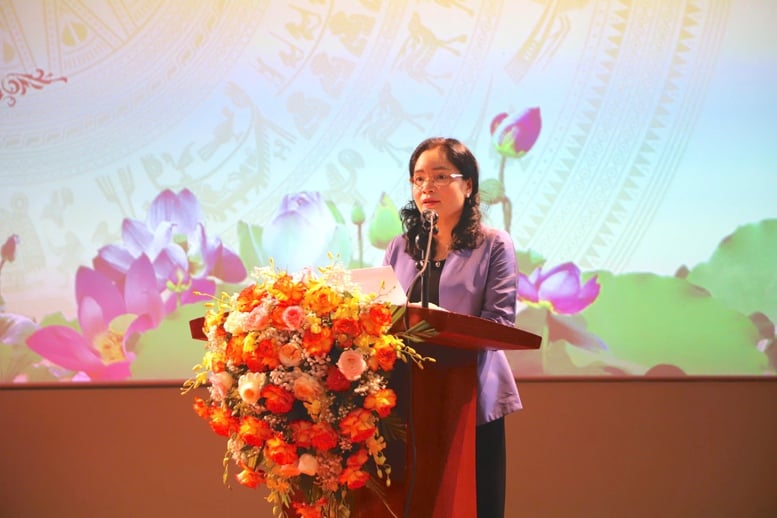
Deputy Minister of Culture, Sports and Tourism Trinh Thi Thuy expressed confidence that in the coming time, the Vietnam Ethnic Groups Cultural and Tourism Village will truly become a vibrant symbol of national unity - Photo: VGP/ Van Hien
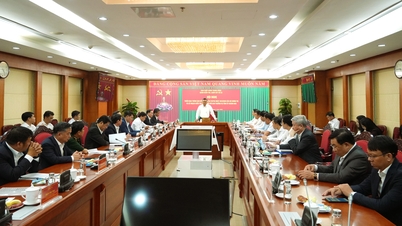
This profound message was unanimously shared by artisans and representatives of cultural management agencies at the Conference summarizing the coordination with localities to mobilize ethnic minorities to participate in activities at the Vietnam Ethnic Culture and Tourism Village, organized by the Department of Ethnic Cultures of Vietnam (Ministry of Culture, Sports and Tourism) on the afternoon of April 18th in Hanoi to celebrate Vietnam Ethnic Cultures Day (April 19th).
We hope for strong local involvement.
Having been involved with the Village for over 10 years, Meritorious Artisan Y Sinh believes that for this "living museum" to operate effectively, strong support policies are needed. Currently, the artisans and people participating in activities at the Village mainly rely on support from the state budget, averaging about 4.8 million VND/person/month (according to Circular 05/2024/TT-BVHTTDL).
Distinguished Artisan Y Sinh also frankly pointed out: "Although this number has increased compared to before, it is still very limited compared to the cost of living. Many elderly artisans still cling to the Village because of their love for culture. But it is not easy to retain the younger generation if we only rely on that meager support. They need income to live, to support their families, and cannot live solely on national pride."
Not only financially, many ethnic houses still lack props, farming tools, and traditional items. Artifacts such as grinding mills, jars, flutes, loincloths, gongs... things that are the soul of the culture have become rare. Because without artifacts, the space recreating the culture becomes rigid and lifeless. Visitors only see the architecture, not the depth of the culture.
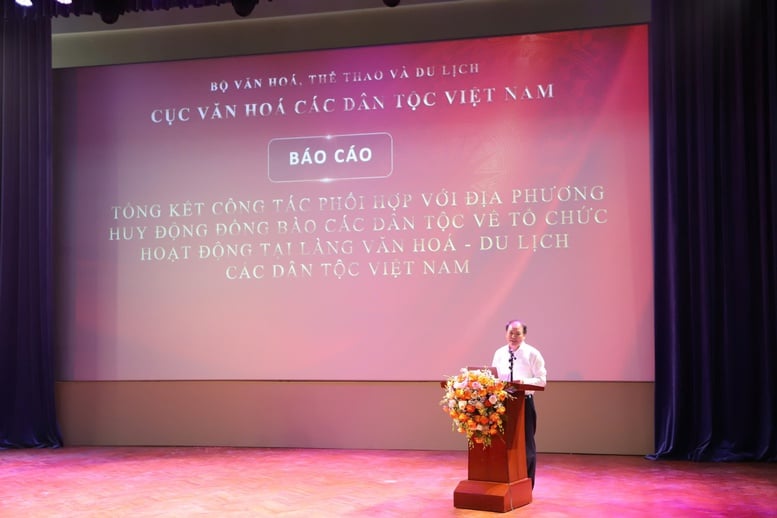
Mr. Trinh Ngoc Chung, Director of the Department of Ethnic Cultures of Vietnam, Ministry of Culture, Sports and Tourism, speaks at the conference - Photo: VGP/ Van Hien
Based on the above reality, artisans, management officials, and many localities share a common recommendation: To preserve ethnic culture at the Vietnam Ethnic Culture and Tourism Village, a coordination mechanism between the central and local governments is needed. It is not possible to rely solely on the state budget and the voluntary contributions of the people.
Dang Chi Quyet, a respected figure from the Cham community in Ninh Thuan province who has been closely associated with the village for many years, affirmed: "To preserve living heritage, we must care for the people who carry it. Each province and district needs its own policies to support artisans, perhaps with a monthly allowance or support in terms of props and equipment. But it is essential to have a systematic approach."
In fact, some localities have taken the lead in implementing these initiatives. Dak Lak province provides an additional 1 million VND/person/month to Ede artisans. Nam Dong district (Thua Thien Hue province) supports the Co Tu group with 500,000 VND/person/month. These models are highly appreciated, creating motivation for artisans to confidently stay in their villages and preserve their crafts.
For example, in Soc Trang province – home to a large Khmer population – the provincial government has maintained support for Khmer ethnic artisans participating in activities at the Village for many years. According to the Provincial Department of Culture, Sports and Tourism, from 2020 to the present, the locality has spent over 300 million VND from its own funds to support the artisans' living expenses. In addition, over 200 million VND has been used to purchase costumes and performance props. However, starting in 2024, this activity faces the risk of interruption due to budget constraints.
"We are proposing that the province develop a separate resolution on supporting artisans. A clear mechanism is necessary for long-term sustainability," a representative from the department stated.
Furthermore, many opinions suggest that instead of spreading resources widely, localities should select a few representative heritage sites with distinctive values for in-depth investment. Building a team of successor artisans, investing in the restoration of rituals, passing on traditional crafts, and organizing regular cultural exchanges will create a stronger ripple effect.
Furthermore, designing activities at the Village requires close coordination with local authorities to ensure representativeness, diversity, and cultural identity. This avoids a situation where some ethnic groups are overly featured while others are conspicuously absent.
Contributing to bringing the "living museum" in the heart of the capital to life.
According to Mr. Trinh Ngoc Chung, Director of the Department of Ethnic Cultures of Vietnam (Ministry of Culture, Sports and Tourism), from 2010 to the present, three annual cultural events have been organized at the Vietnam Ethnic Cultures and Tourism Village: the "Spring Festival Across the Nation", the "Vietnam Ethnic Cultures Day" (April 19th), and the "Week of National Unity and Vietnamese Cultural Heritage".
Since 2020, the Village has been inviting 16 ethnic minority groups on a rotating basis to participate in activities, perform, and reenact traditional life at the Village under contracts lasting 3-6 months. These ethnic groups include: Tay, Nung, Dao, Mong, Muong, Kho Mu, Thai, Lao, Ta Oi, Co Tu, Ba Na, Gia Rai, Xo Dang, Raglai, E De, Khmer… with 6-8 people per group.
Activities range from recreating traditional houses, customs, rituals, and folk games to cultural exchanges and welcoming visitors, contributing to the revitalization of this "living museum" in the heart of the capital.
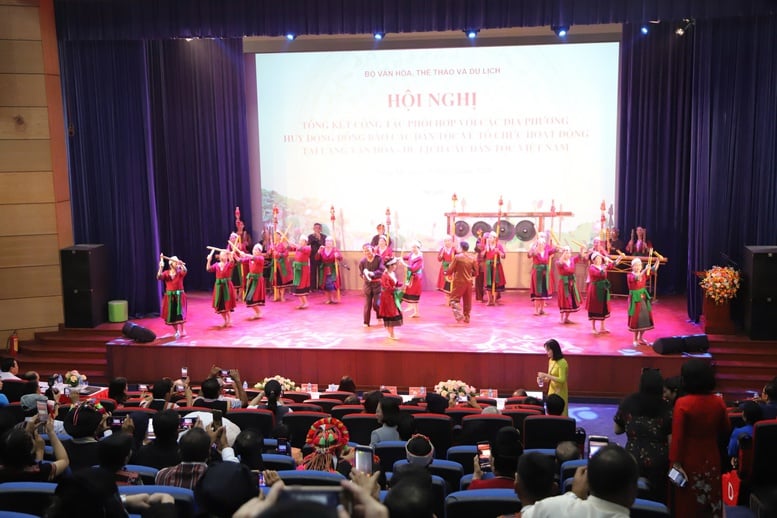
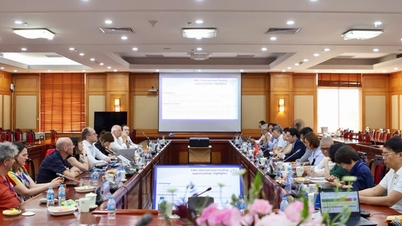
The scene at the conference. Photo: VGP/Van Hien
By the end of 2024, the Village had mobilized nearly 9,000 artisans, village elders, and community leaders from 350 localities, representing 481 ethnic groups. Special emphasis was placed on inviting ethnic minority groups to participate. 101 themed activities and monthly events were organized with diverse themes such as "Uncle Ho and the Central Highlands," "The Sea and Islands in the Hearts of the People," "Celebrating Independence Day," "Delicious Dishes for the New Year," etc., along with the reenactment of over 230 traditional festivals and rituals.
The living allowance for ethnic minority people is 4.8 million VND/person/month, sourced from revenue generated by the community and the state budget. This is the first legal document stipulating a policy of direct support for ethnic minority people participating in activities at the Village.
Currently, 61 out of 63 provinces and cities have coordinated to organize activities at the Village. Many localities have a high frequency of participation such as: Son La (47 times), Ha Giang (31), Hoa Binh (25), Dak Lak (22), Kon Tum (18), Ninh Thuan (17), Lai Chau (16), Soc Trang (14)...
Some major programs that left a lasting impression include: the Bay Nui bull racing festival (An Giang), the Mong ethnic horse racing (Lao Cai), the reenactment of the Southern floating market (Can Tho), the inauguration of the Cham Tower - Khmer Pagoda complex (Ninh Thuan, Soc Trang), and regional cultural festivals…
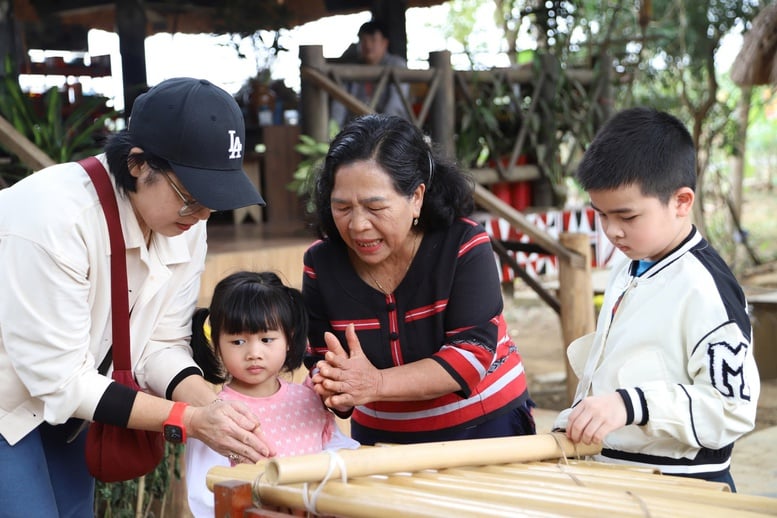
Distinguished Artisan Y Sinh introduces the Xơ Đăng culture to a large number of domestic and international tourists visiting the Vietnam Ethnic Groups Cultural and Tourism Village - Photo: VGP/ Van Hien
By 2030, the Village aims to regularly invite 40–50% of the 54 ethnic groups in Vietnam to participate in daily activities, with each group consisting of at least 8 people, ensuring regional representation and rotation among communities.
The Department of Ethnic Cultures proposes that the People's Committees of provinces and cities continue to coordinate and prioritize the selection of the Vietnam Ethnic Culture and Tourism Village as the venue for organizing unique local cultural events; and at the same time, include the mobilization of ethnic minorities to participate in activities at the Village in their annual plans.
According to Deputy Minister Trinh Thi Thuy, after 15 years of formation and development, the Vietnamese Ethnic Groups Cultural and Tourism Village has demonstrated the effectiveness of the model of close cooperation between the Ministry, localities, and ethnic communities. Only with close, consistent, and substantive coordination can the preservation and promotion of ethnic cultures be sustainable and widespread.
"I hope that, from this Conference, we will together establish a more sustainable long-term development orientation so that the Vietnamese Ethnic Groups Cultural and Tourism Village truly becomes a vibrant symbol of national unity; an attractive cultural destination rich in identity and with profound humanistic values," Deputy Minister Trinh Thi Thuy emphasized.
Representatives from the Ministry of Culture, Sports and Tourism also expressed confidence that, with contributions from localities, artisans, and communities working at the Village, policies will continue to be improved, coordination methods will be innovated, thereby mobilizing broader and more substantive participation from ethnic communities nationwide.
Listening to the heartfelt voices and sincere aspirations of artisans, local representatives, and management agencies at the conference, one common point becomes clear: For the flame of culture to burn brightly, not only in festivals but also in daily life, more collaboration is needed from the localities that preserve the soul of the nation. When each artisan is given the opportunity to tell their own cultural story, the "Common Home" will not only be a destination, but a place where heritage comes alive, spreads, and endures in the heart of the capital.
Van Hien
Source: https://baochinhphu.vn/de-ngon-lua-van-hoa-mai-bung-sang-trong-long-thu-do-102250418160318618.htm

![[Photo] Prime Minister Pham Minh Chinh receives the Chinese Ambassador to Vietnam](https://vphoto.vietnam.vn/thumb/1200x675/vietnam/resource/IMAGE/2026/04/05/1775397481797_ndo_br_dsc-5512-jpg.webp)














































Comment (0)