

This is important and necessary content for the concrete implementation of some of the contents identified in Resolution No. 15-NQ/TW dated May 5, 2022, Resolution No. 06-NQ/TW dated January 24, 2022 of the Politburo , and the Hanoi Capital City Planning, and the Adjusted General Planning of Hanoi Capital City.

Focus on architectural and landscape management.
Sir, on the afternoon of January 13th, the Hanoi People's Committee announced the Regulations on Architectural Management in Hanoi. Could you summarize the main contents of these Regulations?
- The Hanoi City Architectural Management Regulations consist of 4 Chapters, 17 Articles, and 9 Appendices, aiming to manage urban and rural landscapes and the architecture of construction projects according to approved plans, control new construction, renovation, and urban beautification in accordance with development orientations, and protect the landscape, cultural identity, and architectural characteristics of Hanoi.
The regulations also specify national technical standards and norms for planning, architecture, and construction, to manage urban architecture in accordance with the actual conditions of Hanoi and each area within the city. In addition, the regulations stipulate architectural requirements for various types of buildings, serving as a basis for preserving cultural values and heritage, and for state management of planning, architecture, investment, construction, and construction order management.
The Hanoi City Architectural Management Regulations will take effect from January 10, 2025. The principles of Hanoi City architectural management are: compliance with the Architecture Law, alignment with Vietnam's architectural development orientation and the actual conditions in the capital city; application of high-tech, advanced, and new technologies, including research and application of artificial intelligence; and ensuring harmony between economic development and national defense, security, environmental resources, disaster prevention, and mitigation of climate change impacts.
Ensuring new development goes hand in hand with preserving, conserving, and promoting traditional values in architectural structures and village landscape organization, and preserving the cultural identity of the areas; Architectural management must take into account the characteristics and specifics of each area, customs, traditions, etc.; Ensuring the participation of agencies, organizations, communities, and individuals; harmoniously combining the interests of the nation, the community, and the legitimate rights and interests of organizations and individuals.
Is this the first time Hanoi has had a comprehensive regulation related to the city's architecture sector, sir?
- Previously, under the Urban Planning Law, we developed the Regulations on the General Management of Planning and Architecture of Hanoi City, which the city approved in Decision 70/2014/QD-UBND dated September 12, 2014. However, when the Architecture Law was enacted (in 2019), the Regulations on the General Management of Planning and Architecture of Hanoi City could only continue to be implemented until December 31, 2021, and the city had to revise the Regulations on Architectural Management. These regulations place a greater emphasis on architectural management and, naturally, must also be based on the General Planning of Hanoi Capital City until 2045, with a vision to 2065, which was recently approved by the Prime Minister.
What are the differences between the newly approved regulations on architectural management in Hanoi and previous regulations? Does this new regulation focus on any specific provisions, sir?
- Previously, the Urban Planning Law managed both planning and architecture. This new regulation focuses on managing the architecture, space, and landscape of Hanoi. This regulation is implemented according to the provisions of the Architecture Law, especially Decree 85 dated July 17, 2020, which details some articles of the Architecture Law. Furthermore, the architectural management regulation includes provisions on special areas and areas requiring competitive bidding, which are new contents compared to previous regulations.
In this process, we have selectively updated relevant content from individual regulations related to the field of architecture into the overall regulations, ensuring comprehensive management across Hanoi. The Ba Dinh political center, the Thang Long Imperial Citadel area, the Co Loa area, the Old Quarter, the old streets, and several other areas have been identified as special zones.
The architectural management regulations were issued in the context of the Prime Minister having just approved two important planning schemes for the capital city. Could you please tell us how these architectural management regulations have been updated to incorporate the contents of the two recently approved planning schemes?
- It can be said that the Architectural Management Regulations are based on approved planning documents, especially the General Planning of Hanoi Capital City until 2045, with a vision to 2065, which was recently approved by the Prime Minister. During the development of the Regulations, we simultaneously worked on and updated the General Planning. Once the General Planning was issued, we finalized the regulations based on that, submitted them to the City for approval, ensuring consistency and uniformity with the orientations of the two aforementioned planning projects.
Integrated urban development
Sir, what is the significance of issuing the Architectural Management Regulations in terms of management?
- The promulgation of the Architectural Management Regulations is of significant importance in helping Hanoi better manage architectural space and architectural works, especially in the context of developing green architectural projects.

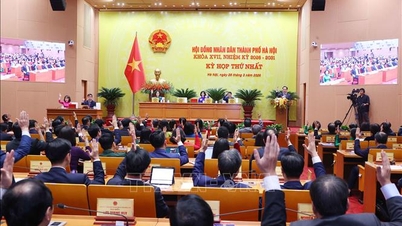
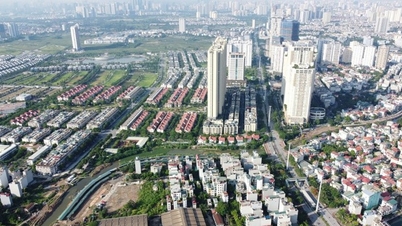
The city's adoption of the Architectural Management Regulations and Urban Development Program is something the people have long awaited. In your opinion, how will the appearance of Hanoi's urban space and architectural landscape change in the coming time?
- I believe these are important tools. We already have the Master Plan for Hanoi Capital City until 2045, with a vision to 2065, which serves as a guiding principle. For that guideline to be implemented, we need programs. The urban development program and the architectural management regulations help develop the city in a synchronized manner in terms of planning, architecture, and landscape. These are very good tools for the Department of Planning and Architecture in the future to advise the city on developing a cultured, civilized, and modern urban environment.
So, sir, what will the resources for implementation be?
- Urban planning and development programs have identified resources from various sources. During implementation, departments and agencies, based on their functions and responsibilities, will advise the city to ensure the resources are available to carry out the programs and plans.
Thank you, sir!
Source: https://kinhtedothi.vn/de-thu-do-phat-trien-hien-dai-co-ban-sac.html




![[Image] National Assembly discusses the implementation of the socio-economic development plan.](https://vphoto.vietnam.vn/thumb/1200x675/vietnam/resource/IMAGE/2026/04/20/1776696707422_ndo_br_img-20260420-185419-jpg.webp)
![[Photo] General Secretary and President To Lam meets with National Assembly delegates from ethnic minorities.](https://vphoto.vietnam.vn/thumb/1200x675/vietnam/resource/IMAGE/2026/04/20/1776696701056_a1-bnd-8331-3342-jpg.webp)



























































































Comment (0)