

These were the heartfelt opinions expressed by delegates at the conference summarizing 20 years of implementing the conservation and promotion of the gong culture heritage of Dak Lak province (2005 - 2025), with orientations towards 2030, which recently took place at the Dak Lak Museum.
Over the past 20 years, along with the changes in all aspects of life, the socio-cultural function of gongs has gradually transformed. From being closely associated with life cycle rituals, crop cycles, water sources, fields, longhouses, etc., gongs have gradually moved out of sacred spaces to become more prevalent in cultural exchanges, festivals, and tourism events.
Researchers point out that this shift presents both opportunities and challenges. The opportunity lies in the fact that gong music now has more "stages," allowing it to spread more widely and reach audiences both domestically and internationally. However, the challenge is that the "sacredness"—the spiritual core of the gong culture—is easily eroded if gong music is only performed on stage for tourists, deviating from its foundation of local beliefs, customs, and knowledge.
 |
| The youth gong ensemble of Kmrơng A village, Tân An ward. |
From this perspective, Dr. Luong Thanh Son (former Director of the Dak Lak Museum) emphasizes the vital role of folk knowledge. She likens folk knowledge to the glue that binds together the cultural space of gong music, ensuring its sustainable preservation: from knowledge about the origin, materials, and structure of each set of gongs; techniques for playing and tuning; the rituals for each ceremony; to customs and beliefs associated with longhouses, water sources, fields, and burial grounds… Those who know how to tune gongs, memorize ancient gong pieces, and master traditional rituals are the “living libraries” of cultural knowledge.
According to the 2024 inventory, the province has 1,603 sets of gongs, including 1,178 Ede gong sets, 219 M'nong gong sets, 118 J'rai gong sets, and 88 other sets. Notably, there are 3,749 artisans who are preserving various forms of heritage, and 1,015 young artisans (who know how to play, strike, and tune gongs); of which 948 artisans know how to teach gong playing.
On the surface, there is a large force of artisans, but beneath the surface, there are considerable concerns: the number of artisans awarded prestigious state titles is still very modest compared to their actual contributions, while the number of elderly artisans is decreasing day by day.
Based on this practical experience, Dr. Luong Thanh Son proposed that documenting, digitizing, and systematizing folk knowledge be considered an urgent task; that a special incentive mechanism be established for artisans; that knowledge about gongs be incorporated into local history education and extracurricular activities in schools; and that more spaces for practicing this heritage be created within the community, not just on stage or in museums.
From another perspective, writer Niê Thanh Mai (Chairwoman of the Dak Lak Literature and Arts Association) mentioned the role of artists and writers as a bridge between tradition and modernity. Through research and collection of epics, long poems, and folk tales; through literary, musical, artistic, theatrical, and photographic works, the image of the gong has become a source of inspiration, helping the heritage not to be "confined" to festivals, but to enter the space of contemporary creativity.
Against the backdrop of the Government identifying the development of cultural industries as a pillar of growth, Dak Lak is building a strategy for the 2025-2030 period that considers culture and cultural tourism as key priorities. From the discussions at the conference, a common understanding emerged: If exploited correctly, the cultural space of gong music is not only the "spiritual voice of the mountains," but also a crucial resource for cultural industries, community tourism, and sustainable livelihoods for those who are keeping the flame of this heritage alive.
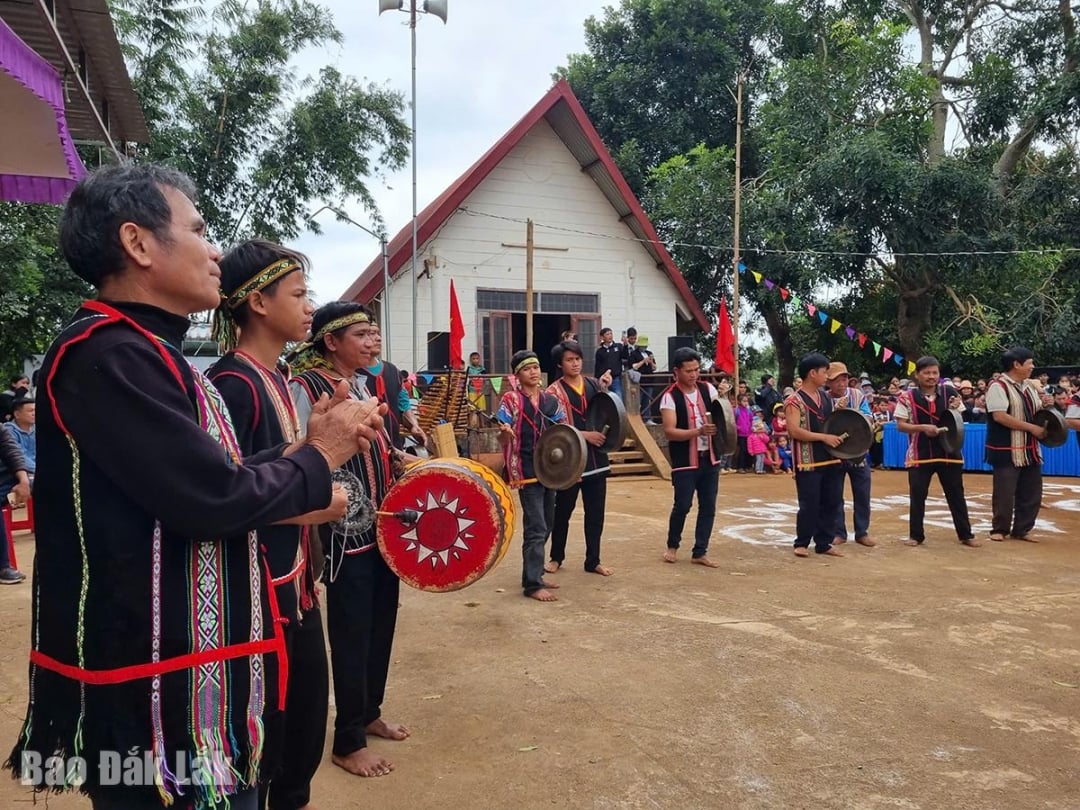 |
| Gongs and drums in the New Rice Offering Ceremony of the Xê Đăng community in Kon H'ring village, Cư M'gar commune. |
Behind the statistics on the preservation of the gong culture heritage, there are still many concerns. Delegates have repeatedly mentioned the trend of "marginalization" of the communities that are the custodians of this heritage. This is not a new warning, but it remains ever relevant.
Researcher Linh Nga Niê Kđăm (former President of the Dak Lak Literature and Arts Association) points out that changes in religious beliefs, shifts in the agricultural economic structure, labor migration, the explosion of digital technology, and the allure of modern music are rapidly shrinking the environment for practicing traditional musical instruments. A segment of young people no longer have much time or interest in the values inherited from their ancestors, while ethnic cultural education in schools remains heavily theoretical and lacks experiential learning.
Many gong ensembles and clubs have been established under programs and projects, but due to a lack of funding and dedicated individuals, they only operate sporadically before gradually disbanding. If heritage management continues to favor a "State-run" approach, and if festivals and celebrations remain merely superficial, it could easily lead to a scenario where the sound of gongs and drums becomes "theatricalized," detached from the religious space and traditional life where the heritage originated.
With the heart of an artisan from the village, Mr. Y Bay Kbuor (Village Head, Chairman of the Folk Arts Club of Kmrong A village, Tan An ward) worries about seeing many young people being swept up in modern life; the nights spent gathering around the fire and with the gongs are becoming less frequent. “I fear that one day, the gongs will only lie dormant in museums, no longer resounding around the fire and in the fields as before…,” Mr. Y Bay said, hoping that the authorities at all levels will continue to pay attention to supporting the village with more good gong sets; support the organization of regular training classes for young people; and create conditions for artisans to remain committed to preserving and passing on the gong tradition. According to him, only when young people are brought back to the gongs and the rice wine to understand and be proud of the soul of their ancestors will the sound of the gongs truly “live” in the life of the village.
These concerns, from the scientific perspective of cultural researchers to the voices of artisans, once again affirm that the ultimate goal of preservation is not merely to keep the sound of gongs in records, museums, or on stage, but to ensure that the sound of gongs continues to resonate, harmonizing with the new rhythm of life in today's villages…
Source: https://baodaklak.vn/van-hoa-du-lich-van-hoc-nghe-thuat/202511/de-tieng-chieng-hoa-nhip-song-moi-b250126/












































































Comment (0)