

We had the opportunity to experience firsthand the management of festivals at the Gầu Tào Festival in Pà Cò commune, which took place from January 30th to February 1st, 2026. This is a prime example of meticulous preparation. This festival aims to preserve the unique intangible cultural values of the Mong ethnic group, and also serves as an occasion for the people to give thanks to heaven and earth, and pray for a new year of favorable weather and a bountiful harvest.
Despite welcoming a large number of delegates and tourists from both within and outside the country, security and order were maintained. This success stemmed from the strict implementation of the commune's festival organization plan. The commune's police force was maximized for patrolling and control. In particular, the parking area was scientifically planned and divided into two zones. The Organizing Committee coordinated with households near the Xa Linh hamlet stadium to arrange auxiliary parking spaces. As a result, despite the large number of vehicles, there was no traffic congestion. The ceremonial parts, such as cutting the ceremonial pole, and the festive activities with folk games like pao throwing, khen flute dancing, and rice cake pounding, all took place safely, creating a positive impression of a civilized festival in the hearts of visitors.
Continuing in that spirit, in Muong Bi commune – where preparations are underway for the 2026 Muong ethnic festival, held on the 6th, 7th, and 8th of the first lunar month – preparations are being carried out urgently. This is the largest folk festival of the Muong people, organized on a provincial scale to honor traditional cultural values, strengthen community bonds, and promote sustainable tourism development. Mr. Bui Minh Hong, Vice Chairman of the People's Committee of Muong Bi commune, said: Immediately after receiving the directive from higher authorities, the commune issued a document on strengthening festival management in the area. Accordingly, the People's Committee of the commune requested agencies and units to strictly implement the directives and guiding documents of the Party and State on festival management and organization. They are also required to strengthen inspection and supervision; promptly detect and strictly handle acts of exploiting historical sites and festivals for personal gain; Strictly adhering to regulations on price listing and publicizing service prices, and absolutely refraining from raising or overcharging tourists, is crucial. Proactive action from the grassroots level is key to preserving the solemnity of the upcoming Muong ethnic group's Khai Ha Festival in the province.
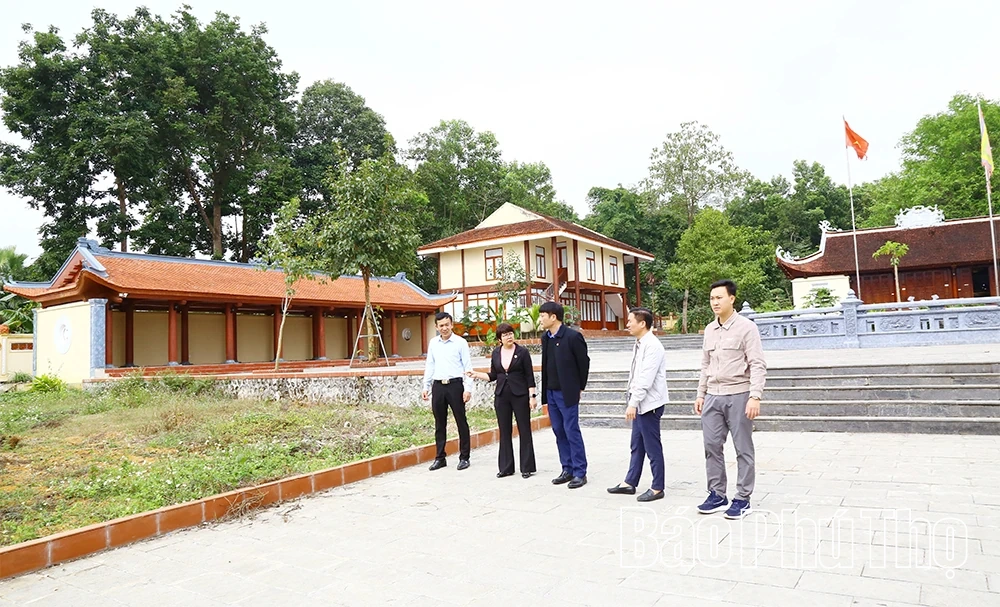
Leaders of the People's Committee of Muong Bi commune inspect the facilities prepared for the 2026 Muong ethnic group's Khai Ha Festival in Phu Tho province.
Looking back at 2025, Phu Tho province has 482 registered traditional festivals of various ethnic groups. These include one national-level festival (Hung Temple Festival) and two provincial-level festivals (the Muong ethnic group's Khai Ha Festival and the Tien Pagoda Festival). Most festivals are held safely and healthily, meeting the spiritual needs of the people and contributing to the education of the moral principle of "drinking water, remembering the source." The dissemination of information about historical relics and the promotion of civilized lifestyles have significantly reduced the practice of burning votive paper...
According to Comrade Nguyen Thanh Xuan - Head of the Cultural Management Department (Department of Culture, Sports and Tourism), to continue building on the achievements, the Department of Culture, Sports and Tourism will closely coordinate with local authorities to register festivals and implement the province's core directives for 2026. This includes focusing on effectively implementing Document No. 262 dated January 22, 2026, from the Department of Culture, Sports and Tourism regarding strengthening the management and organization of festivals in 2026.
To ensure that festivals adhere to traditional rituals, create a joyful, enthusiastic, safe, healthy, and economical atmosphere, the Department of Culture, Sports and Tourism requests that communes and wards pay attention to and coordinate the implementation of tasks within their delegated authority and responsibilities. The head of the local government will be held responsible if serious violations occur in their area. Strictly enforce regulations regarding the placement of donation boxes and offerings. Promote awareness among the people and tourists to maintain civilized behavior when participating in festivals, linking this to the "National Unity for Building a Culturally Rich Life" movement and the "National Unity for Building New Rural Areas and Civilized Urban Areas" campaign. Implement plans to ensure absolute security and safety for festival participants; focus on fire prevention and control, food safety and hygiene, and environmental sanitation at historical sites and spiritual tourism destinations. Strengthen inspections before, during, and after festivals. Businesses are required to publicly display prices, preventing harassment and price gouging of tourists; and addressing deviant behaviors and actions that violate ethics and lifestyle standards.
Currently, relevant agencies are actively coordinating with local authorities to review and register the list of festivals to be held in 2026. Managing these festivals from the preparation stage not only helps preserve cultural beauty but also transforms them into a driving force for tourism development. It is believed that the festivals in the province will always be attractive destinations, where traditional cultural values are preserved and showcased, contributing to building a civilized and distinctive cultural image for the ancestral land.
Huong Lan
Source: https://baophutho.vn/de-nbsp-van-hoa-truyen-thong-luon-toa-sang-247678.htm



![[Photo] National Assembly Chairman Tran Thanh Man attends the policy seminar to promote Vietnam-Türkiye cooperation.](https://vphoto.vietnam.vn/thumb/1200x675/vietnam/resource/IMAGE/2026/04/16/1776351415367_vna-potal-chu-tich-quoc-hoi-tran-thanh-man-du-toa-dam-chinh-sach-thuc-day-hop-tac-viet-nam-tho-nhi-ky-8705791-jpg.webp)












![[Image] Bridges and roads connecting the eastern part of Ho Chi Minh City](https://vphoto.vietnam.vn/thumb/1200x675/vietnam/resource/IMAGE/2026/04/16/1776328595108_ndo_br_bh-vt5-jpg.webp)





















![[Infographic] Details of the Hanoi-Quang Ninh High-Speed Railway Project](https://vphoto.vietnam.vn/thumb/402x226/vietnam/resource/IMAGE/2026/04/16/1776338188424_anh-man-hinh-2026-04-16-luc-18-16-10.png)

![[Photo] National Assembly Chairman Tran Thanh Man meets with the Speaker of the Georgian Parliament](https://vphoto.vietnam.vn/thumb/402x226/vietnam/resource/IMAGE/2026/04/16/1776338494029_anh-man-hinh-2026-04-16-luc-18-21-21.png)











Comment (0)