

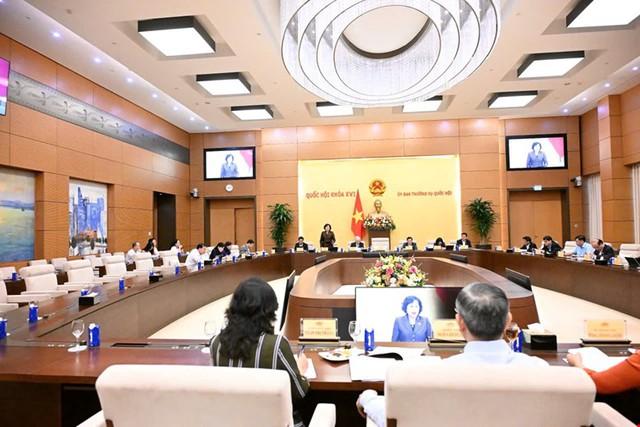
Proposed amendments to the Laws: Personal Income Tax, Value Added Tax, Corporate Income Tax, and Special Consumption Tax.
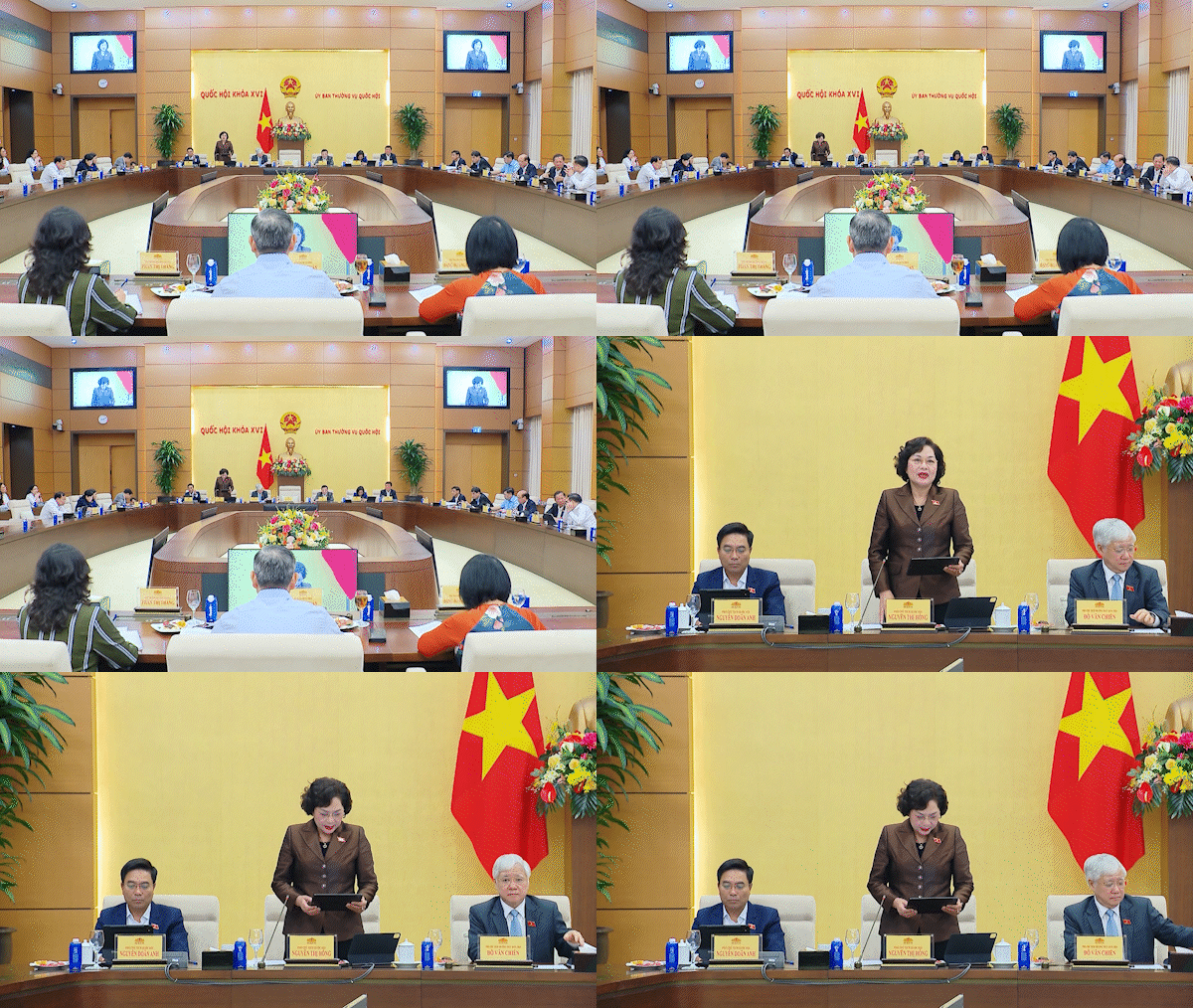
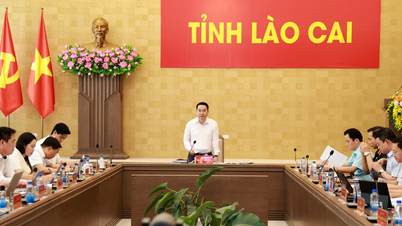
On April 20th, under the chairmanship of National Assembly Vice Chairwoman Nguyen Thi Hong, the National Assembly Standing Committee met to discuss the draft Law amending and supplementing a number of articles of the Law on Personal Income Tax, the Law on Value Added Tax, the Law on Corporate Income Tax, and the Law on Special Consumption Tax.
Presenting the report, Minister of Finance Ngo Van Tuan stated that the draft law was developed on the basis of institutionalizing the Party's policy on business households, individuals, and enterprises as stated in Resolution No. 68-NQ/TW dated May 4, 2025, of the Politburo on the development of the private economy, and the Party's policy on developing a green economy, promoting green transition, and energy transition as outlined in the documents of the 14th National Congress of the Communist Party of Vietnam.
Regarding personal income tax and value-added tax for household and individual businesses: From the beginning of 2026 until now, due to the impact of the global situation leading to many fluctuations in the domestic economy, rising fuel prices have increased input costs, purchasing power has decreased, and the production and business activities of household and individual businesses have faced many difficulties.
Therefore, further research is needed to adjust the revenue threshold for individual businesses that are exempt from personal income tax and the revenue threshold for household and individual businesses that are exempt from VAT, in order to support household and individual businesses, especially those in low-profit margin industries and those heavily impacted by cost fluctuations.
Regarding corporate income tax for small businesses: The current Corporate Income Tax Law already stipulates many preferential policies for small businesses.
However, due to the impact of the global economic context on the domestic economy, one of the first entities affected, besides households and individual businesses, is small-scale enterprises. This is because the capital and human resources constraints of this type of enterprise result in low resilience to external fluctuations.
In reality, recently, due to rising fuel and logistics costs, many businesses of this type have fallen into difficulties and need policy support from the government.
Regarding the special consumption tax on battery-powered electric vehicles , Minister of Finance Ngo Van Tuan stated that the current special consumption tax policy, with its high preferential rates for battery-powered electric vehicles applied from March 1, 2022, has been effective, gradually changing consumer habits from using gasoline-powered vehicles to using electric vehicles, contributing to reducing greenhouse gas emissions into the environment.
Furthermore, the forecast of geopolitical tensions and the potential for prolonged instability and unpredictability in fossil fuel supply means the economy is facing significant energy security pressure and needs to proactively plan to reduce its reliance on fossil fuels by promptly transitioning to environmentally friendly alternatives. This will contribute to a proactive and sustainable energy restructuring while also promoting green economic development.
Regarding the provisions on personal income tax, value-added tax, and corporate income tax in Articles 1, 2, and 3 of the draft Law, Minister of Finance Ngo Van Tuan clarified that, in order to support the development of production and business by households, individuals, and enterprises, especially small-scale households, individuals, and enterprises, and to ensure fairness in income tax policy between households, individuals, and small-scale enterprises, and to encourage households and individuals to transition to enterprises; based on an impact assessment (balancing the impact of reduced budget revenue with creating conditions for households to have resources to develop production and business, and stabilizing social sentiment), the draft Law is amended to not specify the revenue threshold for exemption from personal income tax and the revenue threshold for exemption from value-added tax for households and individuals in the Law, and to entrust the Government with the authority to regulate these levels .
Simultaneously, amend the content of the Corporate Income Tax Law to include a threshold for revenue exempt from corporate income tax and entrust the Government with the authority to regulate this threshold and to specify the details of the tax exemption in accordance with the authority granted in Clause 15, Article 4 of the Corporate Income Tax Law No. 67/2025/QH15 .
Delegating authority to the Government will create a legal basis for the Government to flexibly manage fiscal policy, including tax policy, and will also institutionalize the content stated in Conclusion No. 18-KL/TW, Resolution No. 66-NQ/TW, the Law on the Organization of the National Assembly, and similar provisions granting authority to the Government in some current Laws and Resolutions of the National Assembly on taxation.
Regarding the regulations on excise tax for battery-powered electric vehicles, according to Minister of Finance Ngo Van Tuan, in order to contribute to ensuring the consistency of the current excise tax policy with the goals of environmental protection, sustainable development, and reducing urban pollution, and reducing dependence on fossil fuels, especially in the context of strong fluctuations in fossil fuel prices and a significant shortage of fossil fuel supply, the draft Law amending and supplementing the regulations on excise tax rates for motor vehicles with less than 24 seats powered by batteries will extend the application period of the current policy until the end of 2030.
The Government proposes that this Law take effect from the date of its adoption, except for the provisions in Articles 1, 2 and 3 of this Law, which shall take effect from January 1, 2026.
Agreement on the scope of amendments to the draft law.
In the report reviewing the draft Law, the Chairman of the Economic and Financial Committee, Phan Van Mai, stated that, according to the draft Law's dossier, the scope of amendments focuses on empowering the Government to regulate matters that fluctuate according to socio-economic development (revenue thresholds for exemption from personal income tax and value-added tax for household and individual businesses; income thresholds for exemption from corporate income tax) and proposing an extension of the application period for the low special consumption tax rate on motor vehicles with fewer than 24 seats powered by batteries. The majority of opinions within the Standing Committee of the Economic and Financial Committee agreed with the scope of amendments to the draft Law as proposed by the Government.
Regarding the amendment and supplementation of Clause 1, Article 7 of the Personal Income Tax Law and Clause 25, Article 5 of the Value Added Tax Law: The majority of opinions within the Standing Committee of the Economic and Financial Committee agreed with the Government's proposal, suggesting that consideration should be given to adjusting the revenue threshold for tax exemption for households and individuals to strengthen support measures for small and medium-sized businesses in the current context of numerous difficulties in production and business activities.
Regarding the amendment of regulations in Clause 14, Article 4 of the Corporate Income Tax Law: The majority of opinions within the Standing Committee of the Economic and Financial Committee basically agreed with the direction of adding regulations on corporate income tax exemption for small-scale enterprises to ensure fairness in the application of tax policies between small-scale enterprises and household and individual businesses, creating conditions to encourage household businesses to convert to the enterprise model, contributing to achieving the goals set out in Resolution No. 68-NQ/TW.
Regarding the amendment and supplementation of point g, clause 4, section I of the Special Consumption Tax Schedule in Article 8 of the Law on Special Consumption Tax: The majority opinion within the Standing Committee of the Economic and Financial Committee is that considering and extending the application period of the current special consumption tax rate for motor vehicles with fewer than 24 seats powered by batteries is necessary to contribute to promoting green transition, protecting the environment, and aiming for sustainable development.
After listening to the opinions and concluding the session, Vice Chairwoman of the National Assembly Nguyen Thi Hong stated that the Standing Committee of the National Assembly unanimously agreed to amend and supplement several articles of the Law on Personal Income Tax, the Law on Value Added Tax, the Law on Corporate Income Tax, and the Law on Special Consumption Tax in order to promptly institutionalize the Party's major policies on green transformation, energy transition, private sector development, and the goal of double-digit growth associated with macroeconomic stability.
At the same time, it is required that tax policies ensure appropriate support for household businesses and small and medium-sized enterprises; increase the fairness and consistency of the tax system; contribute to guiding consumption, encouraging the use of environmentally friendly means of transportation, reducing emissions, and moving towards sustainable development.
National Assembly Vice Chairwoman Nguyen Thi Hong requested the Government to fully incorporate the opinions of the National Assembly Standing Committee and the verification agency to finalize the draft law and submit it to the National Assembly in accordance with regulations. The Economic and Financial Committee should continue to refine the verification report; the National Assembly Secretary General and the Head of the National Assembly Office should arrange and report to the National Assembly to add this content to the agenda of the first session of the 16th National Assembly, ensuring that the draft law is considered and passed in a timely manner, meeting the requirements of national development in the new period.
Updated April 20, 2026
Source: https://laichau.gov.vn/tin-tuc-su-kien/chuyen-de/tin-trong-nuoc/de-xuat-sua-doi-bo-sung-4-luat-thue.html


![[Photo] General Secretary and President To Lam meets with National Assembly delegates from ethnic minorities.](https://vphoto.vietnam.vn/thumb/1200x675/vietnam/resource/IMAGE/2026/04/20/1776696701056_a1-bnd-8331-3342-jpg.webp)


![[Image] National Assembly discusses the implementation of the socio-economic development plan.](https://vphoto.vietnam.vn/thumb/1200x675/vietnam/resource/IMAGE/2026/04/20/1776696707422_ndo_br_img-20260420-185419-jpg.webp)











![[INFOGRAPHICS] Phase 2 of the First Session of the 16th National Assembly: Considering and deciding on many important issues](https://vphoto.vietnam.vn/thumb/402x226/vietnam/resource/IMAGE/2026/04/20/1776678933182_20-4-anhquochoi2004.jpeg)





















































Comment (0)