

As the final battle
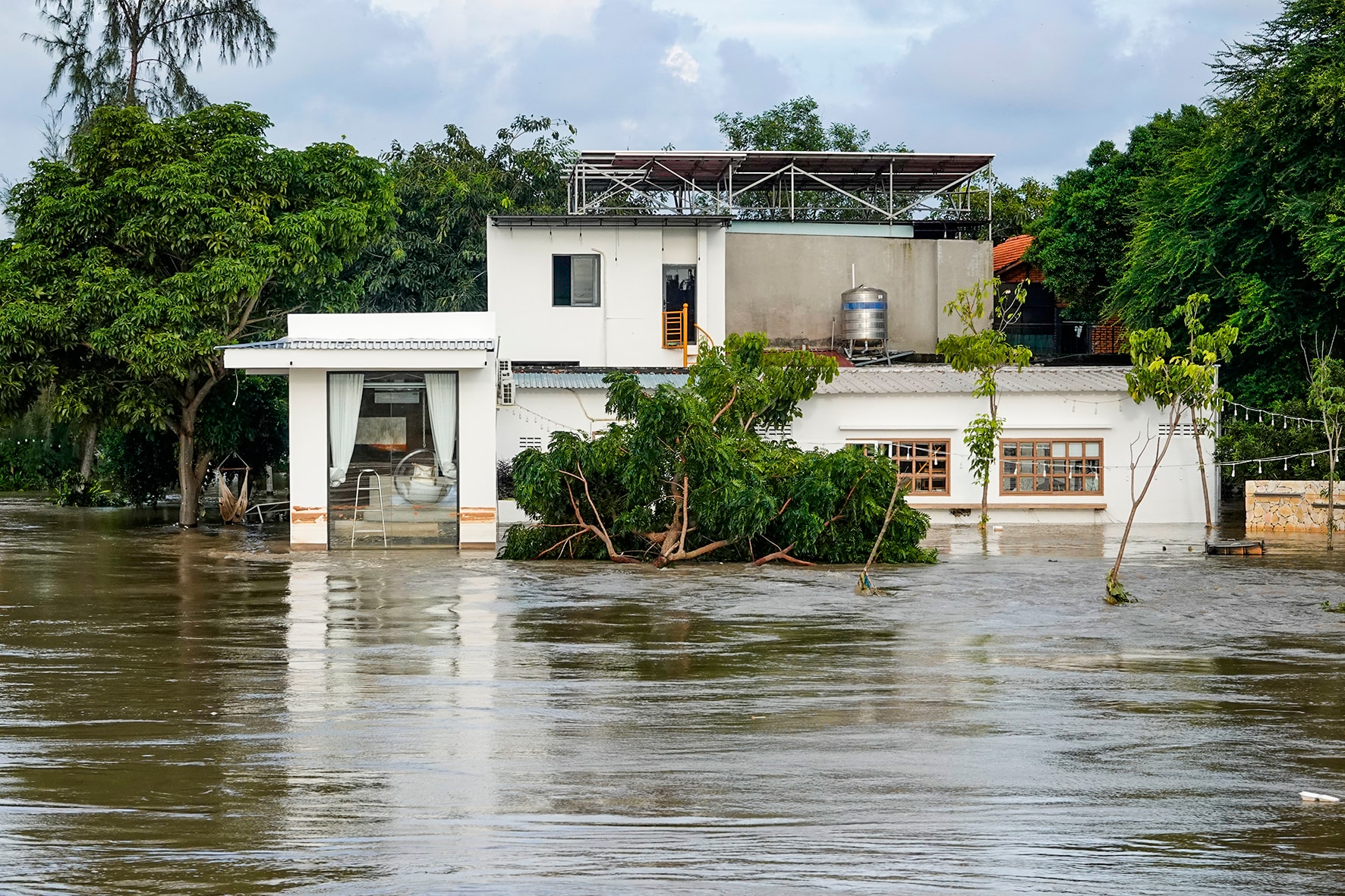
At 4 PM on October 31st, at Phu Hai Bridge, numerous fishing boats were moored close together, each seemingly on the verge of breaking free under the force of the strong current that had submerged more than half of its hull. It appeared that only about half a meter of water was about to reach the bridge. From here, a few hundred meters from the sea, one could see the Ong Hoang Pavilion and the cluster of Cham towers in the distance, also the mouth of the sea (belonging to Phu Thuy ward), and further further, Ham Thang ward. While other communes and wards in the coastal Lam Dong region were experiencing prolonged heavy rains from October 26th to 30th, causing flooding, inundating houses, crops, and trees; and causing landslides and cracks in roads, in Ham Thang ward, the flooding on the Cai River was still a hot topic late in the afternoon of October 31st.
Because this area is downstream of the Song Quao reservoir, the second largest irrigation project in the southeastern region of the province, floodwaters are still being released to ensure the safety of the structure. Since all water flows into the river, and then the river flows to the sea, this creates a accumulation and buildup. As evening falls, the tide rises and floods the estuary. At this time, the tidal surge from the sea cannot match the aggressive speed of the floodwaters, approximately 300 m³ /s, but it still manages to slow down the flow. Following this trend, the floodwaters will accumulate, overflowing into residential areas and villages around the estuary.
In Ham Thang Ward, the situation was such that by late afternoon on October 31st, residential areas in 18 out of 19 neighborhoods were still flooded, and the final evacuations of residents to higher ground were still underway. Meanwhile, on Nguyen Thong Street, traffic was extremely heavy, especially at the Phu Hai Bridge section. This was because the Phu Hai - Kim Ngoc road, connecting to National Highway 1A, was passable on one side of the bridge thanks to the high embankment along the Cai River; however, the Phu Hai - Phu Long road, also connecting to National Highway 1A, was impassable due to the Cai River overflowing and flooding several sections. Despite the announcement, not everyone was aware. As a result, vehicles that had already entered the Phu Hai - Phu Long road had to turn back across the Phu Hai Bridge to take the Phu Hai - Kim Ngoc road to National Highway 1A.
We also made the same roundabout route, after the head of Phu Xuan neighborhood suggested using a tractor to transport us across the flooded section, but it didn't work. Just crossing that 200-meter stretch of flooded land would allow us to reach the households being evacuated by the authorities at Xuan My Primary School. It was 4:30 PM, the tide was rising, the Cai River was surging, and the water in the flooded section was overflowing. It was impossible to cross.
The Party Secretary of Ham Thang Ward, Dang Ngoc Phuc, guided us along Phu Hai - Kim Ngoc road to the ward headquarters. He also informed us that many neighborhoods in the ward were still heavily flooded, so all transportation was by canoe or jet ski. Who would have thought that this once prosperous suburban area of Phan Thiet, with its abundant land and fields, would turn into a river starting from the night of October 30th? That same night, Ham Thang appealed for help via a phone number from an online group, and within just two hours, the nearest tourism businesses had sent 3 canoes and 15 jet skis. Following that, the military forces of the 5th Regional Defense Command and the Mui Ne Border Guard Post deployed another 3 canoes… Therefore, throughout the night of October 30th and all day on October 31st, all 826 households/2,624 people in the flooded neighborhoods were transported to higher ground within the ward. Only a few residents hesitated, missing the opportunity and having to climb onto their rooftops to wait, filled with regret for not believing the flood was coming. Meanwhile, in neighboring communes and wards, people evacuated by the floods were returning home, so the situation in Ham Thang ward felt like a final battle.
"A surprise attack" on subjective judgment.
The sight of canoes and jet skis operating in what were once rice paddies, potato fields, and vegetable gardens attracted the same curiosity as we witnessed when we returned via the Phu Hai - Kim Ngoc road to National Highway 1A. At 5 PM on October 31st, people gathered along the roadside to watch the floodwaters rising, as if it were the first time they had ever seen anything like it. “It really is the first time. This is what made some people reluctant to relocate, wanting to stay home to protect their property, plus the thought that all their lives they’ve lived here have only seen flooded crops and a few houses in low-lying areas. They thought the authorities were overreacting…,” said an official from Ham Thang ward. He continued his story. After a second round of persuasion, plus announcements on loudspeakers, vehicles driving into alleys and lanes, and even the use of portable loudspeakers… most households agreed to relocate, except for 315 households in the Kim Ngoc church area who refused. By then, it was already noon on October 30th. The irrigation company announced it would increase the flood discharge through the Song Quao reservoir spillway from 300 to 500 m³ /s. The ward leaders were anxious and decided to both aggressively persuade the residents and force them to relocate.
As feared, at 11 PM, National Highway 1A, the section passing through Lai An area in the ward, was deeply flooded. Roadblocks had to be set up at both ends immediately to prevent unsuspecting residents from participating and causing accidents. At 2 AM on October 30th, water surged into the ward's People's Committee headquarters like a raging flood, surprising even the flood control officers who had anticipated it. They had heard from adults that the area around the headquarters was high and had never been flooded before. This meant that other neighborhoods in the ward were also flooded. At this moment, the phones rang. Information came in that residents in neighborhoods like Phu Xuan and Phu My were climbing onto their rooftops, desperately pleading for help, regretting not heeding the officials' warnings sooner. Five canoes and 15 jet skis worked at full capacity throughout the night and the following day, October 31st, transporting the flooded residents to safety.
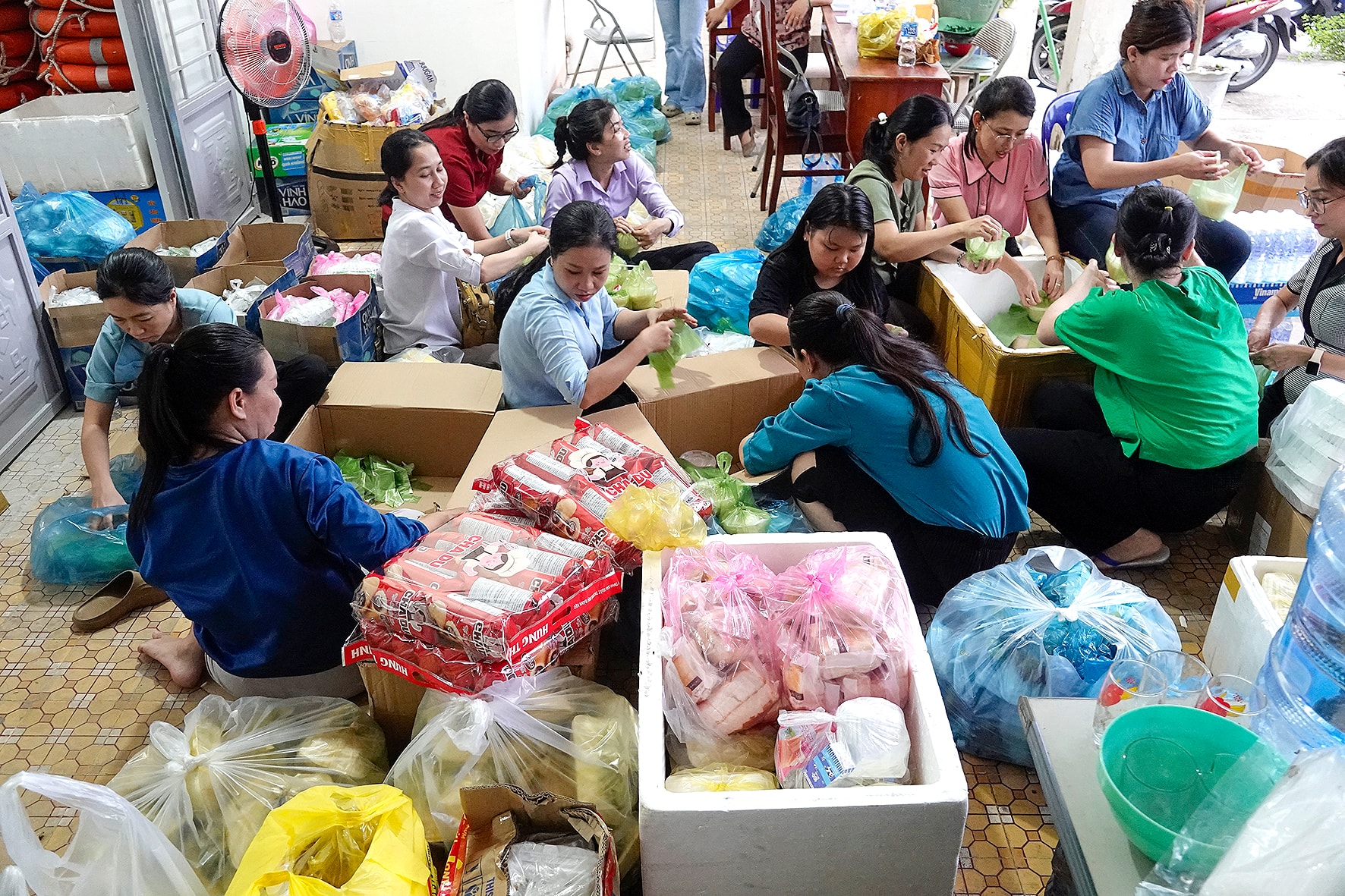
In the ward, the charitable kitchens have started working. The ward mobilized philanthropists and, as if touching the deepest sense of solidarity, from the night of October 30th until now, has provided over 3,600 meals for all three meals a day, along with drinking water, to people affected by the floods.
At 11 PM on October 31st, ward officials inspected the area and found the river water receding. It wasn't raining. Nearly 40 members of the ward's flood control team, primarily the steering committee, neighborhood front committees, and local militia squads, were able to get some sleep, except for those on duty. The next morning, hearing that the discharge rate through the Song Quao reservoir was only 60-70 m³ /s, everyone breathed a sigh of relief. In the neighborhoods, the water had receded to varying degrees. Where the water had dried, residents were busy cleaning up their homes. The authorities deployed disinfectant spraying to minimize the risk of disease outbreaks after the flood. Ham Thuan Bac Power Company also inspected power lines and will restore electricity to the affected neighborhoods. The good news, according to the ward's flood control force, is that some households who had previously refused to relocate apologized, even though it rained again on the afternoon of November 1st and the Song Quao reservoir increased its flood discharge rate to 83 m³ /s...
In Ham Thang Ward, 18 out of 19 neighborhoods were flooded; of which, the total number of households with houses flooded (less than 0.5 m) was approximately 5,726 out of 12,797, accounting for 44% of the households in the ward. 826 households/2,624 people had to be relocated due to severe flooding (over 0.5 m deep), with 315 households/1,115 people forced to relocate. In addition, approximately 275 hectares of vegetables and fruit trees, and 10.25 hectares of aquaculture farms were damaged...
Source: https://baolamdong.vn/dem-trang-vung-gan-cua-bien-399413.html



![[Photo] Prime Minister Pham Minh Chinh receives the Chinese Ambassador to Vietnam](https://vphoto.vietnam.vn/thumb/1200x675/vietnam/resource/IMAGE/2026/04/05/1775397481797_ndo_br_dsc-5512-jpg.webp)
















































































Comment (0)