

Independence Palace - A symbol of the day of complete victory.
Independence Palace – a special national monument associated with a momentous historical moment – is becoming a popular destination attracting a large number of domestic and international tourists. Located on Nam Ky Khoi Nghia Street, District 1, Ho Chi Minh City, Independence Palace is one of the typical architectural works of the former Saigon - Gia Dinh city. Construction began on July 1, 1962, and was completed on October 31, 1966, designed by architect Ngo Viet Thu, who had won the Rome Prize in France.
With a total area of 4,500m², the Independence Palace comprises three main floors, two mezzanines, a basement, a ground floor, and a rooftop. The usable space reaches 20,000m² with over 100 functional rooms arranged harmoniously, each with its own unique decorative style suited to its purpose, yet maintaining a unified overall architectural design. Officially in use since 1966, the Independence Palace quickly became a symbol of political power. After 1975, it was recognized as a national historical and cultural relic (1976) and was classified as a special national relic in 2009. Since 1990, the Independence Palace has officially opened to visitors.
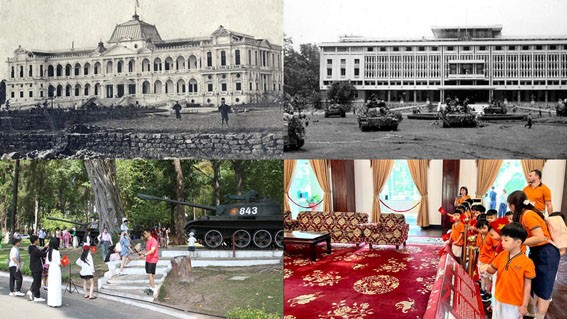 |
Tourists take photos next to two historic tanks, numbered 390 and 843, at the Independence Palace. (Photo: VGP) |
In 2024, the Reunification Hall – the unit managing the Independence Palace – recorded nearly 1.5 million visitors, demonstrating the enduring appeal of a site deeply connected to the nation's history. During these April days, the crowds flocking to the Palace are growing, both to admire the unique architecture and to relive the heroic memories through the artifacts and exhibition spaces.
Beyond its historical value, the Reunification Hall is striving to revitalize the visitor experience. Many interactive programs are organized, such as the exhibition "From Norodom Palace to Independence Palace" and a series of heritage education activities for students aged 7 to 15. These programs help the younger generation gain a deeper understanding of national history and culture, contributing to the development of soft skills such as teamwork, presentation, and problem-solving. In the future, the institution will promote the application of technology in the preservation and promotion of heritage values. Digitizing exhibition spaces and artifacts, as well as applying technology to storytelling and historical interpretation in a visual and engaging way, will help the public, especially young people, access history in a more accessible and lively manner.
Over time, Independence Palace has become not only a historical landmark but also an inspiring open space where the past, present, and future converge in the journey of preserving memory and promoting the national spirit.
Cu Chi Tunnels - A legend beneath the earth
Located approximately 70km northwest of Ho Chi Minh City, the Cu Chi Tunnels are a vivid symbol of the indomitable spirit and creativity of the people and soldiers of Cu Chi during three decades of resistance in the struggle for national independence and freedom. With a tunnel system stretching approximately 250km and a complex, spiderweb-like structure, the Cu Chi Tunnels have gone down in history as a unique military marvel of the 20th century.
Originating from secret tunnels during the resistance against the French, the tunnel system developed significantly during the war against the Americans, particularly from 1961 to 1965. Six communes in the northern part of Cu Chi district completed the "backbone" of the tunnel system, which then developed into a continuous network connecting various units and command centers. The tunnels served not only as shelters but also as trenches, hospitals, food storage areas, secret meeting places, and even venues for cultural performances and film screenings to boost the morale of soldiers and the people.
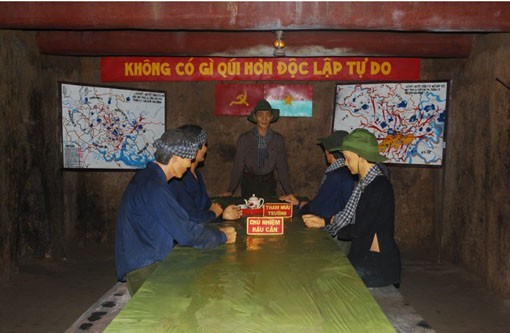 |
The Cu Chi Tunnels are considered one of the symbols of the indomitable spirit of the Vietnamese people. (Photo: Cu Chi Tunnels Historical Site) |
In the cramped, dark, and airless underground tunnels, the people and soldiers of Cu Chi maintained their fighting, living, and production activities. This area endured fierce sweeps by the American army, such as the Crimp (1966) and Cedar Falls (1967) campaigns, but thanks to the sturdy and cleverly designed tunnel system, combined with a network of mines, booby traps, and combat positions, our people and soldiers fiercely fought back, inflicting heavy losses on the enemy. Even sabotage tactics such as pumping water, using chemical weapons, trained dogs, or bulldozers were neutralized by the Vietnamese spirit and intelligence.
The war fought underground demonstrated the superior strength of people's warfare. By the spring of 1975, the Cu Chi tunnels had become the staging area for many main units advancing to liberate Saigon, bringing the resistance war against the US to a victorious end. Throughout 21 years of fighting, the people and soldiers of Cu Chi fought more than 4,200 battles, large and small, eliminating over 22,500 enemy soldiers, destroying thousands of war vehicles, and affirming its status as a "steel fortress" in the hearts of the nation.
Today, the Cu Chi Tunnels are preserved in two main areas, Ben Duoc and Ben Dinh, and are recognized as a National Historical and Cultural Monument. Particularly, on the occasion of the 50th anniversary of the Liberation of Southern Vietnam this year, the number of visitors to the Cu Chi Tunnels in April increased by about 30% compared to usual and is predicted to continue to increase sharply during the April 30th holiday. Part of the attraction stems from the effect of the film "The Tunnels," which is currently gaining attention and vividly portrays the resilient land of Cu Chi.
The tour begins at Ben Duoc Temple – a memorial to the people and soldiers who sacrificed their lives in Saigon-Gia Dinh during the two wars of resistance. From here, visitors move to the tunnel complex, a three-tiered structure reaching a depth of 12 meters, including a command bunker, medical facility, Hoang Cam kitchen, weapons depot, water well, shelter, and a military uniform workshop… The intricate tunnel system, likened to a spiderweb, with branches leading to the Saigon River, cleverly camouflaged ventilation, and secret tunnels, clearly demonstrates the ingenuity of the Cu Chi people and soldiers. Visitors can also experience a recreated liberated zone, enjoy local cuisine, and participate in various outdoor activities, gaining a deeper understanding of life during wartime.
Millions of domestic and international visitors, from heads of state to American veterans, have come here to witness firsthand a great symbol of the Vietnamese spirit. For them, simply walking through a few dozen meters of the narrow tunnel is enough to understand why a small nation could defeat the world's most powerful invaders.
Journeys of gratitude and connection to history.
On this occasion, many travel companies have designed special tours to honor and commemorate the glorious historical milestones of the nation. For example, Saigontourist Travel Service Company has launched a tour program called "50 Years - Returning to the Beloved South," specifically for veterans from all over the country to revisit their former battlefields in Ho Chi Minh City. The program is not only a tourist journey but also an opportunity for veterans to meet historical witnesses and generals, reminisce about their heroic memories, and witness the changes and development of the city that was once a battlefield.
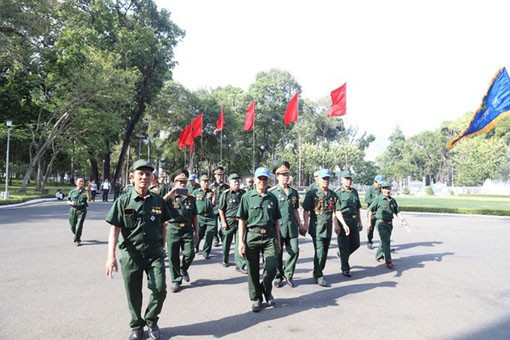 |
The "50 Years - Returning to the Beloved South" tour for veterans in 2025 is also a journey to pay tribute to the soldiers who contributed to making history. (Photo: VGP) |
Historical landmarks such as the Cu Chi Tunnels, Can Gio District, the Independence Palace, Nha Rong Wharf, and the Saigon Commando Weapons Bunker... are all stops on the journey, unforgettable fragments of heroic memories for the veterans who contributed to the historic Spring Victory. Besides these familiar historical sites, visitors can also explore new symbols of the city such as Metro Line 1 (Ben Thanh - Suoi Tien), Hiep Phuoc Industrial Park, Saigon Central Post Office, Nguyen Van Binh Book Street, Nguyen Hue pedestrian street, the City Theatre, or the City Tour double-decker bus... Places that once bore the footprints of the marching army have now shone brightly with a peaceful, modern, and vibrant appearance.
According to a representative from Saigontourist Travel Service Company, the "50 Years - Returning to the Beloved South" tour is not simply a tourism product, but also a journey to pay tribute to the soldiers who contributed to making history. Through this trip, vivid stories from historical witnesses will be conveyed to today's young generation, arousing national pride and appreciation for the value of peace.
Source: https://baophapluat.vn/den-chien-truong-xua-lang-nghe-dat-ke-post546660.html
![[Photo] National Assembly Chairman Tran Thanh Man attends the policy seminar to promote Vietnam-Türkiye cooperation.](https://vphoto.vietnam.vn/thumb/1200x675/vietnam/resource/IMAGE/2026/04/16/1776351415367_vna-potal-chu-tich-quoc-hoi-tran-thanh-man-du-toa-dam-chinh-sach-thuc-day-hop-tac-viet-nam-tho-nhi-ky-8705791-jpg.webp)
















![[Image] Bridges and roads connecting the eastern part of Ho Chi Minh City](https://vphoto.vietnam.vn/thumb/1200x675/vietnam/resource/IMAGE/2026/04/16/1776328595108_ndo_br_bh-vt5-jpg.webp)






























![[Infographic] Details of the Hanoi-Quang Ninh High-Speed Railway Project](https://vphoto.vietnam.vn/thumb/402x226/vietnam/resource/IMAGE/2026/04/16/1776338188424_anh-man-hinh-2026-04-16-luc-18-16-10.png)
![[Photo] National Assembly Chairman Tran Thanh Man meets with the Speaker of the Georgian Parliament](https://vphoto.vietnam.vn/thumb/402x226/vietnam/resource/IMAGE/2026/04/16/1776338494029_anh-man-hinh-2026-04-16-luc-18-21-21.png)





















Comment (0)