

According to the historical record of Vinh Hoa Hiep communal house, from 1861 to 1868, Nguyen Trung Truc led the uprising movement and achieved many resounding victories.
During those years, the French relentlessly hunted down Nguyen's resistance fighters, and anyone associated with them was either killed or exiled to Con Dao Island.
Despite the enemy's pursuit and massacre, in 1867, the people of Ta Nien willingly sheltered and supported the resistance fighters, contributing money and rice. After more than a year stationed in Vinh Hoa Hiep, the bond between the soldiers and the people became strong and unbreakable.
In 1868, during a decisive battle on Phu Quoc Island, Nguyen Trung Truc fell into enemy hands. They threatened and tortured him, but to no avail, so they executed him in Rach Gia as a show of force.
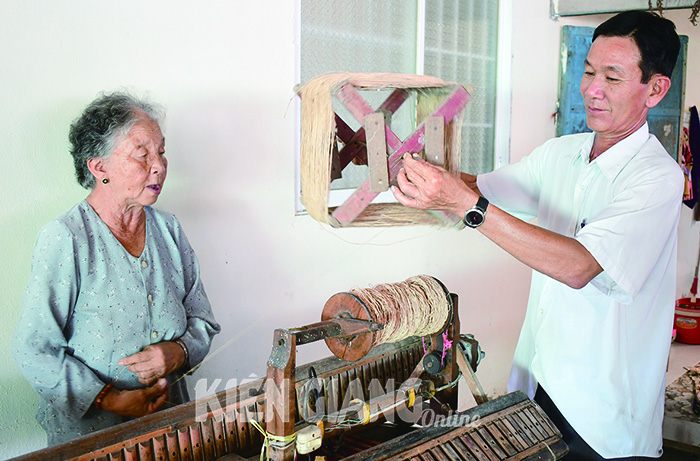
Ms. Le Thi Sa still keeps many tools used for making mats.
Upon hearing the news of Nguyen Trung Truc's execution, the people of Ta Nien and throughout the six southern provinces of Vietnam were deeply moved.
To bid farewell to their national hero, the people of Ta Nien, Rach Gia, Phu Quoc, and Hon Chong went to the Governor's residence demanding that they be allowed to hold a memorial service for Nguyen at the execution ground. Faced with the fervent enthusiasm of the people, the French were forced to concede and agree.
At that time, the people of Ta Nien carried hundreds of local cotton mats to spread on the road for the deceased to walk to the execution ground. To prepare for that tragic moment, the people of Ta Nien worked day and night weaving mats; these mats were imbued with deep affection and the sweat and tears of countless people from Ta Nien.
The story of "The Ta Nien mat, a symbol of heroism and tradition" has been recorded in history ever since. The cotton mat has become a sacred item, a source of pride for the people of Ta Nien.
Although the mat-making craft is declining, and many people no longer weave mats for a living as before, families in Ta Nien still keep cotton mats as mementos. Some families preserve their mat-weaving tools as treasures.
Cleaning the loom and weaving frame, Ms. Le Thi Sa, residing in Vinh Thanh A hamlet, Vinh Hoa Hiep commune, said: "Although mat weaving is hard work and the income is unstable, I have never intended to quit the profession because the sound of the loom has been a part of my life."
Pausing for a few seconds, Mrs. Sa continued: "Occasionally, I split reeds, stretch the straps, and weave mats by hand, partly to serve customers and partly to commemorate my grandparents, parents, and the national hero Nguyen Trung Truc. I am happy that my daughter and daughter-in-law are learning the craft and continuing the traditional occupation of our homeland."
155 years have passed, yet Ta Nien – a village located on the right bank of the Cai Be River – still holds unwavering reverence for the national hero Nguyen Trung Truc.
According to Mr. Nguyen Van Chinh, Deputy Head of the Vinh Hoa Hiep Temple Historical Relic Protection Board, historical documents indicate that after Nguyen Trung Truc was executed by the French, despite the enemy's declaration to ruthlessly execute anyone connected to the resistance, the people of Ta Nien secretly worshipped Nguyen Trung Truc at Vinh Hoa Hiep Temple, and this worship has been maintained to this day.
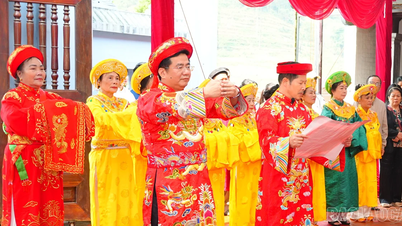
"Every year on the 27th and 28th of August in the lunar calendar, Vinh Hoa Hiep communal house organizes many activities and folk games; the people of Ta Nien contribute money and labor to cook 2,000 free vegetarian and non-vegetarian meals for visitors who come to light incense and pay respects to Mr. Nguyen to remember and express their gratitude to him," Mr. Nguyen Van Chinh added.
Text and photos: BAO TRAN
Source












































































Comment (0)