

To Huu "entered life" through books and newspapers.
Through To Huu's memoir, "Recalling a Time ," readers learn that the revolutionary poet, when in first grade under the name Nguyen Kim Thanh, was quite proficient in French and was exposed to French literature through works like Hector Malot's "Homeless" and short stories by Alphonse Daudet. Young Thanh spent a lot of time in the school library to build a basic foundation of knowledge. "Anyway, knowing French gave me the ability to read original French works or foreign books from the West that had been translated into French. The school had a library, so I got to read many good books, except for communist books," To Huu wrote.
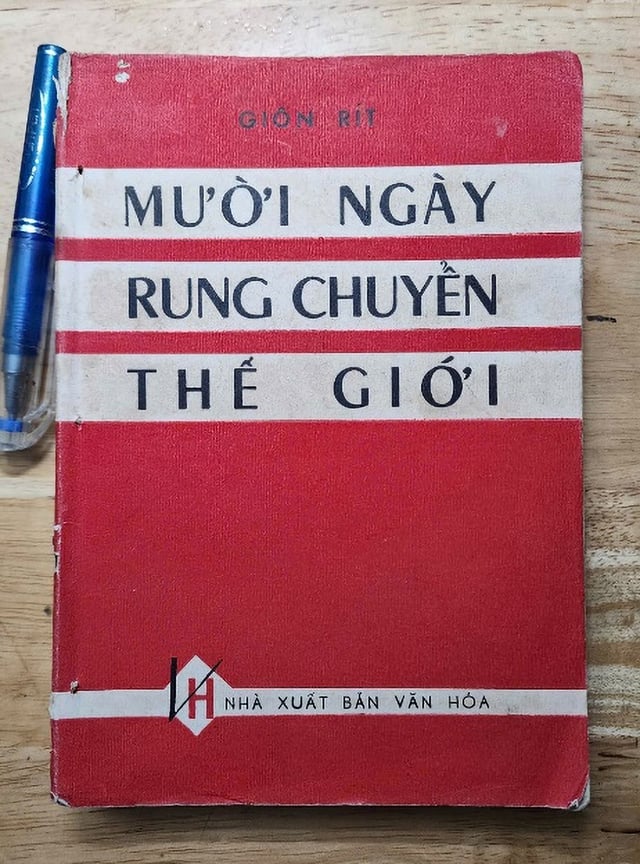
John Reed's book, "Ten Days That Shook the World" (1960 edition), is one of the works To Huu read as a student.
From the books he encountered in school, To Huu later entered life through many other theoretical and ideological works at Hai Trieu's Huong Giang bookstore and Le Duan's Thuan Hoa bookstore. His memoir, " Recalling a Time," reveals that thanks to Hai Trieu's introduction, Kim Thanh read works of Soviet literature such as "The Mother" (M. Gorki), "How the Steel Was Tempered" (Ostrovski), and "Ten Days That Shook the World" (John Reed, the current Vietnamese version is titled "Ten Days That Shook the World "). Meanwhile, works like " The Communist Manifesto" and "Capital " were introduced by Le Duan, the owner of the Thuan Hoa bookstore. Reading books and interacting with revolutionaries like Le Duan, Hai Trieu, Phan Dang Luu, and Nguyen Chi Dieu, " gradually I became enlightened about communism ," To Huu shared about his path to revolution.
Composer Do Nhuan, author of the song "Vietnam, My Homeland," practiced a rare skill from a young age: bookbinding. And what about reading? Do Nhuan "often read the poetry of Xuan Dieu and The Lu. I really enjoyed reading The Lu's thrilling novels such as 'Gold and Blood,' 'On the Thousand-Mile Road,' 'Le Phong the Reporter,' and even detective stories commissioned by Ly Ngoc Hung Publishing House from writers," according to his memoir , "Sounds of Life ."
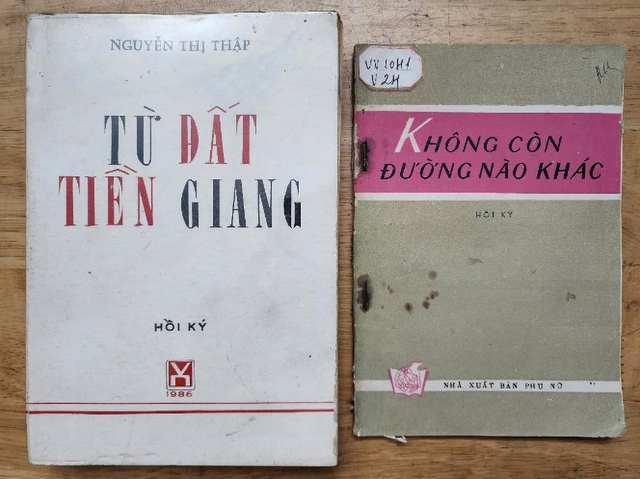
Memoirs from Tien Giang (published in 1986) by Nguyen Thi Thap and No Other Way (published in 1969) by Nguyen Thi Dinh
PHOTO: TRAN DINH BA
In Con Dao, reading and reviewing "The Soul of the Butterfly Dreaming of Immortality"
For those who consider books their confidants, they long for companionship in any circumstance, even in prison, a desire to acquire knowledge no different from that of a hungry person needing food. Therefore, in *Letters from Con Lon* (published by Nguyen Duc Kinh, 1937), the revolutionary Nguyen Duc Chinh, in many letters to his younger brother and friends, earnestly requested that, in addition to money and letters, books and newspapers be sent along. For example, in a letter dated April 13, 1935, he asked Nguyen Cong Hoan to send him newly published novels; in a letter dated December 28, 1935, he requested that his brother send him water, onions, and not forget books and newspapers. In particular, the letter dated March 1, 1936, expressed the fervent desire: "Out here, we need books and newspapers more than sausages or cinnamon rolls. I'm going to collect the boxes, and the brothers at home are just waiting to bring them back… what?… Idealist or materialist books , or newspapers like Tiến Bộ (Progress) or Kiến Văn (Knowledge )… Tell Anh Liệu [Trần Huy Liệu] to send them out for us to read."
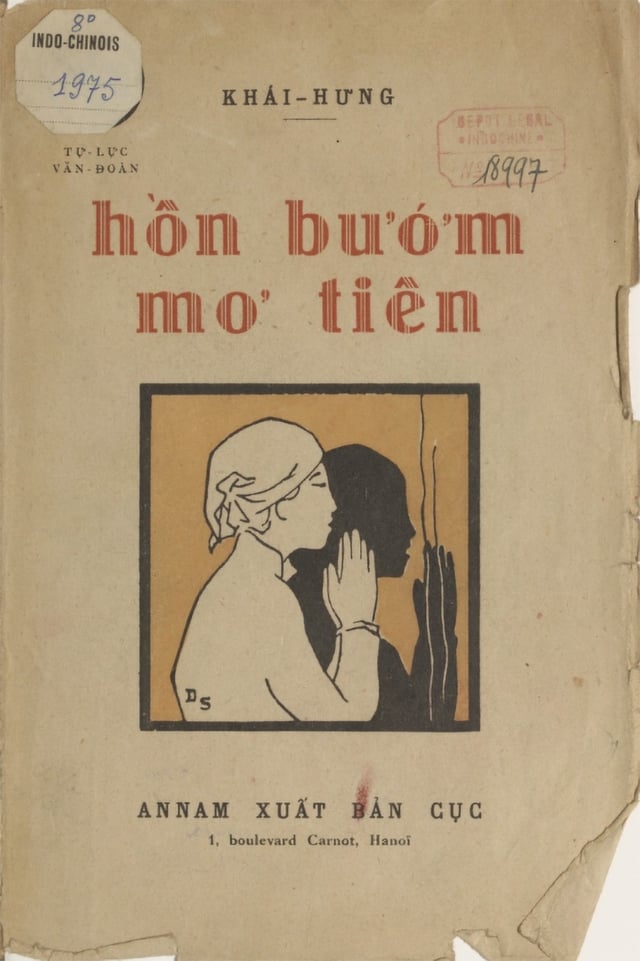
The novel "The Soul of the Butterfly Dreaming of Immortality " (1933 edition) was criticized by Nguyen Duc Chinh.
PHOTO: NATIONAL LIBRARY OF FRANCE
But it wasn't just reading; as a man with strong reasoning and a high level of critical thinking, Nguyen Duc Chinh also engaged in literary criticism. Khai Hung's *The Butterfly's Dream* was criticized for being overly dreamy; the short story *Fragrance That Causes Memories* was deemed to still be the work of a bourgeois writer (letter to Nguyen Duc Kinh and Tran Huy Lieu dated May 27, 1935). Meanwhile, Nhat Linh's * Breakup* was praised as "Quite good! In one aspect, artistically," but uncertain from a social perspective, offering a half-hearted solution of resistance and liberation for the character of Miss Loan (letter dated August 28, 1936).
There were female revolutionaries who also maintained a sincere love for books from a young age. General Nguyen Thi Dinh revealed in her memoir, "There's No Other Way," that as a child she heard and read the story of Luc Van Tien , so from a young age she hated evil people and loved the beautiful images of Luc Van Tien and Kieu Nguyet Nga. Revolutionary Nguyen Thi Thap had a passionate love for books: "I was very passionate about reading. Every time I carried bananas or betel nuts to the market to sell, I didn't dare eat any snacks, saving the money to buy books to read. Small, thin books like Vo Dong So, Bach Thu Ha, Because the Flower Falls, The Drop of Blood of Shared Love … I read them over and over again and never got tired," her memoir, " From Tien Giang Land ," records.
According to the memoir "From Tien Giang Land ," besides the aforementioned literary books, later books about the lives and patriotic writings of Phan Chau Trinh and Phan Boi Chau sparked the young woman's awareness of issues of gender equality, outdated customs and traditions... Furthermore, she "sought out and read secret revolutionary books and newspapers," and later, with the guidance of senior revolutionary comrades, the young woman Nguyen Thi Thap embarked on the path of revolutionary activity to save the country. ( to be continued )
Source: https://thanhnien.vn/det-nhung-soi-vang-can-sach-bao-hon-lap-suong-banh-que-185250423215339019.htm


![[Photo] Prime Minister Pham Minh Chinh presides over a meeting on private sector economic development.](/_next/image?url=https%3A%2F%2Fvphoto.vietnam.vn%2Fthumb%2F1200x675%2Fvietnam%2Fresource%2FIMAGE%2F2025%2F12%2F20%2F1766237501876_thiet-ke-chua-co-ten-40-png.webp&w=3840&q=75)

![[Photo] Prime Minister Pham Minh Chinh presides over the conference announcing the establishment of the International Finance Centre in Vietnam.](/_next/image?url=https%3A%2F%2Fvphoto.vietnam.vn%2Fthumb%2F1200x675%2Fvietnam%2Fresource%2FIMAGE%2F2025%2F12%2F21%2F1766309817714_ndo_br_dsc-3400-jpg.webp&w=3840&q=75)


















































Comment (0)