

 |
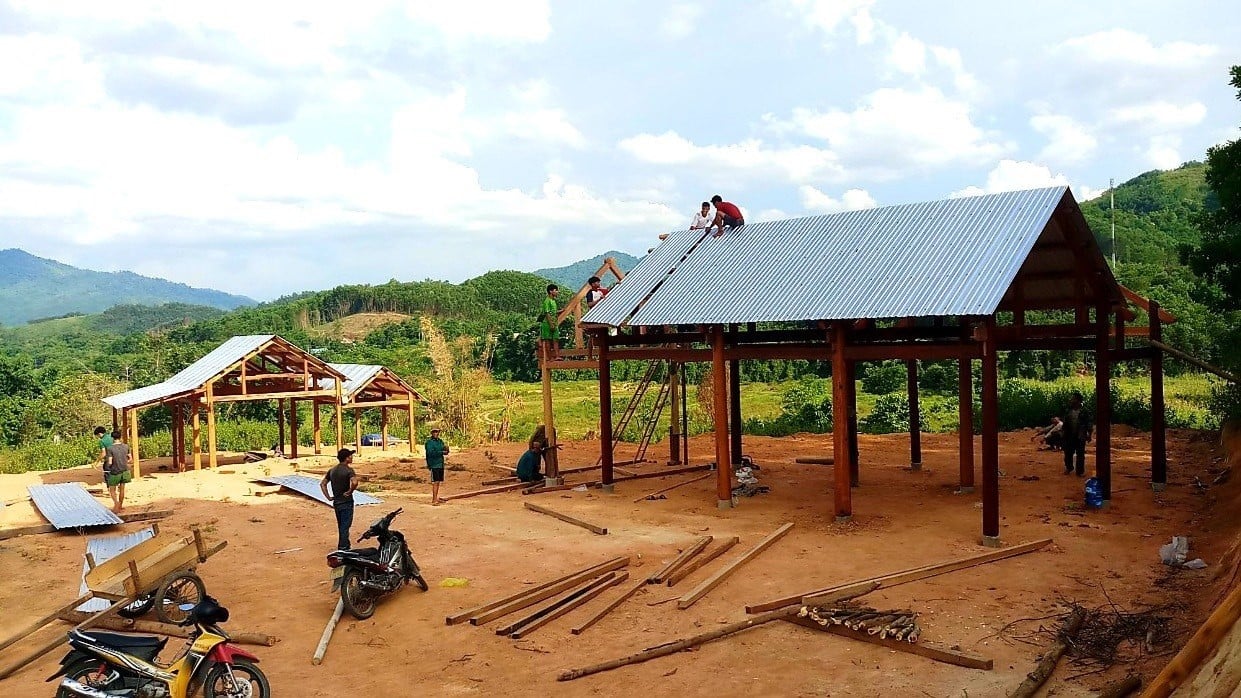
| Quang Nam province is making efforts to relocate and resettle residents in mountainous areas across its nine mountainous districts. (Source: Quang Nam Newspaper) |
Mobilizing state resources and the people's strength.
Quang Nam province has a large mountainous area, with a significant difference in slope between the mountains and the plains. Coupled with the negative impacts of climate change, landslides are a frequent occurrence in mountainous regions. The Quang Nam Provincial People's Council's resolution on the resettlement and stabilization of mountainous residents in the province's nine mountainous districts, implemented over the past nearly 10 years, is considered a sound policy of the Party and State. Between 2017 and 2021, Quang Nam resettled and stabilized over 3,200 households. Based on practical assessments, these resettled households were not affected by major floods in the area. Building on this success, Quang Nam continues to resettle over 7,000 households in this term, along with developing livelihoods for the people.
As a mountainous area with a sparse population density, posing difficulties for poverty reduction efforts, Nam Tra My district has resolutely planned and reorganized 242 residential areas into 115 to create a breakthrough in people's livelihoods. From 2017 to the present, the entire district has reorganized 62 areas with 2,857 households of the Ca Dong, Xe Dang, and Mo Nong ethnic groups, with a total support budget of up to 166 billion VND.
Previously, the ethnic minority communities in the mountainous district of Nam Tra My lived a nomadic lifestyle, making it challenging to stabilize their lives. Subjective factors such as inadequate living conditions, the risk of landslides, and disease outbreaks led to the relocation of many villages. Population growth resulted in the frequent splitting of old villages and the establishment of new ones, hindering investment in infrastructure serving the community. In 2017, Nam Tra My district had 43 villages (currently reduced to 35), but there were 242 scattered residential areas on remote, isolated mountain slopes. This significantly impacted the lives and livelihoods of the people, hindering their children's education and contributing to the high poverty rate.
Faced with this situation, Nam Tra My district decided to develop a plan for relocating and resettling residents using a joint government-people model. In 2017, Nam Tra My district implemented the resettlement plan in 15 areas involving 475 households in 10 communes. The total budget for this phase was over 71 billion VND. Of this, the government invested approximately 49.2 billion VND in infrastructure projects such as roads, centralized water supply, schools, cultural centers, irrigation works, land leveling, house construction, sanitation facilities, electricity supply, and livestock barns; the remaining 21.8 billion VND was mobilized from the people through contributions of labor.
The newly planned residential area has sufficient living space, livestock farming, and production facilities for each household, and is convenient for the implementation of public infrastructure projects such as electricity, roads, schools, and health stations. Nam Tra My district has mobilized the entire political system, from the district level to the grassroots, to explain and disseminate the policy to each household, resulting in positive developments. People have boldly registered to participate in the project, and some households have enthusiastically donated land to form densely populated residential areas.
As for Tay Giang mountainous district, after 18 years of implementing the Project, the district has arranged and allocated 123 resettlement sites with a total area of 374 hectares, resettling over 5,530 households of ethnic minorities in stable conditions, linked with production development to achieve sustainable poverty reduction.
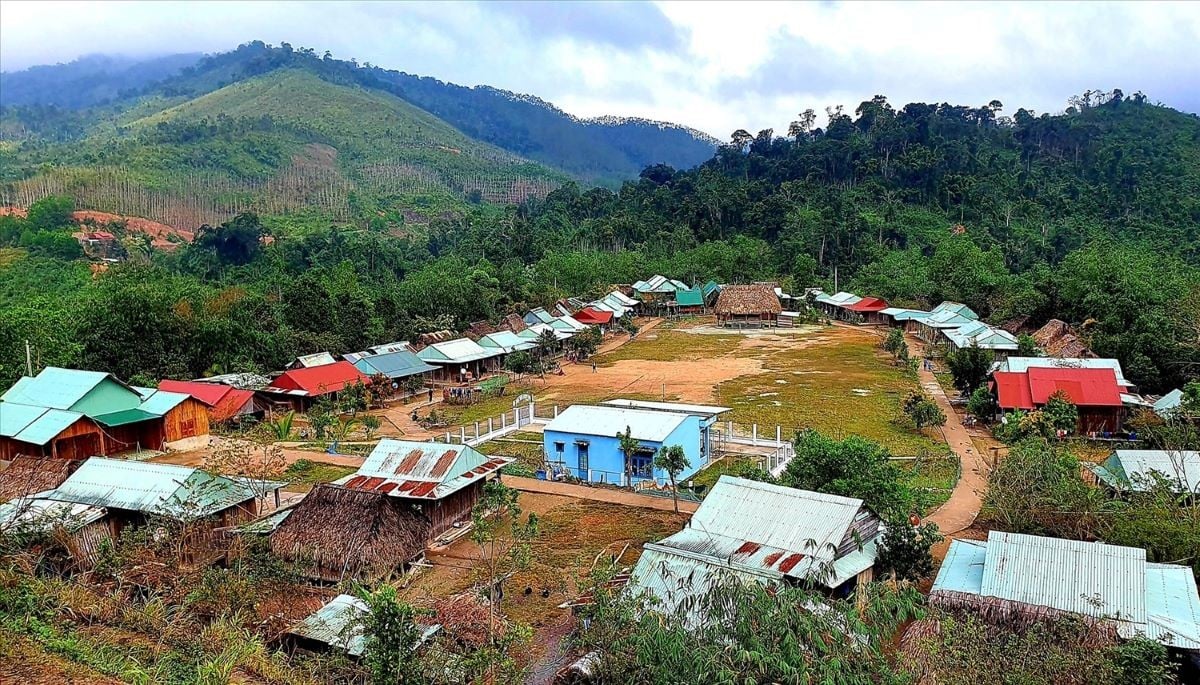 |
| As a result of Quang Nam province's resettlement policy, the appearance of villages and hamlets has gradually changed, becoming more modern and prosperous. People now have better lives in their new homes and the conditions to stabilize their livelihoods. (Source: Dan Toc Newspaper) |
A new life thanks to resettlement.
Pơr'ning village in Lăng commune is the first and most densely populated residential area in Tây Giang district. It is home to 170 Cơ Tu households with approximately 600 people. On a flat piece of land, a community center (large and small Gươl) is built in the center, shared by the residents and belonging to individual clans. Surrounding the center are individual households, and children play in spacious areas. During holidays, festivals, and monthly gatherings, the villagers come together in the Gươl for communal activities.
Mr. Bling Lam, 75 years old, can never forget the image of Bor'ning village in its early days, nearly 20 years ago. “Back then, this land wasn't flat like it is now. It was a hill over 50 meters high with a few houses. The government leveled it to create a large area for people to build houses. Bor'ning village used to consist of three scattered hamlets, but now they are concentrated in one place. Currently, the entire Lang commune has seven concentrated residential areas. Living like this makes it very convenient for children to go to school. People working in the fields may have to travel further than before, but we have managed to overcome that.”
Mr. Bhling Mia, Secretary of the Tay Giang District Party Committee, stated that the planning and resettlement work can be considered a new revolution for the government and people of Tay Giang district. Simultaneously, once the population is organized and concentrated, the district will be able to renovate and maximize the potential and available land for housing and production, converting previously residential land to cultivate medicinal plants and fruit trees, and diversifying production methods for the people.
Previously, people lived scattered along rivers and streams, in low-lying areas at risk of landslides, flash floods, and mudslides. Now, they have been relocated to resettlement areas in a well-planned manner. In fact, despite damage to infrastructure during storms like those in previous years and the harsh effects of climate change, Tay Giang has not suffered any casualties or injuries.
According to Mr. Trinh Minh Hai, Head of the Agriculture and Rural Development Department of Nam Tra My district, "the implementation of population resettlement has created favorable conditions for investing in synchronized, efficient, and appropriate infrastructure in accordance with local conditions; gradually improving the infrastructure network, accelerating the rapid and sustainable poverty reduction, and improving the material and spiritual lives of the people, especially ethnic minorities."
Emphasizing the effectiveness of the policy to resettle people in mountainous areas, Mr. Ho Quang Buu, Vice Chairman of the Quang Nam Provincial People's Committee, said: "Building on the success of the 2021-2025 period, Quang Nam continues to implement the resettlement and stabilization for more than 7,820 households, with a total estimated cost of approximately 968 billion VND. Alongside the resettlement aimed at disaster prevention and control, it will be linked to developing livelihoods for people in high mountainous areas."
The results of the resettlement policy have gradually changed the appearance of villages and hamlets towards a more modern and prosperous direction, providing people with better lives in their new homes and conditions for stable livelihoods. Many planned resettlement areas are in line with the planning for new rural communes and the socio-economic development orientation of the locality, contributing to sustainable poverty reduction and rural development, as well as disaster prevention and control, and improving the quality of life for people in mountainous districts, especially ethnic minorities.
| On October 25th, the People's Committee of Quang Nam province issued Decision 2289/QD-UBND to implement Resolution No. 13/2023/NQ-HĐND dated September 22nd, 2023, of the Provincial People's Council, stipulating the level of support for the elimination of temporary and dilapidated houses in the province during the 2023-2025 period. From now until 2025, the entire province is expected to allocate more than 407 billion VND from the provincial budget, social security fund, and social contributions to support the elimination of 15,735 temporary and dilapidated houses, including the construction of 8,675 new houses and the repair of 7,060 houses. Specifically in the six poor districts of Phuoc Son, Tay Giang, Nam Giang, Dong Giang, Nam Tra My, and Bac Tra My, 8,179 households will receive support for the elimination of temporary and dilapidated houses, including 7,606 poor households and 573 near-poor households. In addition to the funding from the National Target Program, this group will receive an extra 14 million VND per newly built house and 7 million VND per house renovation. |
Source
![[Photo] Standing Committee member of the Party Central Committee Tran Cam Tu presents the Decision appointing the Secretary of the Party Committee of the Ho Chi Minh National Academy of Politics.](/_next/image?url=https%3A%2F%2Fvphoto.vietnam.vn%2Fthumb%2F1200x675%2Fvietnam%2Fresource%2FIMAGE%2F2026%2F02%2F02%2F1770039902160_le-cong-bo-bt-hvctqg-11-7880-jpg.webp&w=3840&q=75)


![OCOP during Tet season: [Part 3] Ultra-thin rice paper takes off.](/_next/image?url=https%3A%2F%2Fvphoto.vietnam.vn%2Fthumb%2F402x226%2Fvietnam%2Fresource%2FIMAGE%2F2026%2F01%2F28%2F1769562783429_004-194121_651-081010.jpeg&w=3840&q=75)





Comment (0)