

Baoquocte.vn. Bac Tu Liem District has great potential, advantages, and momentum to become a green economic development hub linked to tourism, cultural industry development, and the construction of a creative city.
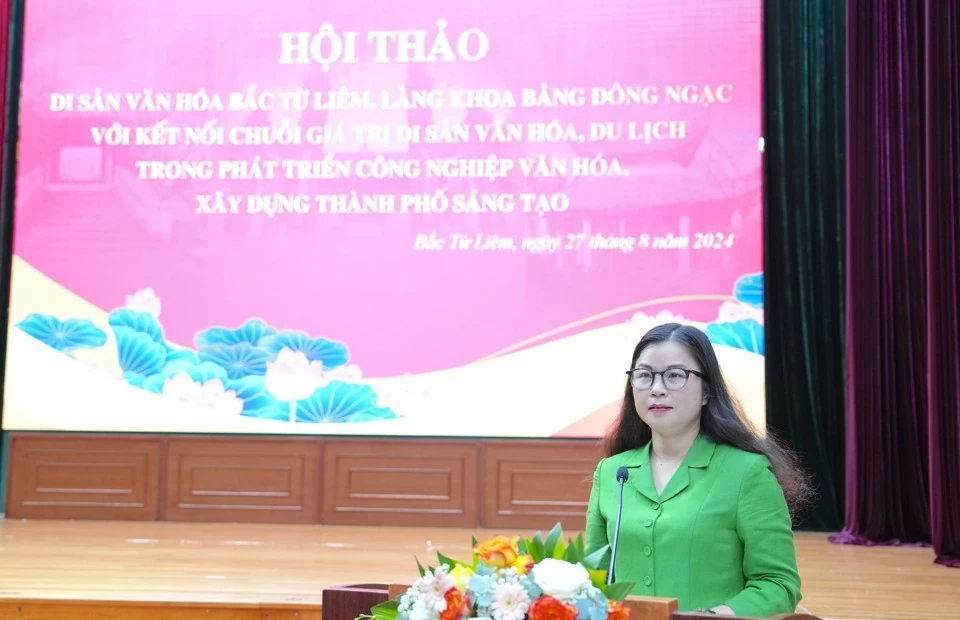 |
| Ms. Le Thi Thu Huong, Vice Chairman of the People's Committee of Bac Tu Liem District, speaks at the workshop. (Source: KTĐT) |
On the afternoon of August 27th, the People's Committee of Bac Tu Liem District and the Bac Tu Liem Gazetteer Collection and Compilation Board organized a scientific seminar with the theme: "Cultural Heritage of Bac Tu Liem, Dong Ngac Scholar Village and the Connection of Cultural Heritage and Tourism Value Chains in the Development of the Cultural Industry and the Construction of a Creative City".
This is a practical activity to celebrate the 79th anniversary of National Day on September 2nd (September 2nd, 1945 - September 2nd, 2024) and to commemorate the 70th anniversary of the Liberation of Hanoi (October 10th, 1954 - October 10th, 2024).
Preserving and promoting cultural heritage in conjunction with sustainable tourism development and building a cultural industry, as outlined in Resolution No. 09-NQ/TU of the Hanoi City Party Committee on "Developing the Cultural Industry in the Capital City in the period 2021-2025, with orientation to 2030 and vision to 2045," is the direction of local authorities in Bac Tu Liem district. Following the general trend of sustainable development and the context of urbanization, preserving and promoting the value of traditional cultural heritage within the urban environment is extremely important.
In her opening remarks, Vice Chairman of the Bac Tu Liem District People's Committee Le Thi Thu Huong stated that the district currently has 135 historical and cultural relics, of which 63 are classified by the State as historical and cultural relics (including 1 special national relic, 48 national relics, and 14 city-level relics). In addition, the district has 35 intangible cultural heritage items, including 3 festivals that have been included in the National Intangible Cultural Heritage list, 29 traditional festivals, 26 revolutionary and resistance relics, and many traditional craft villages, especially the Scholar Village - Dong Ngac ancient village.
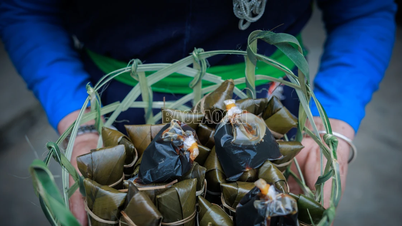
Famous historical sites such as Nhat Tao Temple, Thuong Cat Temple, Hoang Temple, Chem Pagoda, Ve Pagoda, temples dedicated to prominent figures like Do The Giai Temple and Pham family temple, and famous festivals like the Dam swimming festival in Tay Tuu flower village... are all located in Bac Tu Liem district. The district also preserves many traditional craft villages such as the sausage-making village of Thuong Cat commune, the Tet jam-making village of Xuan Dinh, along with rich customs, traditions, and folk knowledge. This is an invaluable cultural resource that can become a driving force and create breakthroughs for the development of tourism.
It can be said that Bac Tu Liem district has great potential, advantages, and momentum to become a green economic development hub linked to tourism, cultural industry development, and the construction of a creative city. Therefore, researching, preserving, and effectively promoting cultural heritage values in conjunction with sustainable tourism development will make a worthy contribution to the overall development of Bac Tu Liem in the coming time.
However, currently, the exploitation of cultural tourism resources in general and cultural heritage values in particular for tourism development in the district still faces many difficulties and limitations, including organizational mechanisms for implementation, product development and customer markets, the participation of the community and local businesses in tourism activities, as well as activities related to the preservation, restoration, and exploitation of cultural heritage for tourism development.
To promote cultural tourism in Bac Tu Liem district, Dr. Le Thi Thu Huong, Head of the Department of Culture and Tourism, Hanoi Metropolitan University, suggested identifying core values to form the district's historical and cultural space, while also making good use of the Red River flowing through the district, connecting with neighboring localities to create unique river tourism tours.
“In the area, Bac Tu Liem district needs to prioritize the cultural space of the residents along the Red River, where many core values from the Van Lang - Au Lac civilization period are rooted, reflecting the cultural characteristics of the Red River Delta region and the area surrounding the ancient Thang Long capital. Therefore, the Dong Ngac area (a scholarly village of ancient Thang Long) along with Chem Temple (a special national monument) should be chosen to build a historical and cultural space that symbolizes the culture of Bac Tu Liem.”
"Within that historical and cultural space, there is sufficient cultural capital for designers and creative communities to apply technology, scientific achievements, and business skills to create cultural tourism products that meet the consumption and cultural enjoyment needs of locals and tourists. This is truly a good space to develop cultural industries," emphasized Dr. Le Thi Thu Huong.
Scientists suggest that Bac Tu Liem district should continue to prioritize cultural resources, starting from the local communities in areas with cultural heritage. Simultaneously, it should develop experiential tourism programs suitable for various target groups, paying particular attention to young people by utilizing the riverside areas and the surface of the Red River as creative spaces.
Discussing the preservation and promotion of the values of Khoa Bang Dong Ngac village, Mr. Nguyen Van Cuong, Chairman of the People's Committee of Dong Ngac ward, said that with its long history, Dong Ngac ward has preserved a system of ancient cultural architectural works dating from 100 to 300 years old, along with many valuable relics and artifacts such as statues, royal decrees, horizontal plaques, genealogical records, couplets, bronze bells, ancient books, etc.
The ancient Dong Ngac communal house still retains its architectural landscape and valuable artifacts quite intact. The ancient Tu Khanh pagoda preserves a 750kg bell dating back to the reign of King Gia Long (1817) and two smaller bells cast during the Nguyen dynasty. Currently, the pagoda also houses 50 round statues displayed in the main buildings. The ancient village of Dong Ngac is famous for its tradition of scholarship; the village has 22 doctoral graduates whose names are inscribed on a stone stele at the village communal house.
Dong Ngac is included in the general planning, as an expanded inner-city area. Therefore, identifying heritage sites with conservation and restoration value to develop them into tourist destinations will contribute to preserving and promoting traditions while also enhancing socio-economic efficiency.
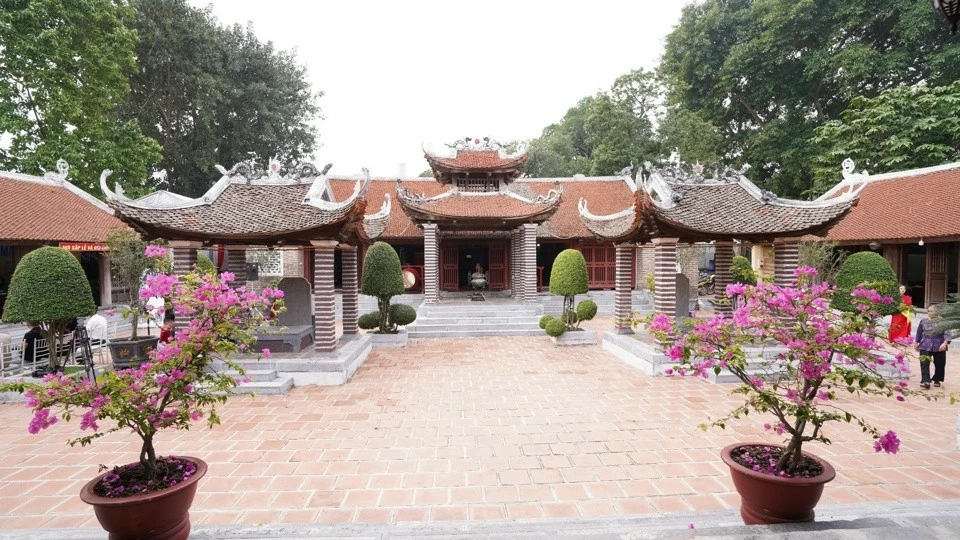 |
| Chem communal house, a special national historical site. (Source: KTĐT) |
The context of urbanization and urban development, along with the implementation of strategies for developing cultural industries and creative cities, is creating a demand for the preservation and promotion of traditional cultural heritage values. This helps communities maintain and develop cultural resources, exploit human resources for tourism development, and ensure sustainable socio-economic development while minimizing negative impacts on heritage values.
Associate Professor Pham Lan Oanh from the Vietnam National Institute of Culture and Arts believes that cultural heritage in the district, especially relics and festivals associated with the Hung Kings era and the Trung Sisters era, is not only an important part of the national heritage but also a valuable resource for developing tourism. Bac Tu Liem is undergoing rapid urbanization and population growth. This poses a challenge to the protection and promotion of cultural heritage values. Developing and implementing comprehensive conservation plans, along with mobilizing resources and raising community awareness, is absolutely essential.
At the workshop, delegates shared experiences, successful models, as well as recommendations, proposals, and trends for leveraging and connecting value chains in the development of tourism, cultural industries, and creative cities.
Source: https://baoquocte.vn/di-san-van-hoa-bac-tu-liem-loi-the-phat-trien-kinh-te-xanh-gan-voi-xay-dung-thanh-pho-sang-tao-284107.html
![[Photo] General Secretary and President To Lam presides over a meeting with the Central Organizing Committee.](https://vphoto.vietnam.vn/thumb/1200x675/vietnam/resource/IMAGE/2026/06/03/1780482764658_a1-bnd-4741-3342-jpg.webp)
![[Photo] Secretary of the National Assembly Party Committee, Chairman of the National Assembly presides over the meeting of the Standing Committee and Executive Committee of the National Assembly Party Committee.](https://vphoto.vietnam.vn/thumb/1200x675/vietnam/resource/IMAGE/2026/06/03/1780480353201_ndo_br_bnd-2585-jpg.webp)
![[Photo] First session of the 14th Congress of the Vietnam Trade Union](https://vphoto.vietnam.vn/thumb/1200x675/vietnam/resource/IMAGE/2026/06/03/1780465947883_ndo_br_img-3852-jpg.webp)


































![[Video] Sunset at Lap An Lagoon – Where the sun sets over the fishing nets](https://vphoto.vietnam.vn/thumb/1200x675/vietnam/resource/IMAGE/2026/05/31/1780192137701_beach-landscape-sea-water-nature-grass-745871-pxhere-com.jpeg)





























Comment (0)