Behind the crowd are the things you have to hear.
On October 18, 2024, more than 50 people gathered on the Tuyen Quang - Phu Tho highway. Traffic was blocked. Phones were turned on to livestream the event on social media.
Behind that crowd were complaints related to land reclamation for road expansion, school construction, sports fields, and cultural centers in the former Doi Binh commune, Yen Son district, now part of Nhu Khe commune. The implementation process was sometimes lax, with insufficient consultation, communication, and dialogue, leading to accumulated resentment. Some individuals took advantage of the situation, inciting households to sign collective petitions and engaging in excessive behavior.
That's when a civil matter risks escalating into a complex security and public order situation.
Dealing with a crowd isn't as difficult as dealing with what lies behind it. Haste can lead to people feeling unheard. A single delay can allow the situation to escalate, spread online, and become a pretext for malicious individuals to distort the truth and incite unrest.
The Department of Internal Security coordinated with the police at all levels to review each case, assess the role of each individual; and at the same time advised the Party committee and the government to organize dialogues, explain policies, and resolve any arising difficulties. Five cases of violations were handled according to regulations. Those who were misled were distinguished from the ringleaders and instigators.
The incident is over. The road is open again.
But for those working in domestic security, the job doesn't stop there. They must return to the area, listen to the people, identify unresolved grievances, and uncover conflicts that could be exploited again.
This goes to show that domestic security is not just about combating an act that has already occurred. More importantly, it's about recognizing what might happen next.

The Internal Security Department of the Tuyen Quang Provincial Police was established on December 3, 2010, initially named the Social Security Department. After several restructurings, the unit now handles the areas of ethnic security, religious security, and social security; combating reactionary forces and terrorism; and preventing activities that exploit ethnic and religious issues or grievances to complicate security and order.
The area under their responsibility spans from the midland region to the high mountainous and border communes. The population is unevenly distributed, with many ethnic groups living together; the level of education and access to information varies significantly between areas. In some places, officials have to travel all day to meet a family. Yet, a piece of distorted information from outside can reach a village phone in just seconds.
That's where the difficulty lies.
In an interview with a reporter from the People's Police Newspaper, Colonel Ha Trung Truc, Head of the Internal Security Department of the Tuyen Quang Provincial Police, once said: "We don't impose our will, but we work alongside. Sometimes, a piece of advice from a village elder is more effective than a hundred leaflets."
Behind that seemingly simple statement lies a whole working method. Some people need to meet with others multiple times. In some cases, it requires mobilizing the entire family and extended family. Some issues cannot be resolved solely by police officers and require the voice of village elders, community leaders, respected individuals, or religious figures.
You have to find the right people. And be persistent.
One of the unit's most protracted and complex tasks is combating the influence of the "Duong Van Minh illegal organization." This organization exploits beliefs and religion to attract a segment of the Hmong people, build a core network, establish "funeral homes," organize illegal activities, and harbor intentions of gathering forces, seceding, and achieving autonomy.



One solution cannot be applied to all cases.
The Department of Internal Security has advised on the classification of each group and individual. The ringleaders and key figures involved in violations are being strictly investigated and punished. Those who were misled due to a lack of information are being educated, explained the situation, and given the opportunity to return to normal life. Simultaneously, efforts are being made to strengthen the political system at the grassroots level, address shortcomings in the implementation of ethnic and religious policies, and resolve the legitimate needs of the people.
Officials went down to each village, meeting with each household. Reputable individuals were invited to participate. Some who were once key figures, after being influenced, became intermediaries in mobilizing others.
The results didn't come in a day. But they came.
All 31 villages in 10 communes across 5 districts that were previously affected have been transformed; 703 households with 4,083 people have pledged to abandon the organization. Forces have successfully dismantled 206 white banners and 80 illegally erected or rebuilt "funeral houses." Eleven former key figures have been rehabilitated and become positive contributors at the grassroots level. The task was completed in 2022, one year ahead of schedule.
Peace is built from the hearts of the people.
In domestic security work, some results are measured by what doesn't happen: preventing a group from developing into an opposition organization; preventing complaints from becoming flashpoints; and preventing naive individuals from being further pushed into violating the law.
To get those "no"s, the official often has to travel a little further, sit for an extra session, and explain things one more time.
In the field of beliefs and religions, the Internal Security Department both combats and prevents illegal activities while ensuring the legitimate right of people to practice their religion. The handling of these issues aims not only to eliminate a phenomenon but also to help former believers stabilize their beliefs and return to normal life within the community.
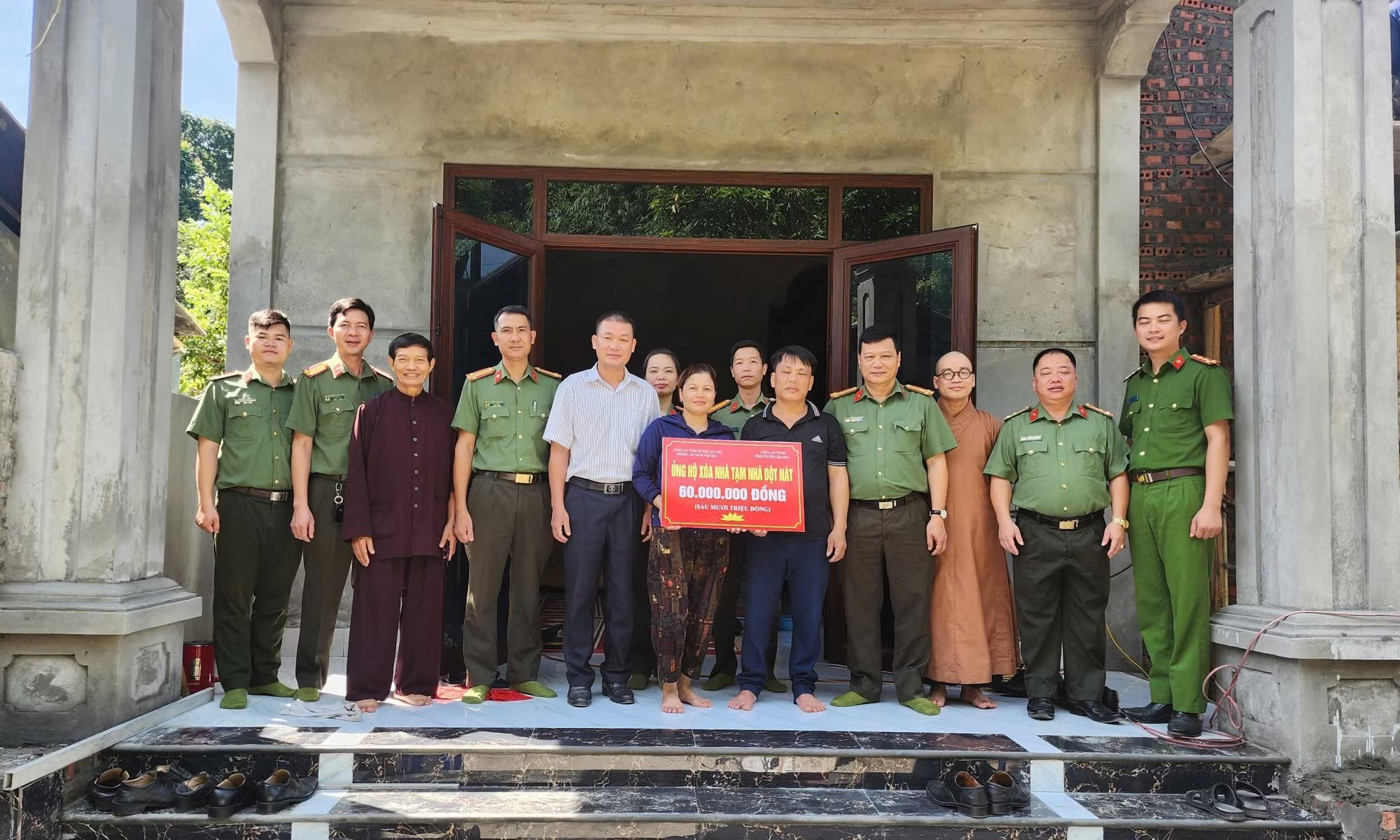
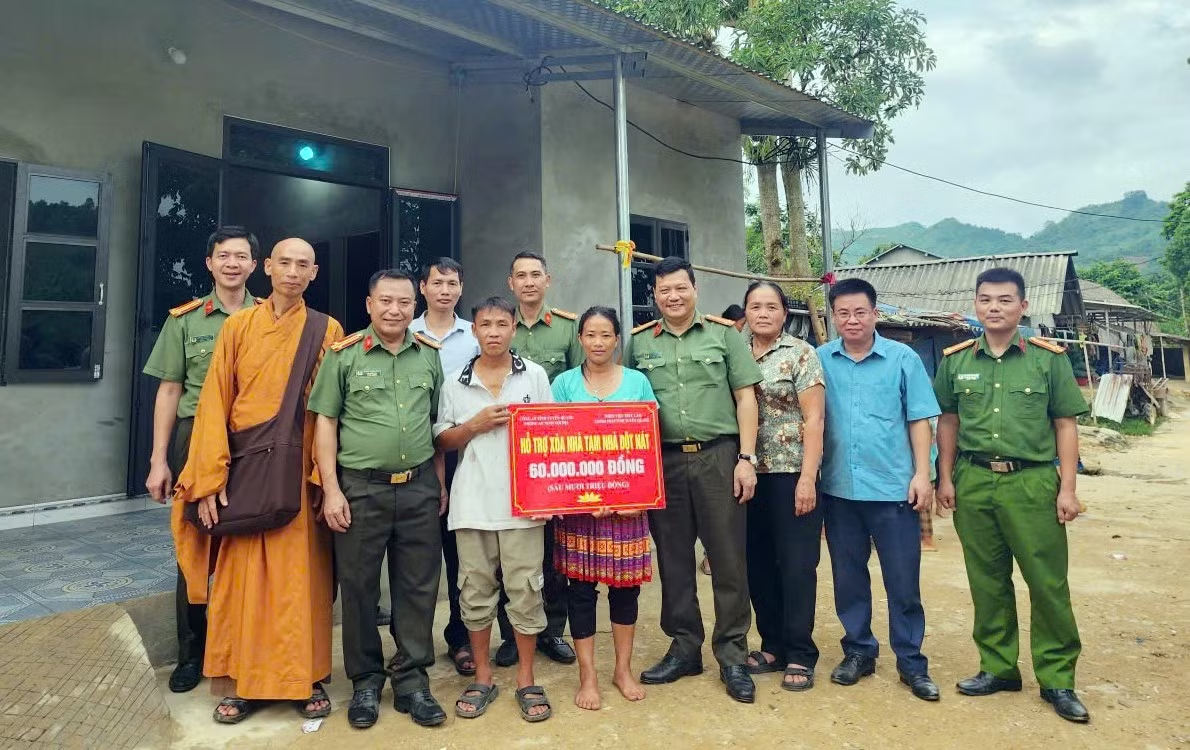
Through propaganda, mobilization, and struggle, all 12 new and complex religious and belief phenomena in the area have been resolved. The "San Su Khe To" cult was eradicated after 27 years of existence; 1,015 households with 5,985 people voluntarily pledged to abandon it, and 61 individuals returned to traditional beliefs. Regarding the "Grace of Salvation" organization, 356 people were persuaded to return to participating in the Protestant organization with legal status.
Colonel Ha Trung Truc stated that the important result lies not only in the number of cases where individuals have committed to abandoning their religion, but also in people recognizing the true nature of activities that exploit religion and voluntarily returning to normal life. For those who have previously violated the law and served their sentences, the unit continues to coordinate with them, providing education and support to help them stabilize their lives and avoid recidivism. This is not just a requirement of management work; it's also an act of compassion.
This approach has also been applied in resolving complaints and ensuring security at socio-economic projects. Regarding the Tuyen Quang - Ha Giang expressway, the unit coordinated the handling of 17 complex cases; and persuaded 32 households to hand over their land. Of these, 11 households had been ordered to forcibly reclaim their land, but ultimately, no enforcement action was necessary.
Not resorting to coercion does not mean loosening the law. It is the result of numerous meetings, thorough analysis of right and wrong, and reaching consensus before the final measure has to be implemented.
While officials still had to stay close to each village and hamlet, another front opened up in cyberspace. The unit reviewed 553 groups and associations with reactionary and subversive content; discovering 4,077 accounts with information and addresses related to Tuyen Quang. Of these, 1,307 cases with potential for tracing the source were verified, and 709 cases were questioned, investigated, and required to remove the infringing content. Three individuals were prosecuted for the act of propagating, possessing, or disseminating information and documents aimed at opposing the State.
Technology has changed the methods of sabotage, but it hasn't changed the fundamental principle of security work: understanding the local area and understanding the people. An online account, ultimately, is still a real-life person with a family, social relationships, and varying levels of awareness and understanding. Those who actively engage in sabotage must be distinguished from those who, due to a lack of understanding, share false information.



The struggle must be right. The campaign must also be effective.
After more than 15 years of development and combat, the Internal Security Department of the Tuyen Quang Provincial Police was awarded the Third-Class Labor Medal by the President of Vietnam in 2020 and the Second-Class Military Merit Medal in 2025. The unit has received the Government's Emulation Flag three times; the Ministry of Public Security and the General Political Department of the People's Police seven times; and dozens of Certificates of Merit from the Government, the Ministry of Public Security, and the Provincial People's Committee.
Those awards acknowledge a journey. But the work of a Homeland Security officer is not just about paperwork.
It's still out there, in a remote village where someone just received misinformation on the phone; beside a construction site facing land acquisition issues; or in a house where someone who once went astray is now trying to rebuild their life.
There, the official had to set off again.
Take one more step. Listen to one more story. Have one more conversation.
Peace, often, is preserved through things like these.
Source: https://cand.vn/di-them-mot-buoc-de-giu-binh-yen-post814939.html