A team of scientists at the Vietnam Museum of Nature has found and identified two rare ginseng species in the wild in Tuyen Quang and Ha Giang provinces.
Since 2021, the research team of Associate Professor Phan Ke Long, Vietnam National Museum of Nature, has been tasked with investigating the current status of medicinal plant species belonging to the genus Panax L. in Tuyen Quang and Ha Giang provinces. Over two years, he and his colleagues visited these two provinces to explore this valuable ginseng with two main objectives: to investigate and assess its current status and to propose conservation plans for Panax L. species.
Associate Professor Long stated that the Panax genus belongs to the Araliaceae family, both of which are rare and valuable medicinal plants famous worldwide . Data from previous research indicates that this ginseng species appears in Tuyen Quang and Ha Giang provinces, but its specific species name has not been identified due to a lack of information on its morphology and molecular biology.
The research team's stop in Tuyen Quang was Lam Binh district, home to a 39,752-hectare protected forest spanning eight communes, with mountain peaks exceeding 1900 meters and rugged limestone mountain ranges. The altitude and climate here are considered highly suitable for ginseng cultivation. The team reported that ginseng species thrive in areas with altitudes of 1200-1500 meters, where the climate is typically mild, cool year-round, and has relatively high humidity (over 85%).
Focusing on areas within the forest canopy where the soil is porous, rich in humus, well-ventilated, and where tree regeneration is limited, Associate Professor Long and his colleagues identified three populations of Panax medicinal ginseng, all of which are P. notoginseng (Burk.) Chow & Huang, 1975 (Panax notoginseng/Northern Panax notoginseng).
Traveling to Ha Giang province, with its 345,860 hectares of natural forest, which plays a vital role in protecting the upstream ecological environment of the Northern Delta and providing raw materials for industrial and construction production, the group focused their search for ginseng in the three mountain ranges of Chieu Lau Thi, Tay Con Linh, and Ta Phin Ho, located in the districts of Hoang Su Phi, Bac Quang, and Vi Xuyen. The highest point reaches 2400 meters above sea level.
The results showed that 5 populations of Panax stipuleanatus CTTsai & KMFeng (wild Panax) were identified. Accordingly, 57 individuals belonging to 5 subpopulations in Dong Van, Quan Ba, Hoang Su Phi, Bac Quang, and Vi Xuyen recorded ginseng seeds in small quantities.



With a decline rate of over 90%, the wild Panax notoginseng population in Ha Giang is assessed as critically endangered. According to IUCN assessment criteria (2019), the current status of the wild Panax notoginseng population is extremely critical due to the very low number of regenerating plants and the risk of shrinking proximity to other medicinal plants of the Panax genus.
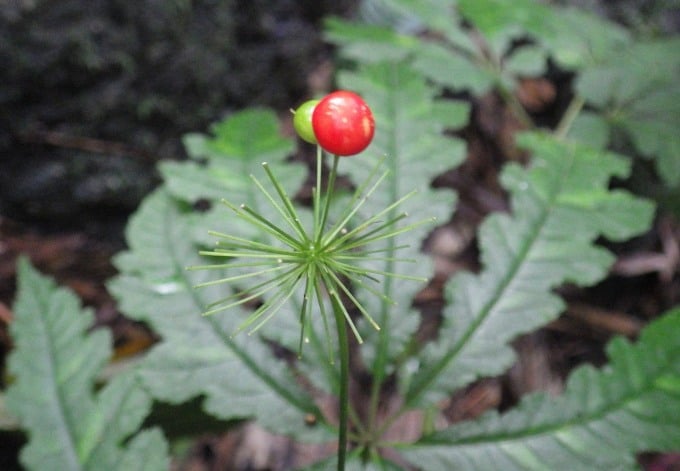
The medicinal ginseng plant P. stipuleanatus (wild Panax) in Ha Giang. Photo: Research team.
Associate Professor Phan Ke Long believes that some ginseng species are critically endangered and at high risk of extinction due to habitat degradation and overexploitation by humans. This also makes it difficult for researchers to find wild ginseng species in Tuyen Quang and Ha Giang.
After two years of searching for and evaluating rare ginseng species, the research team proposed a conservation and cultivation model in the Lam Binh forest (Tuyen Quang) and the Chieu Lau Thi forest area (Ha Giang).
Scientists also proposed strict management of regenerating trees and conservation of genetic resources in 5 populations in Ha Giang and 3 populations in Tuyen Quang, while also testing planting at the same altitude and climate zone. According to Mr. Long, businesses and people need to work together to participate in conservation, in-situ propagation, and sustainable exploitation of medicinal plants belonging to the ginseng genus.
The research team has initially identified several valuable compounds in wild Panax notoginseng, including aglycone, oleanolic acid, and panaxadiol. These substances have expectorant, analgesic, hemostatic, and health-boosting effects. They also contain oleanane-triterpenoid, which has anti-cancer and anti-inflammatory properties through a mechanism that inhibits the activity of NF-ĸB signaling, which activates the expression of certain genes related to inflammation.


Currently, Vietnam has several species of ginseng belonging to the genus Panax growing in the wild, including Panax japonicus var. bipinnatifidus (Seem.), Wu & Feng (P. bipinnatifidus Seem.), Panax notoginseng (P. notoginseng), wild Panax notoginseng (P. stipuleanatus), Panax vietnamensis var. fuscidiscus, and Panax langbianensis (P. vietnamensis var. langbianensis).
Panax vietnamensis (P. vietnamensis var. vietnamensis), also belonging to the Panax genus, has been studied in detail regarding its medicinal value but has not yet been found in the wild. Panax vietnamensis contains ocotillol saponin, which has sedative effects, and majonoside-R2, which has the potential to inhibit agents that cause nasopharyngeal cancer.
Bich Thao
Source link