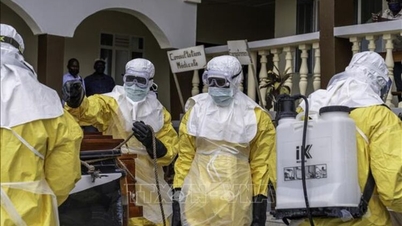
An isolation and treatment area for Ebola virus patients in Mubende, Uganda. (Illustrative photo: THX/VNA)
The IMST launch ceremony was held at Makerere University in Kampala, Uganda. IMST is established as a unified operational platform aimed at improving coordination, preparedness, and emergency response across Africa.
According to the Africa CDC, IMST will provide integrated technical support, coordinate operations, and mobilize a multidisciplinary team of experts to support Uganda, the Democratic Republic of Congo, and neighboring countries at risk from the Bundibugyo virus strain. This new platform is built on the principle of "one team, one plan, one budget," bringing together experts in various fields such as epidemiological surveillance, testing, case management, infection prevention and control, emergency logistics, risk communication, information management, and partner coordination.
According to the center, the establishment of IMST marks a significant step in strengthening Africa's public health emergency response system. This initiative also demonstrates the shared commitment of the Africa CDC, WHO, the African Union (AU), and member states to building a faster, more coordinated, and nation-centered response to increasingly complex health threats.
In the future, IMST is expected to contribute to strengthening the region's preparedness, promoting cross-border cooperation, and enhancing Africa's long-term response to disease outbreaks and other health emergencies.

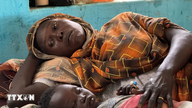
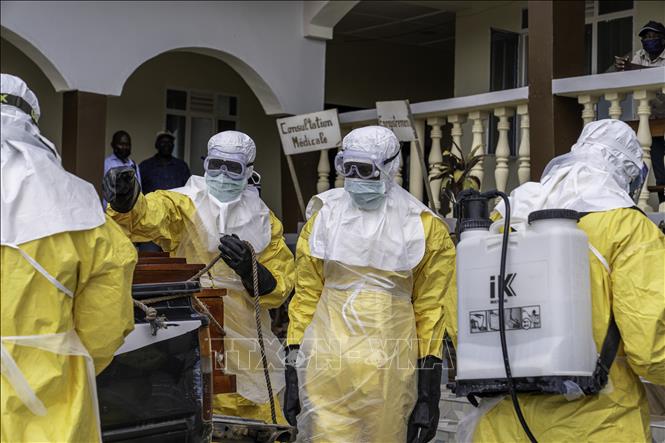
Medical staff carry out disinfection work at an Ebola treatment center in Goma, Democratic Republic of Congo. Photo: THX/VNA.
In a related development, on June 30, the United Nations warned that the current Ebola outbreak could cost Africa up to $3.6 billion and result in hundreds of thousands of job losses, while also risking a region-wide development crisis.
According to the government of the Democratic Republic of Congo, since the outbreak was announced on May 15, the Bundibugyo virus strain – for which there is currently no vaccine or specific treatment – has infected 1,307 people and caused 377 deaths. In addition to the Democratic Republic of Congo, a small number of cases have also been recorded in Uganda. Experts warn that the disease could continue to spread to other neighboring countries such as South Sudan.
Damien Mama, Permanent Representative of the United Nations Development Programme (UNDP) in the Democratic Republic of Congo, stressed: “If we have sufficient resources and intensified action, we can control this outbreak and prevent further losses. Conversely, without sufficient resources and intensified action, this health emergency risks becoming a deep and prolonged development crisis for the region, even on a pan-African scale.”
The UNDP has developed three scenarios regarding the impact of the pandemic. In the most optimistic scenario, where the pandemic is contained within the Democratic Republic of Congo and Uganda, the Gross Domestic Product (GDP) of the Democratic Republic of Congo would decrease by approximately $1 billion.
In a worst-case scenario, if the pandemic spreads to countries like Rwanda and Angola, coinciding with soaring fuel prices related to the current Gulf crisis, Africa's GDP could fall by $3.6 billion and approximately 328,000 people could lose their jobs.



According to VNA
Source: https://baoangiang.com.vn/dich-ebola-chau-phi-thiet-lap-co-che-dieu-phoi-chung-a491033.html
![[Image] National conference summarizing one year of operation of the overall organizational model of the political system, the three-tiered government model.](https://vphoto.vietnam.vn/thumb/1200x675/vietnam/resource/IMAGE/2026/07/01/1782882811691_ndo_br_1-jpg.webp)



































































![[INFOGRAPHICS] Policies to support vocational retraining and decommissioning of fishing vessels no longer needed for fishing operations.](https://vphoto.vietnam.vn/thumb/402x226/vietnam/resource/IMAGE/2026/07/01/1782905930516_1782905712.webp)