


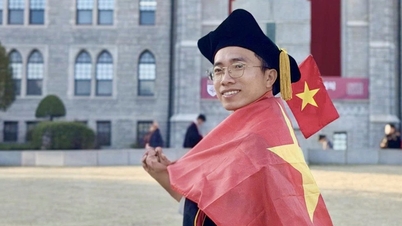
Young translator Le Hong Phuong Ha - Photo: Provided by the interviewee
The young female translator with over 30 books on various topics is Le Hong Phuong Ha. She studied Management Information Systems until her third year but lacked the motivation to continue, so she boldly changed her mind, wanting to contribute to bringing knowledge to more people through books. In a conversation with Tuoi Tre newspaper, Phuong Ha recalled:
- The moment I found an idiom with an equivalent meaning between English and Vietnamese in a translation assignment during my freshman year of university was like love at first sight. That moment planted in me the first seeds of my passion for translation, the feeling of happiness in finding a way to translate a language into Vietnamese naturally and smoothly.
Learn and develop yourself.
* What experience led you to decide to pursue a career in translation?
- When I read the Harry Potter series, I admired the translation skills of translator Ly Lan. Then, after reading the autobiography "Never Give Up" by translator Bich Lan, I felt a strong urge to translate books and hoped that one day I would have my name listed as a translator on the cover. I started translating and participated in a translation course taught by translator Uong Xuan Vy.
Later, I worked as a freelance translator for a knowledge-sharing social media site, and my dream of becoming a translator grew stronger. But my serious decision to pursue translation as a career was marked by my decision to retake the university entrance exam and switch to linguistics because "I need to master Vietnamese to do good translation."
* Which work left the deepest impression on you?
- My favorite book is "The Miracle of God ," the first literary work I translated when I was 21. It's a story about a family who, after much loss, pain, and heartbreak, still nurture love to warm each other like a "miracle" on Christmas night. Partly because I empathize with the characters' emotions, as I've experienced them myself.

But the mother-daughter relationship in the book "Crying at H Mart" has more similarities to my own mother-daughter relationship. So, while translating, I tried to balance my emotions, empathizing with the author to convey her feelings through the words, while maintaining the spirit of a translator, avoiding excessive sentimentality. I listened to music and watched videos of Korean cooking that the author mentioned to better understand and translate, which was also a way to explore the culture.
* What moment made you feel that translation was the right job for you?
- For me, it's an opportunity to learn through each project. Each book represents a new field with new knowledge and perspectives, rarely repeated, which makes me feel like I'm constantly developing while working. Translation has instilled in me meticulousness, perseverance, and dedication. This work lets me know that I'm contributing a little to sharing knowledge and humanistic messages with readers.
Having artificial intelligence (AI) also requires maintaining core competencies.
* What is the current status of young translators in your view?
- I think young translators have many opportunities now that there are more and more book publishing companies and a wider variety of languages. Editors are open-minded; if you are proactive, there will always be opportunities. However, today's readers have different tastes. Because they are proficient in foreign languages, they demand more accurate and faithful translations that still retain a natural Vietnamese feel. This is both an advantage and a challenge for young translators.
When translating classic works for the first time, young translators often face the pressure of being compared to previous translations, especially if the translations of their predecessors were excellent. But once they accept the task, young translators can see it as an opportunity, deciding to translate differently for a new generation of readers, while simultaneously asserting their own unique translation style.
With AI developing to its current level, what should young people who want to pursue a career in translation keep in mind?
- It's essential to have a collaborative mindset with AI, taking ownership and working alongside it. Master the process of asking questions and giving instructions to the AI, while also being able to critically analyze it like a colleague. Maintain core translation skills such as reading comprehension, style judgment, word choice, and grasping the flow of ideas... to be proactive and succeed in this field in the long run.
I've worked with AI for a while and realized that while AI translations are acceptable, they can't possibly be polished or lively. In other words, they lack soul, and it's the simple, sincere, and diverse writing style of each translator that is the most unique and must be preserved.

Learn to love, listen to yourself.
The divorce of her parents when Phuong Ha was 8 years old devastated her mother. Ha always felt abandoned and deprived, but she had to learn to put aside her sadness to comfort her mother. Studying became her greatest motivation; even when she had to spend long periods in the hospital, Ha clung to her studies, along with much support from her maternal family, to give her mother the strength to live.
Ha once suffered from depression, losing interest in her work and pursuing her goals, forcing her to reflect on her life's journey of over 20 years. That experience helped Ha change her perspective on inner strength, happiness, and resilience in life.
"I've been practicing gentler self-dialogue; my mother and I have honest conversations, but without hurting each other. I've made a commitment to never abandon myself, no matter the circumstances," Ha confided.
Source: https://tuoitre.vn/dich-gia-tre-va-uoc-mo-khong-song-mon-20260604085926069.htm










































![[Video] Sunset at Lap An Lagoon – Where the sun sets over the fishing nets](https://vphoto.vietnam.vn/thumb/1200x675/vietnam/resource/IMAGE/2026/05/31/1780192137701_beach-landscape-sea-water-nature-grass-745871-pxhere-com.jpeg)



























Comment (0)