 |
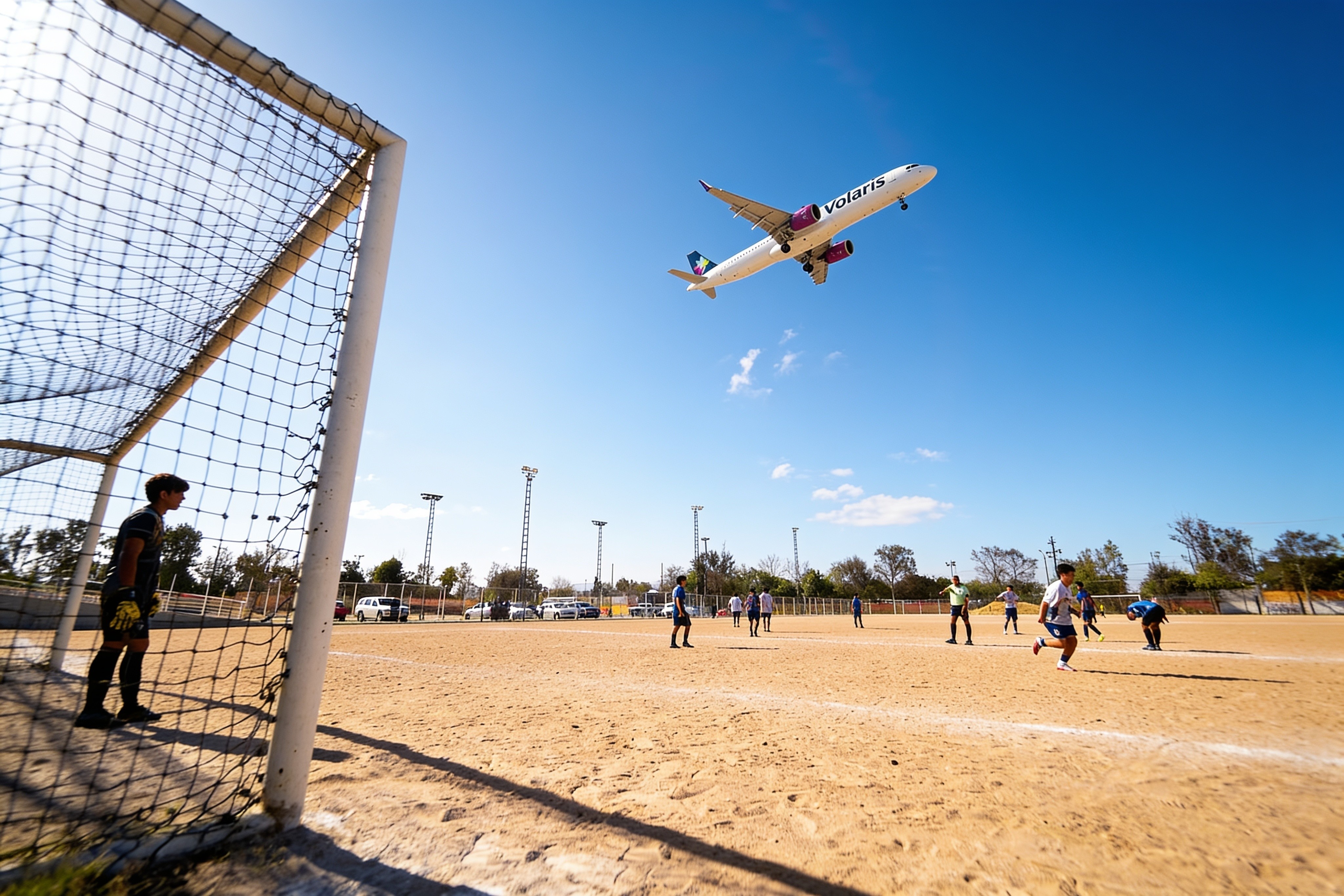
The plane flies directly over a soccer field in Mexico. Photo: Reuters . |
The 2026 World Cup, to be held in the United States, Canada, and Mexico, risks becoming the most polluted tournament in football history.
The FIFA report, "Climate Blind Spots," has just issued a serious warning about this issue. The expansion in scale, geographical distance, and frequency of flights will increase the negative impact on the climate.
Research from New Weather indicates that this year's tournament will emit at least 9 million tons of CO2 equivalent. This figure is nearly double the average of 4.7 million tons for the tournaments from 2010 to 2022. In a worst-case scenario, emissions could reach 15 million tons.
According to Euronews , the core reason stems from the change in the tournament format. The 2026 World Cup will feature 48 teams with a total of 104 matches, a 63% increase compared to previous tournaments.
This expansion means an increase in the number of fans and greater pressure on infrastructure. Emissions from flights remain the biggest source of pollution.



 |
Security forces are working to manage crowds of fans in Mexico City. The immense pressure from record-breaking travel numbers is testing the capacity of host cities. Photo: Reuters . |
Logistical factors further exacerbated the problem. Unlike previous tournaments that were concentrated in a single country, this World Cup spanned 16 cities across North America.
The distances between locations can be thousands of kilometers. The teams, reporters, and millions of fans are almost entirely dependent on air travel.
The report estimates that air travel alone will generate more than 7.7 million tons of CO2. Emissions from flights could increase by 160% to 325% compared to previous World Cups.
Unlike Europe, North America lacks a high-speed rail network to mitigate carbon emissions.
The study also criticized FIFA's climate strategy as inconsistent. Increasing the number of participating teams and choosing host cities thousands of kilometers apart directly contradicts the organization's commitment to sustainable development.
FIFA has affirmed that the tournament will include measures to mitigate environmental impact, including promoting green building standards, energy efficiency, and encouraging the use of public transport in the host cities.



However, scientists warn that these measures are insufficient to offset the emissions generated by the very structure of the tournament. With projected emissions reaching 15 million tons of CO2, the gap between FIFA's commitment and reality has never been greater.
Source: https://znews.vn/diem-mu-cua-fifa-post1659016.html