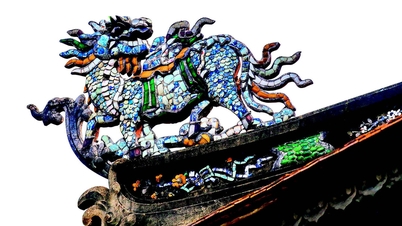
The dragon-horse screen at Kim Long village communal house was created by Hue artisans using ceramic inlay techniques.
From ceremonial horses to royal mascots
The Imperial Edict on the Regulations of Dai Nam (translated by the Institute of Historical Studies, Thuan Hoa Publishing House) records that, from the time of Emperor Minh Mang, the Thuong Tu Institute, located in the capital city, was designated as a place for breeding and training horses. All matters related to horses serving the court, from selection criteria and feeding regimes to responsibilities and penalties for those directly in charge, were strictly regulated.
This shows that horses were not only material assets, but also an important element in the ceremonial system and military organization of the Nguyen Dynasty. However, in military operations during this period, horses did not leave many traces of battle but were mainly used for escorting chariots, drills, official duties, and participating in major ceremonies such as the Sacrifice to the Nation, the Ceremony of the Land and Harvest, and the Ceremony of Ploughing the Fields.
The image of the horse was also chosen by King Minh Mạng to be engraved and cast on the Huyền Đỉnh and Anh Đỉnh, part of the Nine Dynastic Urns, placed in the Thế Miếu courtyard in the Huế Imperial Citadel, and is now recognized as a National Treasure.

The image of the dragon-horse atop the roof of the Four Directions of Serenity Pavilion (Hue Imperial Citadel).
Over time, along with changes in aesthetic perception and philosophical concepts, the image of the horse gradually evolved into that of a mythical dragon horse, becoming a distinctive mascot of Hue.
According to Dr. Phan Thanh Hai, Director of the Department of Culture and Sports of Hue City, the dragon-horse is a special combination of dragon, unicorn, and horse, associated with good fortune, symbolizing wisdom, luck, and longevity. In deeper symbolism, the dragon-horse also represents the ambitious spirit of a noble person: the dragon flying upwards symbolizes the vertical axis, and the horse running horizontally symbolizes the horizontal axis, implying harmony between heaven and earth.
The dragon-horse embodies the majesty of the dragon and the freedom and spontaneity of the horse, and is seen as the embodiment of supernatural power and wisdom, heralding the arrival of a sage.
--------
Dr. Phan Thanh Hai, Director of the Department of Culture and Sports of Hue City
“This mythical creature embodies the majesty of a dragon and the freedom and spontaneity of a horse. In some beliefs, the dragon-horse is also seen as the embodiment of supernatural power and wisdom, heralding the appearance of a sage. Therefore, the image of the dragon-horse appears in many different spaces, becoming a typical symbol in the decorative arts and architecture of the Hue imperial palace,” emphasized Dr. Phan Thanh Hai.
Researchers believe that, among the four mythical creatures, the dragon holds the highest position of authority with its majestic and powerful appearance, and is the mythical creature that appears in the most diverse and varied forms in Hue's imperial architecture. Following the dragon in terms of frequency of appearance is the dragon-horse. Therefore, the image of the dragon-horse creates a distinct and easily recognizable mark, and is revered as a special mythical creature in cultural life.
Dragon Horse in Hue's Feng Shui Space
The image of the dragon-horse is present in many important architectural works, such as Hung Mieu Temple, Truong Sanh Palace, Tu Phuong Vo Su Pavilion, as well as in the tombs of the Nguyen dynasty kings. However, the place where the dragon-horse appears most frequently in Hue is on screens. Tourists can easily find dragon-horse screens everywhere, from villages to cities.
According to feng shui principles, the presence of a dragon-horse on a screen further enhances its ability to ward off evil spirits, toxic energies, and fire energy. This is why dragon-horse screens are particularly favored by people in Hue.
For a long time, people in Hue have believed that the dragon-horse is an incarnation of the unicorn, one of the four mythical creatures. According to folk imagery, the dragon-horse has the body of a horse, the head of a dragon, scales covering its body, and carries the Eight Trigrams on its back, always appearing to be in motion. This creature does not exist in reality, but is a product of imagination, a crystallization of symbolic thinking and the spiritual aspirations of humankind.
For a long time, Hue artisans have known how to use ceramic mosaic techniques to create dragon-horse figures on screens. Through the skillful hands of folk artisans, pieces of ceramic and porcelain are arranged harmoniously, creating a mythical creature that is both powerful and majestic, yet graceful and lively. The undulating mosaic lines further highlight the dragon-horse's spirit, conveying auspicious meanings of wisdom and prosperity.
The exquisite combination of ceramic mosaic art and the dragon-horse imagery has created vibrant and enduring screens, representing a pinnacle of Hue's imperial decorative art.
A living legacy in the contemporary world.
Possessing vibrant beauty and profound meaning, the image of the dragon-horse has been chosen by Vietnamese and French artists as the symbol for the Hue Festival logo. The original model is the screen in front of Hue National High School for the Gifted. This is the most famous and oldest dragon-horse screen in Hue, built in 1896 during the reign of Emperor Thanh Thai. The chosen location for this screen is beautiful, facing the Perfume River, Phu Van Lau, and the Imperial Citadel. The image of the dragon-horse appears in a posture of galloping on clouds but still turning its head back, exuding a gentle, sacred yet approachable aura, as if conveying a message of prosperity for the school with its rich tradition.

The dragon-horse screen in front of Hue National High School attracts the attention of many foreign tourists.
The image of the dragon-horse is still present in the life and cultural space of Hue today. Right in the heart of the city, one can find typical screens at the Privy Council (now the headquarters of the Hue Imperial City Relics Conservation Center), the temple of Saint Tran Hung Dao, the Tuy Ly Vuong Palace, Kim Long village communal house, and An Hoa village communal house.
Further afield, in the suburban areas, dragon-horses are present in the ancient rural landscapes of Trieu Son, Phuoc Tich, Lai The, and Duong No. These screens, whether standing in the heart of the city or nestled beside the village bamboo groves, silently preserve a beautiful symbol in the flow of culture.

The screen at Kim Long village communal house has stood the test of time.
Ideas have emerged for a "following the dragon horse" discovery tour, a journey connecting the past with the present, leading participants along the lines of historical screens to appreciate the depth of history, architecture, and art. More than just a stroll through heritage sites, this journey is an opportunity to listen to Hue tell the story of an icon that has endured through generations but has never left the rhythm of life in the ancient capital.
Source: https://nhandan.vn/theo-dau-long-ma-o-co-do-post943644.html