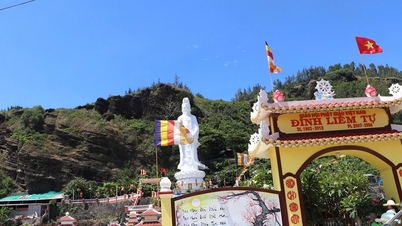
Located on the slopes of Gieng Tien Mountain, an extinct volcano millions of years ago, Duc Pagoda (Dinh Liem Tu) has long been considered a famous spiritual destination in Ly Son. Along with its unique volcanic crater system, it creates a distinctive landscape, contributing to the allure of this strategically important island.

Many potential dangers
However, the prolonged impacts of natural disasters over the years have severely damaged this area. On top of Duc Pagoda, many volcanic rock faces have large cracks due to water seepage after rainy seasons. Previously, dozens of cubic meters of soil and rocks had collapsed right in front of the pagoda, posing a safety risk to locals and tourists.
More worryingly, along the road leading to the Gieng Tien volcanic crater, many cliffs continue to show long cracks. Some large rocks have shown signs of shifting, posing a risk of landslides at any time, especially during the rainy season. Nun Thuy Lien, abbess of Ngoc Duc Monastery and manager of Duc Pagoda, said that the pagoda is attached to the unique volcanic cliff and is a place of religious activity and practice for monks, nuns, and Buddhists. In addition, the statue of Quan The Am Bodhisattva facing the sea is considered by the local people as a symbol of protection, a prayer for safety for fishermen on their voyages at sea.
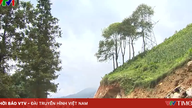
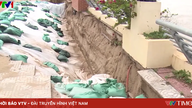

According to Venerable Nun Thuy Lien, since Typhoon No. 12 in 2017, the geological structure in the area around Duc Pagoda has been severely affected. Although the local authorities and the pagoda have coordinated to temporarily address the landslide in front of the pagoda, the deep cracks on the mountain slope have not yet been completely repaired. “The terrain here is very complex, and the cost of implementing technical solutions to reinforce and address the landslide is very high, exceeding the pagoda's capabilities. Because safety cannot be guaranteed, the only road leading to the Gieng Tien volcanic crater has to be temporarily closed,” Venerable Nun Thuy Lien shared.
The suspension of visitor access to the Liem Tu peak area and the Gieng Tien volcanic crater has significantly impacted the experience of tourists visiting Ly Son Island. Nguyen Tan Tai, a tourist from Ho Chi Minh City, said that before his trip, he had researched and eagerly awaited the opportunity to visit the Gieng Tien volcanic crater to admire the panoramic view of Ly Son Island from above. However, upon arrival, he learned that the road had been blocked due to the risk of landslides. “I am quite disappointed because this is one of the destinations that many people have recommended. I hope that in the future, the authorities will soon find a solution to address this issue so that tourists can safely explore this unique scenic spot,” Mr. Tai said.

Recommendations for support in evaluation and proposed solutions .
In response to this situation, the Ly Son Special Economic Zone authorities have conducted on-site inspections, installed warning signs, and strictly prohibited residents and tourists from accessing areas at high risk of landslides. However, this is only a temporary solution to mitigate immediate risks. Mr. Ngo Dinh Man, Vice Chairman of the Ly Son Special Economic Zone People's Committee, said that the locality is coordinating with relevant departments and agencies of Quang Ngai province to survey the current state of the deteriorating historical sites in order to develop a plan for preservation and restoration in the coming period.
According to Mr. Man, dealing with the rocks at risk of landslides in the Duc Pagoda area is difficult due to the unique topography and volcanic geological structure. The local authorities will continue to request support from higher-level specialized agencies to survey and assess the level of danger and propose appropriate technical solutions to ensure the long-term safety of the historical site.




The Duc Pagoda and the Tien Well volcanic crater are not only cultural and spiritual symbols of the people of Ly Son but also valuable geological assets, contributing to the unique identity of the island. Ly Son is aiming for sustainable tourism development linked to heritage preservation, and finding solutions to address erosion in this area is an urgent requirement to protect the landscape, ensure community safety, and preserve a unique local destination.
Source: https://baovanhoa.vn/van-hoa/van-chua-co-giai-phap-cap-thiet-240355.html
![[Image] Ho Chi Minh City: Ma Lang area, Chicken-Rice Market about to change its appearance](https://vphoto.vietnam.vn/thumb/1200x675/vietnam/resource/IMAGE/2026/06/25/1782377698627_ndo_br_m1-jpg.webp)


































![[Image] Schools organize meetings and introduce teaching models to students admitted to grade 10.](https://vphoto.vietnam.vn/thumb/1200x675/vietnam/resource/IMAGE/2026/06/25/1782368077271_ndo_br_z7970052192242-1ec8daeb77a6eed1a4e9f58c564ddd3e-jpg.webp)