

The Organization for Economic Cooperation and Development (OECD), established in 1961 and headquartered in Paris, France, has the primary mission of bringing together countries with a strong commitment to democracy and market economies.
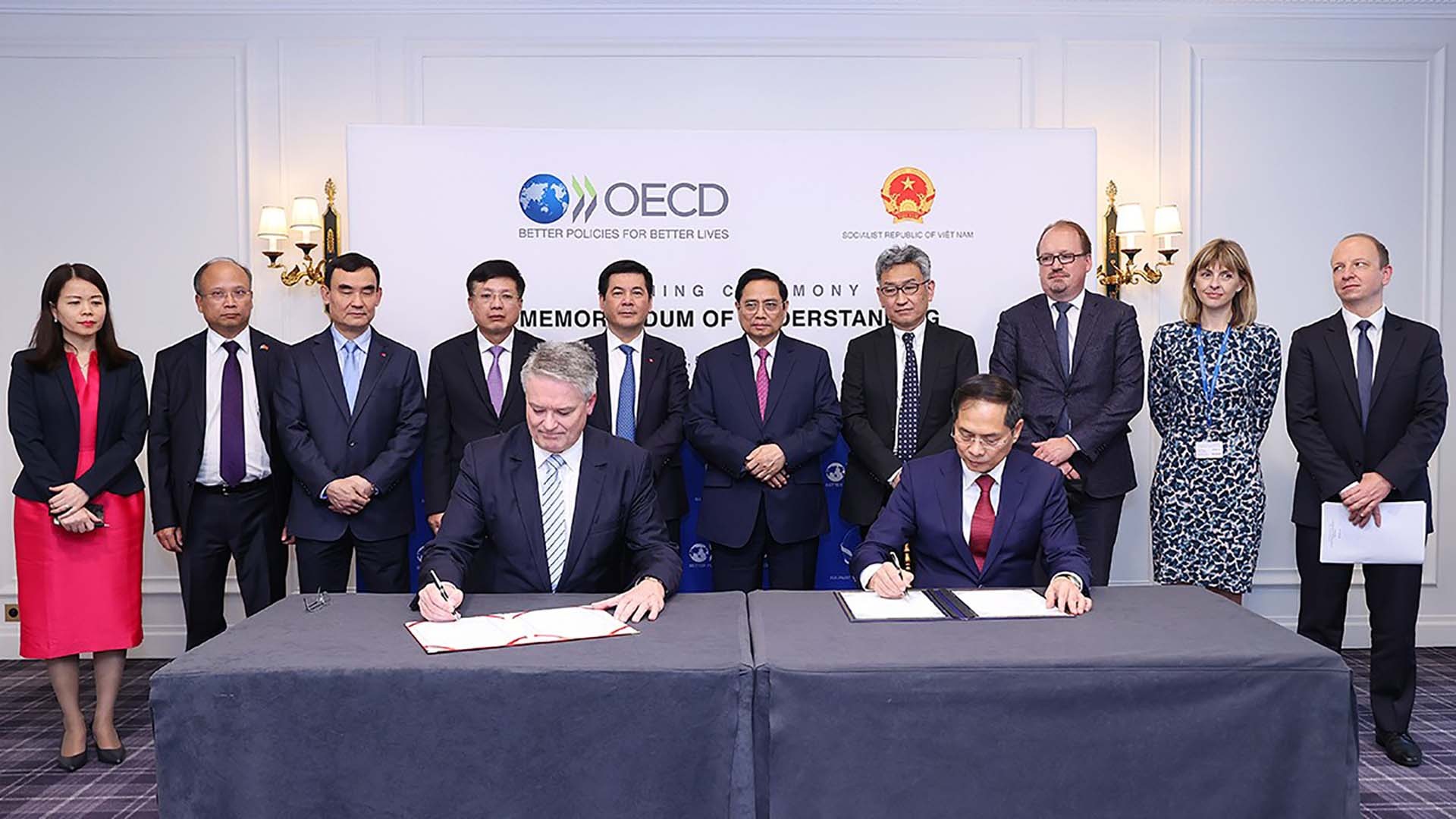 |
| On November 5, 2021, Prime Minister Pham Minh Chinh and Mr. Mathias Cormann, Secretary-General of the Organization for Economic Cooperation and Development (OECD), witnessed the signing ceremony of the Vietnam-OECD Memorandum of Understanding (MOU) for cooperation in the period 2022-2026. (Source: VNA) |
The predecessor of the OECD was the Organization for Economic Cooperation in Europe (OEEC), established in 1948 with the aim of restoring the European economy and overseeing the allocation of US aid to Europe after World War II through the Marshall Plan.
Reputation in development
To date, the OECD has developed into a prestigious international forum with 38 member countries. For over 60 years, the OECD has played a crucial role in promoting economic progress, social welfare, and international cooperation, serving as a forum where governments foster collaboration on economic and social policy issues.
The OECD's purpose is to enhance economic cooperation and coordinate policies among member countries on global economic and development issues. In addition to programs with member countries, the OECD has several specific mechanisms involving non-member countries, such as the Southeast Asia Programme (SEARP) and the OECD Development Centre. The OECD Ministerial Council Meeting (MCM) is the OECD's most important annual event, discussing strategic political, economic, and social issues, guiding cooperation within the OECD, and exchanging views on developing global economic governance rules and standards.
Through research, analysis, and policy recommendations, this organization contributes to policy recommendations and reforms on economics and development worldwide. OECD's core research areas include economic policy, education, environment, digitalization, healthcare, trade, and investment… and its corresponding policy recommendations have become standards for governments and international organizations. OECD reports on economic indicators such as GDP growth, inflation, and unemployment… are widely used by policymakers, economists, and global financiers. Furthermore, the OECD's peer review mechanism encourages member countries to make policy adjustments and administrative reforms, enhancing transparency and accountability. Non-member countries also benefit from OECD expertise through the sharing of collaborative initiatives and capacity building.
OECD and Vietnam
Although not a full member, Vietnam has actively participated in cooperation with the OECD in various fields over the years, such as policy reform, investment promotion, and public governance, to advance socio-economic goals.
In March 2008, Vietnam officially became a member of the OECD Development Centre, a platform for knowledge sharing and policy dialogue between OECD member countries and developing countries that are not yet members of the forum. This also marked the first time Vietnam became a member of one of the mechanisms under the OECD.
Vietnam's participation in the OECD Development Centre brings many practical benefits, allowing it to leverage advice and policy support based on the socio-economic development practices of OECD member and non-member countries through various forums and dialogues, and to utilize the extensive network of multinational corporations and development investment funds globally. In particular, through the OECD Development Centre, Vietnam successfully developed its Multidimensional Development Assessment (MDR) report in 2020. This report plays a crucial and useful role in developing Vietnam's 10-year socio-economic development strategy for the period 2021-2030 and its five-year socio-economic development plan for the period 2021-2025.
Bilateral cooperation between Vietnam and the OECD is primarily conducted through specific national projects and the Southeast Asia Programme (SEARP), in various forms, including participation in OECD agencies, national policy review reports, data contributions to the OECD data system, and activities related to measurement/evaluation and compliance with OECD standards. Since 2012, Vietnam has consistently developed bilateral cooperation plans with the OECD for the periods 2012-2015, 2016-2020, and 2021-2025. Based on adhering to the specific cooperation guidelines and frameworks for each ministry and sector, Vietnam-OECD cooperation has become increasingly substantive and effective.
Simultaneously, Vietnam and the OECD collaborated on research and development of 10 reports in various fields and at different levels, such as the OECD's Southeast Asia Economic Outlook Report (together with Switzerland) for the 2018-2021 term; and the "Multidimensional Assessment of Vietnam" (MDR) report. Vietnam's MDR report is considered a comprehensive document with valuable reference value and serves as useful input for the drafting of the 10-year Socio-Economic Development Strategy (2021-2030) and the five-year Socio-Economic Development Plan (2021-2025).
Furthermore, since January 2019, at the suggestion of the OECD, Vietnam and the organization have been negotiating to develop a National Program, comprising 8-10 specific cooperation projects to be implemented over three years from 2020-2023. The National Program represents a higher level of cooperation between the OECD and a non-member country. These cooperation projects include not only recommendations and policy advice but also support for policy implementation.
In 2021, Vietnam and Australia were elected as co-chairs of the SEARP Programme for the 2022-2025 period. At the SEARP Ministerial Meeting (February 9-10, 2022, Seoul, South Korea), Vietnam and Australia officially assumed the co-chair role from South Korea and Thailand. Vietnam's first-ever co-chairship of the Programme with Australia for the 2022-2025 term is of significant importance. This marks the first time Vietnam has chaired a high-standard mechanism of an organization of which it is not a member, affirming the recognition of Vietnam's international role and position, as well as the trust of OECD countries and the region in Vietnam's capacity to effectively engage the OECD and the region.
During its co-chairing term in 2022, Vietnam chaired the OECD-Southeast Asia Ministerial Forum and the OECD-Southeast Asia High-Level Forum. At the 2023 OECD-Southeast Asia Ministerial Forum and the Vietnam-OECD Investment Forum on “Promoting High-Quality Investment for Green, Smart, and Sustainable Growth,” with practical themes closely aligned with the needs of countries in the region and consistent with the priorities and strengths of OECD countries, the forums organized by Vietnam received strong support from OECD and ASEAN member states. In 2023, at the invitation of the OECD Secretary-General and the UK Foreign Secretary (OECD Chair in 2023), Vietnamese Foreign Minister Bui Thanh Son led the Vietnamese delegation to attend the OECD Council of Ministers Meeting (June 7-8, in Paris). This was the first time the OECD invited Vietnam and several other guests to attend all sessions of the OECD Council of Ministers Meeting.
Despite its achievements, the OECD still faces several challenges, with some arguing that its approaches and policies primarily reflect the interests of the wealthiest member states, leading to a lack of inclusiveness and representation for developing countries. Furthermore, OECD recommendations are sometimes criticized for being overly standardized and one-size-fits-all, ignoring the diverse needs and contexts of individual nations. However, despite the challenges in ensuring inclusiveness and addressing criticisms of its approach, the OECD remains an important forum for governments to collaborate and address common challenges in an increasingly interconnected world.
In its capacity as Chair of the OECD Ministerial Council Meeting (MCM 2024), Japan invited Foreign Minister Bui Thanh Son to attend the MCM 2024 meeting from May 2-3 in Paris, combined with the celebration of the 10th anniversary of the SEARP Programme. MCM 2024 focuses on discussing issues such as climate change, the digital revolution, promoting multilateralism and shared values, and seeking solutions to maintain a rules-based international order and sustainable and inclusive economic development. The MCM 2024 conference is taking place against the backdrop of increasingly active, substantive, and in-depth cooperation between Vietnam and the OECD. Vietnam and the OECD have signed a Memorandum of Understanding on cooperation between Vietnam and the OECD for the period 2022-2026, with many specific and practical contents serving the process of transforming the growth model and achieving the socio-economic development goals of the country. |
Source




![[Photo] General Secretary and President To Lam presides over a working session with the Central Policy and Strategy Committee on the development of the materials industry.](https://vphoto.vietnam.vn/thumb/1200x675/vietnam/resource/IMAGE/2026/05/21/1779359935432_a3-bnd-3129-1412-jpg.webp)
![[Photo] National Assembly Chairman Tran Thanh Man working with the Standing Committee of the Law and Justice Committee](https://vphoto.vietnam.vn/thumb/1200x675/vietnam/resource/IMAGE/2026/05/21/1779378929214_ndo_br_1-4610-jpg.webp)











































































Comment (0)