

Causes of nail fungus (fingernails and toenails)
Nail fungus can stem from a variety of causes, including:
- Exposure to the source of infection: Sharing nail clippers, shoes, or towels with someone who is infected.
- Wet, unsanitary environments: Walking barefoot in swimming pools, gyms, and public restrooms increases the risk of fungal infections.
- Sharing unsterilized nail tools: Nail tools containing fungi are a common source of infection.
- Weakened immune system: People with diabetes or weakened immune systems are at a higher risk of developing nail fungus.
- Nail damage: Injuries and impacts to the nails create favorable conditions for fungi to invade and grow.
Nail fungus can affect multiple nails at once and can be persistent if not treated properly.
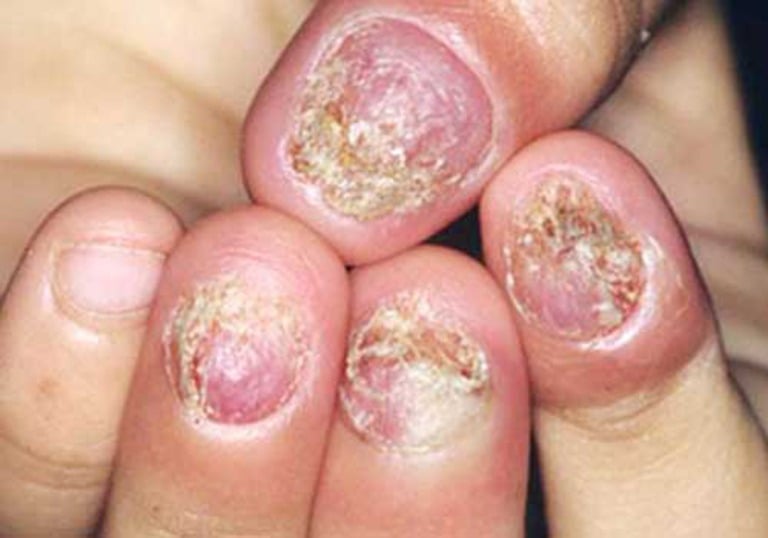
Nail fungus, affecting both fingernails and toenails, is a common dermatological condition.
Symptoms of nail fungus (fingernails, toenails)
Nail fungus is a fungal infection of the nails, accounting for approximately 30% of superficial fungal infections. It is common in people whose hands and feet are frequently exposed to moisture, such as beverage vendors, fruit vendors, cooks, laundresses, hairdressers, car washers, and livestock workers.
In the skin, the fungus usually enters through small scratches, spreading from the center outwards to form a circular lesion with many blisters at the edges. In the scalp, the fungus invades the hair shaft and then spreads gradually. In the nails, the fungus usually enters from the free edge or side of the nail, then spreads to the nail matrix.
Common symptoms of nail fungus include:
- The surface of the nail is rough, covered with a layer of fine, bran-like scales.
- Vertical or horizontal lines appear on the nails.
- The nails change color to pale yellow, brown, or dark brown.
- Nails are brittle, easily crumble, and break easily.
- The nail may peel or chip, damaging the area beneath the nail.
Initially, the infection usually affects only one or two nails. If left untreated, the lesions will gradually spread to more fingers. Depending on the type of fungus, the lesions may spread from the nail margin inward without causing perionychial inflammation (due to Dermatophytes), or spread from the nail bed outward with perionychial inflammation (due to Candida fungus). In cases of perionychial inflammation, there is usually significant pain, swelling, redness, pus formation, and itching around the nail.
If left untreated, nail fungus can spread and infect other nails.
Effective ways to support the treatment of nail fungus.
Depending on the type of fungus and the patient's specific condition, the doctor will prescribe the appropriate treatment, which may include:
- Topical antifungal medications: These help kill the fungus locally, reduce itching, minimize nail damage, and prevent recurrence.
- Oral antifungal medications: These work from the inside, helping to control the infection and prevent the fungus from spreading. Their use must be strictly according to a doctor's instructions to ensure safety.
- CO₂ laser technology: Uses a Fractional CO₂ laser to eradicate fungi at the root, without affecting healthy tissue, while stimulating regeneration, helping nails grow back strong and healthy.
Combining medication and laser technology helps improve treatment effectiveness and reduce the risk of recurrence.
In addition, patients can apply some supportive measures such as:
- Sea salt: Dissolve sea salt in warm water and soak your nails 1-2 times a day to disinfect and reduce itching.
- Tea tree oil: Apply a few drops to the affected nail and massage gently to aid its natural antibacterial properties.
How to prevent nail fungus
To prevent nail fungus from recurring and protect nail health, the following habits should be maintained:
- Keep your hands and feet dry and clean; wear rubber gloves when in contact with water.
- Avoid soaking your hands and feet in water for too long; after contact with water, wash and dry them immediately.
- Do not share towels, and do not use damp towels.
- Change your socks every day; choose socks that are breathable and wick away sweat well.
- Trim your fingernails and toenails regularly and properly; don't let them get too long.
- Avoid sharing nail clippers; limit getting your nails cut, painted, or soaked at salons that do not ensure sterility.
- Wash your hands and feet frequently and dry them immediately after washing; limit contact with harsh soaps and chemicals.
- In cases where the illness is chronic and difficult to treat, patients should consider changing jobs if possible.
Source: https://suckhoedoisong.vn/dieu-tri-hieu-qua-nam-mong-tay-mong-chan-169251229080026799.htm

![[Photo] The General Secretary, President and his wife begin their state visit to the Philippines.](https://vphoto.vietnam.vn/thumb/1200x675/vietnam/resource/IMAGE/2026/05/31/1780230559452_anh-man-hinh-2026-05-31-luc-19-28-11.png)
![[Photo] Admire the coral "masterpiece" amidst the million-year-old heritage of Dak Lak province.](https://vphoto.vietnam.vn/thumb/1200x675/vietnam/resource/IMAGE/2026/05/31/1780221235105_anh-man-hinh-2026-05-31-luc-16-53-27.png)

![[Photo] Solemn bathing ceremony and Buddha procession in Hue](https://vphoto.vietnam.vn/thumb/1200x675/vietnam/resource/IMAGE/2026/05/31/1780228263543_1-jpg.webp)

















![[Video] Sunset at Lap An Lagoon – Where the sun sets over the fishing nets](https://vphoto.vietnam.vn/thumb/340x192/vietnam/resource/IMAGE/2026/05/31/1780192137701_beach-landscape-sea-water-nature-grass-745871-pxhere-com.jpeg)





































![[Photo] Admire the coral "masterpiece" amidst the million-year-old heritage of Dak Lak province.](https://vphoto.vietnam.vn/thumb/402x226/vietnam/resource/IMAGE/2026/05/31/1780221235105_anh-man-hinh-2026-05-31-luc-16-53-27.png)





































Comment (0)