


"THE ESSENCE" OF HUE CULTURAL RITUALS
In a small alley in Phuong Duc Ward (Hue City, Thua Thien Hue Province), the family of artisan Hoang Ngoc Tuyen (80 years old) is one of the rare places that still preserves the craft of making royal parasols.
Driven by the needs of the people of Hue, in 1991, seeing the increasing use of ceremonial umbrellas and lanterns for weddings, while at that time there were very few quality umbrella manufacturers in Hue City, Mr. Tuyen diligently researched and learned from various sources and produced the first ceremonial umbrellas.
After three years of perseverance, Mr. Tuyen's unique product manufacturing facility has achieved a dominant position in the market, distributing his parasols far and wide.
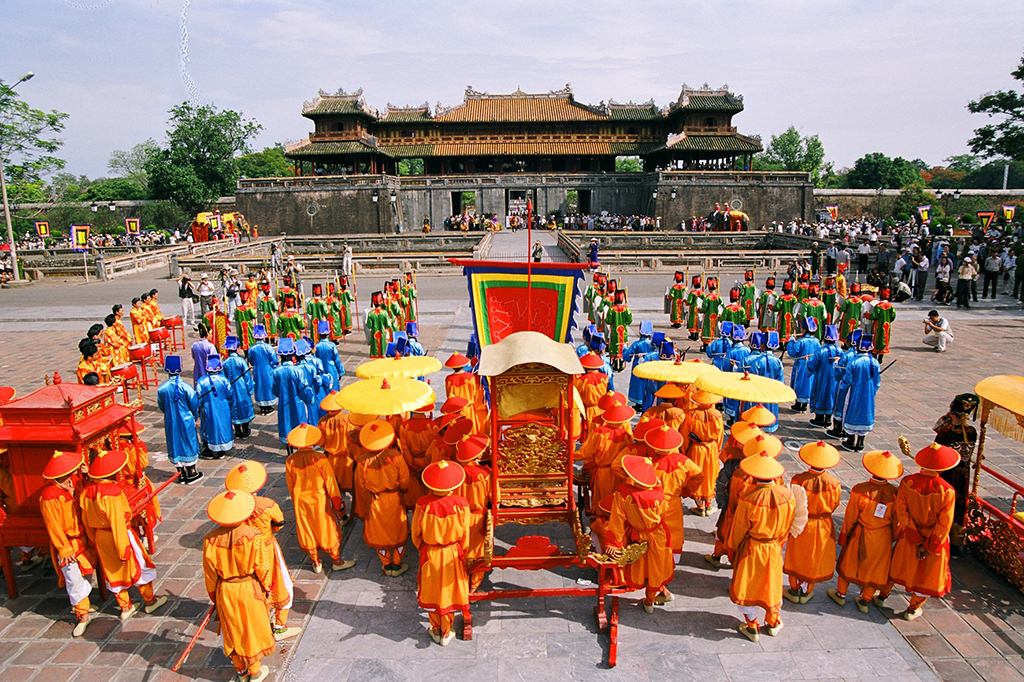
Today, the royal canopy is the soul of cultural and spiritual ceremonies and rituals for the people of Hue.
To this day, despite having worked in the craft for over 30 years, this artisan doesn't remember exactly when the parasol originated. He only remembers that it was a unique product used to honor the solemnity and nobility in the ceremonies of the ancient royal court as well as in folk rituals. "From the time of the Nguyen lords, parasols were used in royal ceremonies to shield the king and royal family members from the sun. In everyday life, people in Hue use parasols on occasions of religious ceremonies deeply rooted in folk beliefs, closely associated with preserving and developing Hue's identity through festivals such as the ceremony of worshipping the gods of the land and the Hon Chen Temple...", Mr. Tuyen explained.
Each occasion and ceremony has its own unique characteristics. In the royal court, the emperor's canopy was yellow and embroidered with dragons and phoenixes. In folk weddings, the canopy was red, creating a joyful atmosphere. According to many historical documents, the craft of making canopies in Vietnam began during the Le-Mac dynasty, with Le Quang Hanh as the founder. Canopies were called "divine umbrellas" or "official umbrellas." In the past, canopies were used for daily travel and official duties by the emperor and officials. Depending on the rank of the official, the number and color of the canopies provided for each trip would vary.
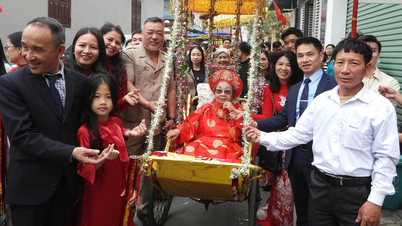
Today, parasols are present at weddings, funerals, and religious ceremonies. "The imperial parasols of Hue are now traveling further afield, to Europe to serve overseas Vietnamese for weddings and cultural events. I receive more orders and this also requires me to improve quality, research and innovate, but I must always preserve the spirit of traditional culture," Mr. Tuyen said.
A BRIGHT AND FRESH FINAL SONG
In his twilight years, Mr. Tuyen is happy to see his children enthusiastically carrying on his legacy. Interspersed with Mr. Tuyen's stories are the crackling sounds of bamboo splitting from behind the workshop. There, about 15 artisans work, regularly processing bamboo – sawing, bending, drilling, splitting, shaping, drying, painting… up to the more demanding and artistic stages such as assembling, tying, sewing, carving dragons and phoenixes, and attaching frames. "To complete a single parasol requires dozens of intricate steps, demanding meticulous attention to detail," said Hoang Minh Quoc (40 years old, an artisan working at Mr. Tuyen's workshop), pausing to continue the conversation.
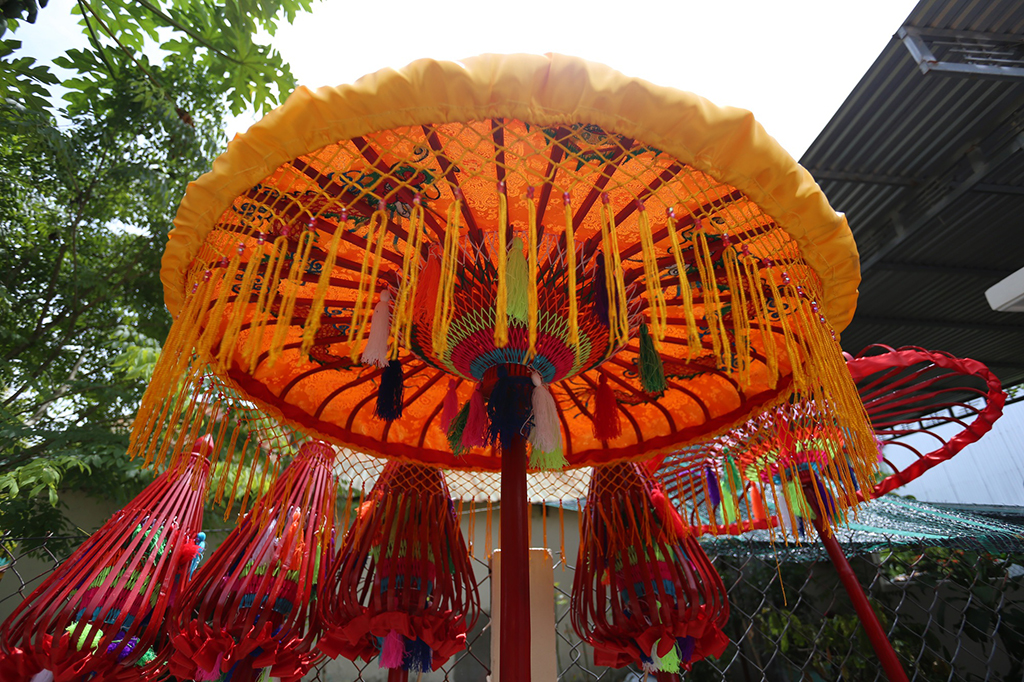
A finished parasol at the workshop of artisan Hoang Ngoc Tuyen.
The canopy frame must be made from male bamboo stalks about 2 meters long, dried, straightened, and polished. Similar to a giant umbrella, the frame is woven from evenly sharpened bamboo strips, fixed in place by a hollow, round wooden block called a "gen," the part used to open and close it. Afterward, the craftsman covers the frame with a layer of silk fabric.
According to Mr. Quoc, every step requires perseverance, but the most challenging part is handling the raw materials, knowing how to prevent termite infestation, straightening them, and then whittling them smooth and even. This craft also requires artisans to "breathe life" into each bamboo stick, thread, paint, and piece of wood to produce durable and beautiful products with increasing artistic value. "Maintaining this craft also requires a secret technique. If you don't know how to handle the materials, they will easily be infested with termites, the product quality will be compromised, and it will be difficult to retain customers. That's why many workshops have had to close," Mr. Quoc explained.
Today, the making of parasols utilizes machinery in many stages such as drilling, turning, and grinding, but the processes of splitting bamboo, painting, and embroidery still require the hands of artisans. And also the skillful hands of those who sew the fabric for the parasols. In the family of artisan Hoang Ngoc Tuyen, his daughter, Hoang Thi Au Lim (38 years old), is responsible for this stage.
According to Ms. Lim, current demand is higher, so the ceremonial umbrellas have been improved with many more beautiful and sophisticated designs. This establishment has exported hundreds of ceremonial umbrellas, serving Vietnamese people living abroad who hold wedding ceremonies according to their homeland's culture. The price of each ceremonial umbrella sold on the market ranges from 800,000 VND to 5 million VND depending on the order and customer requirements. (to be continued)
Source link













![[Photo] General Secretary To Lam attends the meeting between voters and candidates for the 16th National Assembly.](https://vphoto.vietnam.vn/thumb/1200x675/vietnam/resource/IMAGE/2026/02/26/1772088196117_a1-bnd-7412-5887-jpg.webp)






















































Comment (0)