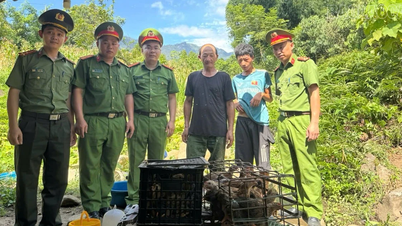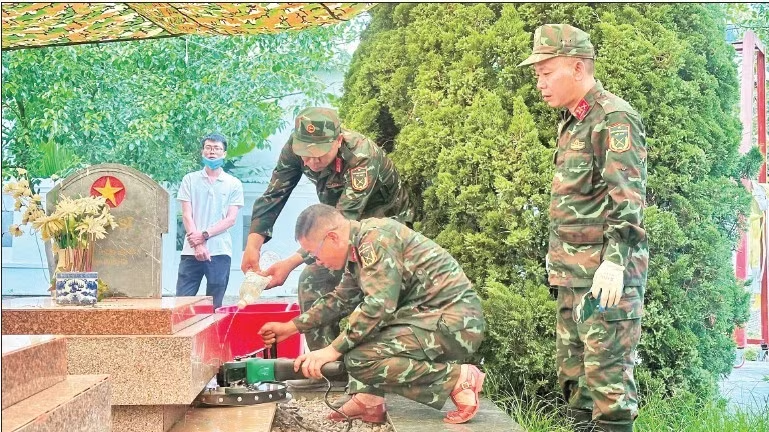
Early in the morning of June 17th, Colonel Vuong Dinh Hoa, Political Commissar of the Provincial Military Command, was present to directly supervise the excavation and sample collection for the identification of the remains of fallen soldiers at the Him Lam Martyrs' Cemetery (located in Group 17, Him Lam, Dien Bien Phu Ward, Dien Bien Province). He instructed officers and soldiers to make every effort and carefully carry out each step so that the identification of the fallen soldiers' names could be completed as soon as possible…
Lieutenant Colonel Le Dinh Hai, Deputy Head of Political Affairs of the Dien Bien Provincial Military Command, said: 80 officers and soldiers from the Command units and Regiment 741 were assigned to carry out the campaign.
At the Him Lam Martyrs' Cemetery, the forces were divided into 4 teams (each team consisting of 20 officers and soldiers) to simultaneously carry out the tasks, with the requirement that each step be precise, safe, and as quick as possible.
Through researching documents about the formation, renovation, and beautification of the Him Lam Martyrs' Cemetery, Lieutenant Colonel Le Dinh Hai noticed many unique difficulties in the geology and geographical features of each grave.
Established at the same time as the A1 Martyrs' Cemetery and the Doc Lap Martyrs' Cemetery (from 1958-1959), the Him Lam Martyrs' Cemetery contains 896 graves of martyrs who died in the Dien Bien Phu Campaign, and currently, the identities of all the martyrs remain unknown.
By 2023 and 2024, Dien Bien province invested funds to renovate 100% of the graves in the Him Lam Martyrs' Cemetery by covering them with flat, uniform square flagstones. Geological changes after nearly 70 years of repatriation, coupled with a renovation and refurbishment, made the excavation and sample retrieval process very difficult.
Therefore, despite having experience in excavating and collecting samples at the two martyrs' cemeteries in Tuan Giao and Tua Chua, the task force is not yet confident in proposing the most feasible plan for excavating and collecting samples at the Him Lam cemetery.


After hearing the task force's full report of the data, Colonel Vuong Dinh Hoa agreed to proceed simultaneously with both methods of sample collection.
“Due to the time constraints in finding samples, we had to carefully consider and choose the most advantageous excavation method, ensuring speed and safety, but then restoring each tomb completely. If we were to implement each method sequentially (cutting across the stone cladding or digging underground to find samples) and then choose the optimal method for the entire cemetery, it would take a lot of time,” Lieutenant Colonel Le Dinh Hai explained.
As one of the 24 soldiers of Squad 1, Regiment 741, assigned to excavate and identify the remains of fallen soldiers, soldier Vu A Di said: “For the past 11 days, I, along with my comrades and the officers, have been continuously searching day and night at the Tuan Giao Martyrs' Cemetery in Tua Chua. When I feel tired, thinking about the arduous and fierce battles and the sacrifices of the fallen soldiers, I try my best.”
Working alongside Vu A Di, first-year soldier Mai Huu Loi shared: “My home is in Ta Leng. When I was little, my teachers took me to visit the A1, Him Lam, and Doc Lap martyrs' cemeteries, but I didn't understand why the tombstones of the martyrs only had a five-pointed gold star… it wasn't until I enlisted that I understood. This time, I am honored to be trusted by my commander and assigned the task of searching for the names of the heroic martyrs from the 500-day and night campaign. I am very moved. I have promised myself that I will wholeheartedly carry out the task with the hope of contributing my small effort to this journey of gratitude.”
Silently observing the officers and soldiers on duty, looking at each grave, Colonel Vuong Dinh Hoa could not suppress his emotion: “They went to the battlefield at the young age of eighteen or twenty, and here, in this very place, they have been lying here for decades—nameless, ageless, and without hometowns. Meanwhile, far away in their hometowns, countless mothers, fathers, wives, and young children are anxiously waiting, hoping for even a single message, a glimmer of hope… Understanding these things, understanding the immense sacrifices they made for the peace and freedom of the country and the nation, the soldiers today on the land of Dien Bien Phu pledge to dedicate their hearts and minds to fulfilling the tasks entrusted by the Party, the State, and the people in this Gratitude Campaign.”
Early in the morning at Him Lam Martyrs' Cemetery, Ms. Lo Thi Lich, the cemetery caretaker, quietly lights incense at each grave, just as she has done every day for the past 20 years.
She shared: “I feel so much compassion for the elderly people lying here and for their families! Many elderly women come from far away every year to light incense for their loved ones and comrades. They waited so long for news of their loved ones that many have passed away! Today, witnessing firsthand the officers and soldiers of the Dien Bien Provincial Military Command and other forces searching for samples and identifying the names of fallen soldiers here, my heart feels relieved. I have vowed to do my best and dedicate myself to working with my comrades to complete the task of collecting samples and identifying the names of fallen soldiers here as soon as possible.”
According to Lieutenant Colonel Le Dinh Hai, although they have experience excavating and collecting samples at two martyrs' cemeteries, Tuan Giao and Tua Chua, and are currently working at Him Lam martyrs' cemetery, and will soon be working at A1, Doc Lap, and Tong Khao martyrs' cemeteries, each cemetery is different, making it difficult to have a common method.
However, with the determination of soldiers on their journey of gratitude, the task force was determined to make the utmost effort, working every hour, every minute, regardless of sun or rain, to complete the sample search as quickly as possible.



In carrying out the 500-day campaign to search for, collect, and identify the remains of fallen soldiers, the Dien Bien Provincial Military Command was assigned to lead and coordinate with the Department of Internal Affairs, the Party committees and authorities of communes and wards, and other relevant forces to collect samples from 4,593 graves of unidentified fallen soldiers in 7 martyrs' cemeteries throughout the province.
Starting on June 6th, the team collected samples at the Tuan Giao Martyrs' Cemetery, then transferred them to the Tua Chua Martyrs' Cemetery for further sampling. Sampling at the Him Lam Martyrs' Cemetery began on the morning of June 17th.
Source: https://nhandan.vn/doc-tam-suc-cho-chien-dich-tri-an-post970088.html

![[Image] Schools organize meetings and introduce teaching models to students admitted to grade 10.](https://vphoto.vietnam.vn/thumb/1200x675/vietnam/resource/IMAGE/2026/06/25/1782368077271_ndo_br_z7970052192242-1ec8daeb77a6eed1a4e9f58c564ddd3e-jpg.webp)

![[Image] Ho Chi Minh City: Ma Lang area, Chicken-Rice Market about to change its appearance](https://vphoto.vietnam.vn/thumb/1200x675/vietnam/resource/IMAGE/2026/06/25/1782377698627_ndo_br_m1-jpg.webp)
































![[Video] National Anti-Drug Day, June 26th: Van Ho has overcome its dark days.](https://vphoto.vietnam.vn/thumb/402x226/vietnam/resource/IMAGE/2026/06/26/1782439509010_vlcsnap-2026-06-25-22h20m22s108-9941-png.webp)