


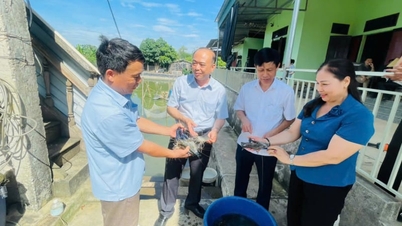
Farmers inspect shrimp raised on rice paddies. Photo: PHAM HIEU
In recent years, the U Minh Thuong region has experienced earlier and more prolonged droughts and saltwater intrusion, along with unusually heavy rainfall, altering the aquaculture environment. In response, the agricultural sector has encouraged farmers to shift from less efficient production models to shrimp-rice, shrimp-crab, or integrated aquaculture models. This approach is well-suited to the natural conditions, offers economic benefits, helps utilize land effectively, and maintains ecological balance.
Mr. Dang Minh Lan, a resident of Vinh Thuan commune, said that previously, this area mainly produced two rice crops per year. Whenever the dry season lasted too long, saltwater intrusion deep into the fields caused significant damage to rice paddies. In some years, yields were halved, rendering all the family's hard work wasted. Later, with guidance from the local agricultural sector, people boldly switched to a shrimp-rice rotation model. During the dry season, they bring in saltwater to raise shrimp and crabs, and then use it to flush out the salt during the rainy season to plant rice. “After a few seasons following the shrimp-rice model, we saw higher economic efficiency, so many farmers followed suit. My family has 8 hectares of land, and we earn about 500 million VND in profit from the shrimp-rice model each year. More importantly, this model helps reduce risks from unpredictable weather patterns,” Mr. Lan said.

Besides individual production, people are also forming cooperatives. Tran Van Men, Director of the Binh Hoa 1 Shrimp-Rice Cooperative in Vinh Binh commune, said that by participating in the cooperative, people produce according to established processes, applying science and technology, and using biological products… which helps reduce input costs, increase productivity, and boost profits. “On average, the cooperative's production model yields an income of 130-150 million VND/hectare, more than double that of traditional two-crop rice production. In addition, the cooperative is gradually building its brand, aiming for clean and safe rice and shrimp products to meet market demands,” Mr. Men shared.
According to Mr. Men, agricultural production has recently faced many risks due to climate change, coupled with continuously rising prices of fertilizers, pesticides, feed, and shrimp medications... Therefore, changing agricultural production processes towards biosafety not only brings high economic efficiency but also contributes to reducing emissions and moving towards sustainable agricultural production.
In coastal areas, climate change has a more severe impact. According to Mr. Nguyen Chi Anh, a resident of Van Khanh commune, his family previously practiced a shrimp-rice farming model. However, due to severe saltwater intrusion, he had to switch to antibiotic-free industrial shrimp farming. “With 2 hectares of land, I dedicate most of the area to water storage and treatment, while the rest is used for raising whiteleg shrimp. Thanks to the abundant and safely treated water reserves, plus the use of biological products, I have a distinct advantage in raising shrimp at high densities. The shrimp grow quickly, are healthy, meet clean standards, and are well-received by the market. Thanks to this industrial shrimp farming model, I earn several hundred million dong in profit each year,” Mr. Chi Anh said.
The authorities in the U Minh Thuong region are not only focused on increasing productivity but also on quality, safety, and adaptation to climate change to produce "fragrant rice and clean shrimp" to meet market demands. "We propose that the competent authorities invest in irrigation infrastructure, climate change adaptation projects, the application of science and technology, market forecasting, and connection and cooperation with export businesses to help people develop sustainable production," suggested Huynh Ngoc Nguyen, Chairman of the People's Committee of Vinh Thuan commune.
According to the Provincial Agricultural Extension Center, the province currently has nearly 3,500 hectares of shrimp farms certified under ASC, BAP, and VietGAP standards. In the coming period, the province will continue to promote the national action program focusing on transforming the shrimp industry into a modern, green industry adapting to climate change, and the project to promote the development of high-tech aquaculture. Simultaneously, it will reorganize production towards forming large-scale farming areas along the value chain, building brands, and especially controlling antibiotic residues and banned chemicals, ensuring a clean, high-quality shrimp supply for domestic and international markets.
Source: https://baoangiang.com.vn/doi-cach-nuoi-de-giu-nghe-tom-a487908.html































![[Video] Sunset at Lap An Lagoon – Where the sun sets over the fishing nets](https://vphoto.vietnam.vn/thumb/1200x675/vietnam/resource/IMAGE/2026/05/31/1780192137701_beach-landscape-sea-water-nature-grass-745871-pxhere-com.jpeg)
























Comment (0)