

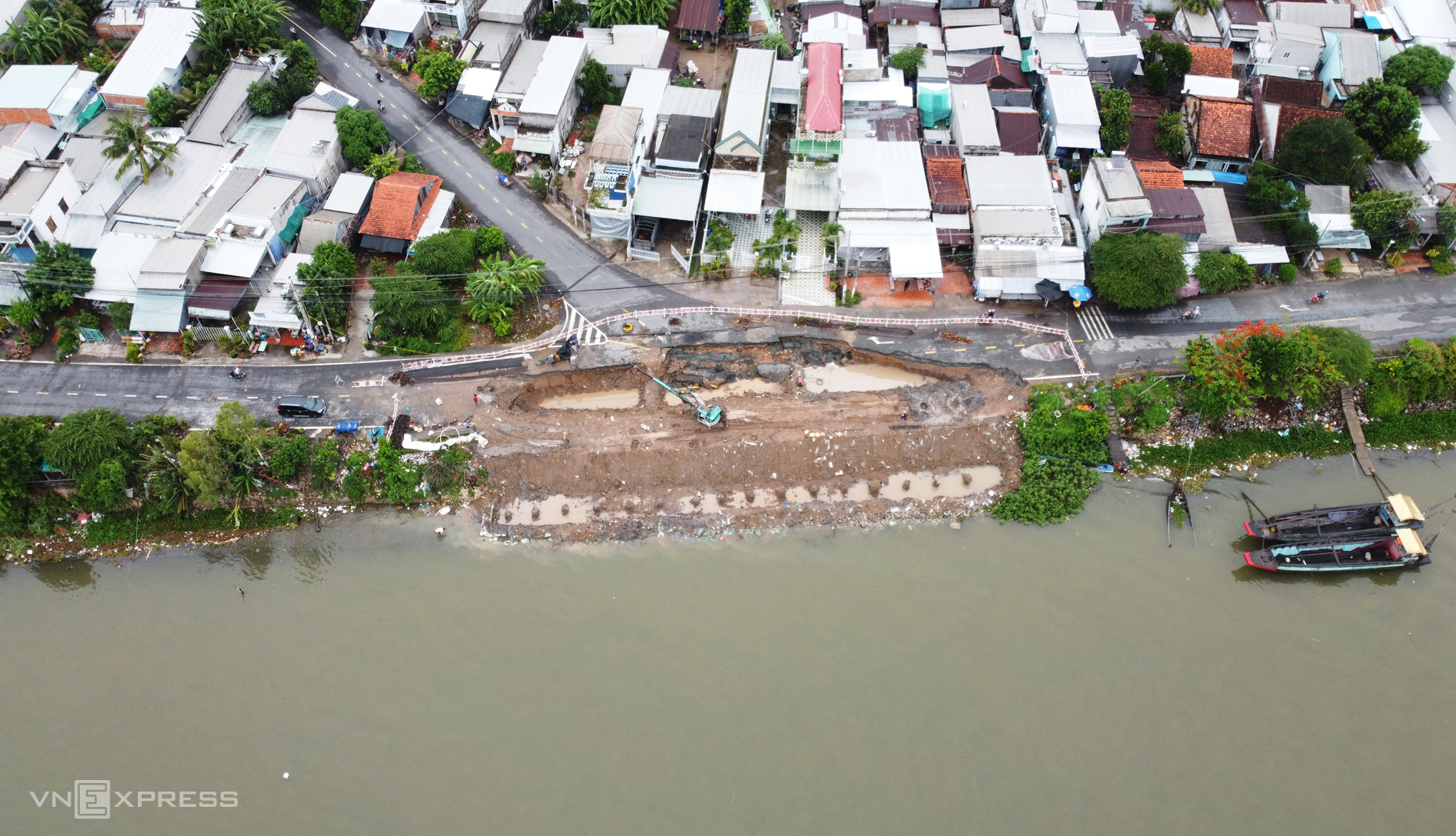
Despite choosing a location on a sandbank deep within the river, planting trees, and building embankments to prevent erosion, Mr. Tran Quang Vinh ( An Giang ) still lost half of his factory to the Mekong River.
Mr. Vinh gazed silently at the 160-meter embankment crumbling like foam, then looked at the dilapidated 1.2-hectare factory of the Hoa Binh Food Processing Plant, unsure of what to prepare for the future. After 15 years of building his business in the Mekong Delta, he had used many methods to cope with erosion, but it still wasn't enough.
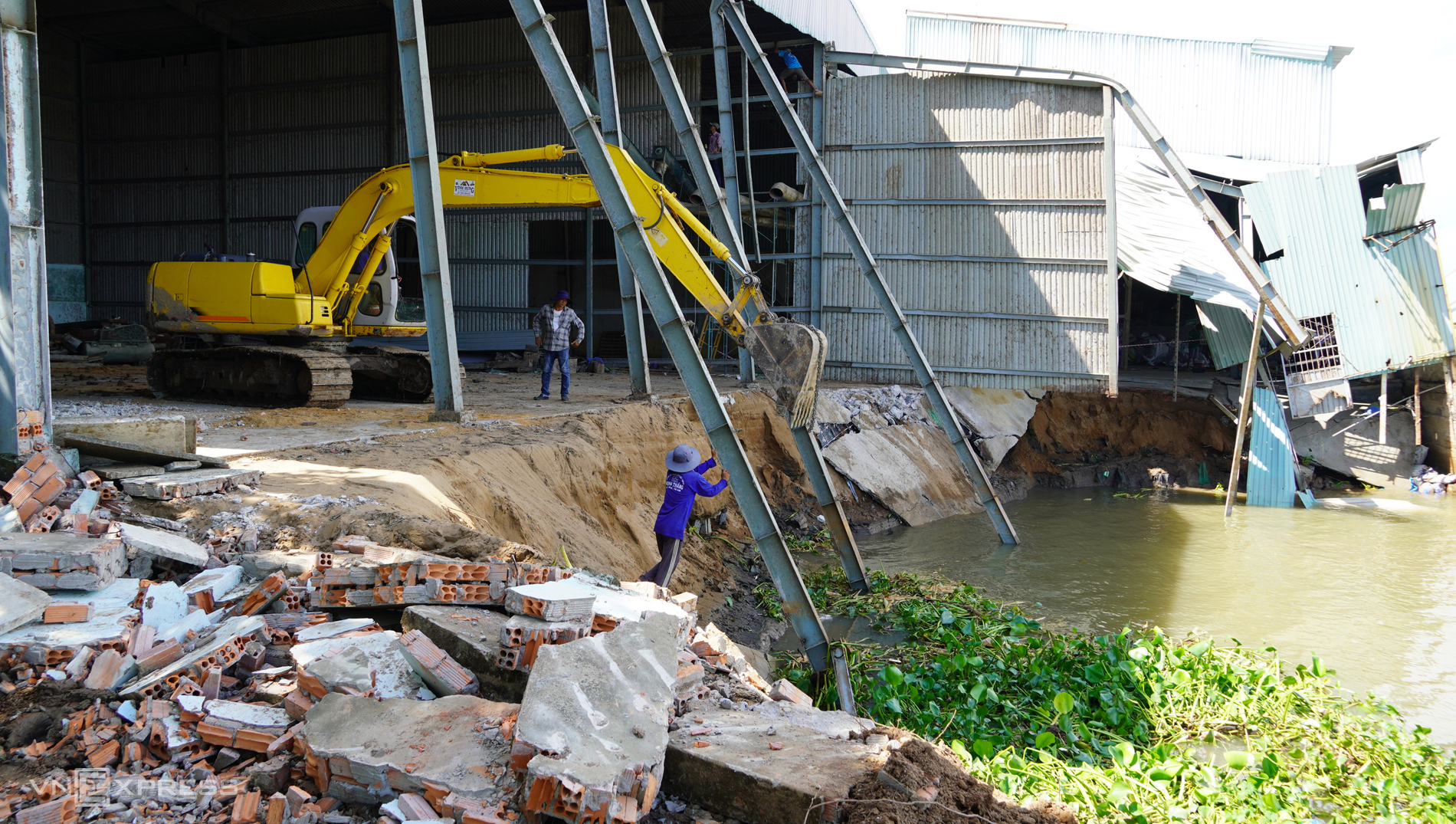
The landslide in mid-May caused the workers' three-room dormitory to sink deeply, requiring its demolition. Half of the 1,300 square meter warehouse was destroyed, leaving behind torn corrugated iron sheets and twisted, deformed roof beams.
Decades of hard work went down the drain in an instant, resulting in losses of over ten billion dong. This led to 100 workers having to halt production for several days while the factory was restored. Each day of downtime resulted in a loss of revenue equivalent to 200 tons of rice.
Mr. Vinh's workshop is among 136 houses damaged by landslides in the Mekong Delta over the past six months. 145 landslides since the beginning of the year have cost the delta region more than 30 billion VND, along with 1.7 km of dikes and 1.5 km of roads. Even before the rainy season – the peak of the landslide season – five provinces – Long An, An Giang, Dong Thap , Vinh Long, and Bac Lieu – have declared a state of emergency in 10 riverbank and coastal areas.
Those damages are just the tip of the iceberg. Each landslide leaves behind lasting concerns for both residents and businesses in this riverside region.
There's no escaping fate.
Recalling 2008, when he went to Cho Moi to survey a location on the banks of the Hau River for a rice mill, Mr. Vinh calculated and searched for the safest place. Seeing an alluvial plain several tens of meters from the riverbank, convenient for transporting large quantities of goods by ship, and in a place with calm water, he decided to fill it in and build a warehouse.
Everything went as planned for the next 12 years, until the river in front of the factory became more turbulent, and the alluvial plain gradually disappeared. An Giang became one of the areas with the highest risk of landslides in the Mekong Delta. To protect the factory area, he had a series of mangrove piles driven in, then coconut piles, before building a concrete embankment. The cost exceeded 10 billion VND.
After Tet (Lunar New Year), before the rainy season arrived, he heard that a village on the opposite bank of the river (My Hoa Hung, Long Xuyen City) had lost thousands of square meters of its fish ponds due to landslides. Seeing signs of the mangrove trees in front of the factory also collapsing, the 59-year-old man sensed something was wrong. He immediately hired someone to use a "monitoring machine" to scan the riverbank around the factory, believing he had anticipated all the risks, until the landslide actually occurred.
"Nobody thought the riverbank would collapse right there," he recounted, further explaining that inspections revealed no undercutting and that the base of the riverbank below was not hollow.
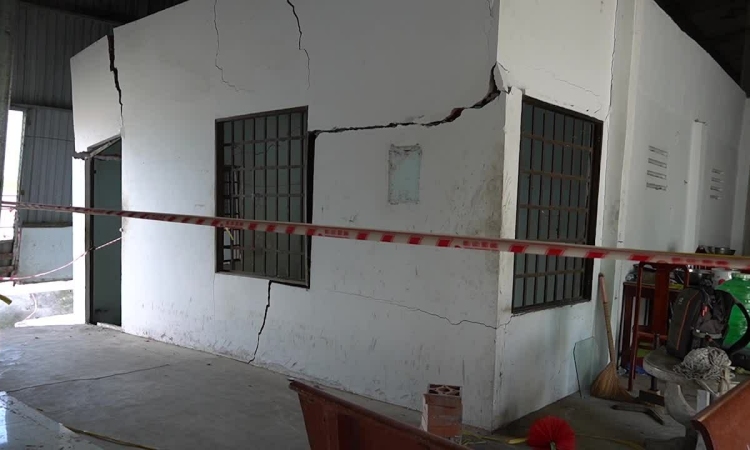
After the landslide, the "hungry" water continued to silently erode the banks, occasionally "devouring" large chunks, and it was unknown when it would swallow the rest of the factory. Many new cracks began to appear on the cement floor 20 meters from the landslide site. As a precaution, Mr. Vinh had the entire warehouse and machinery dismantled. A section of the rice conveyor belt had already been swept away by the river, and he didn't want to lose any more.
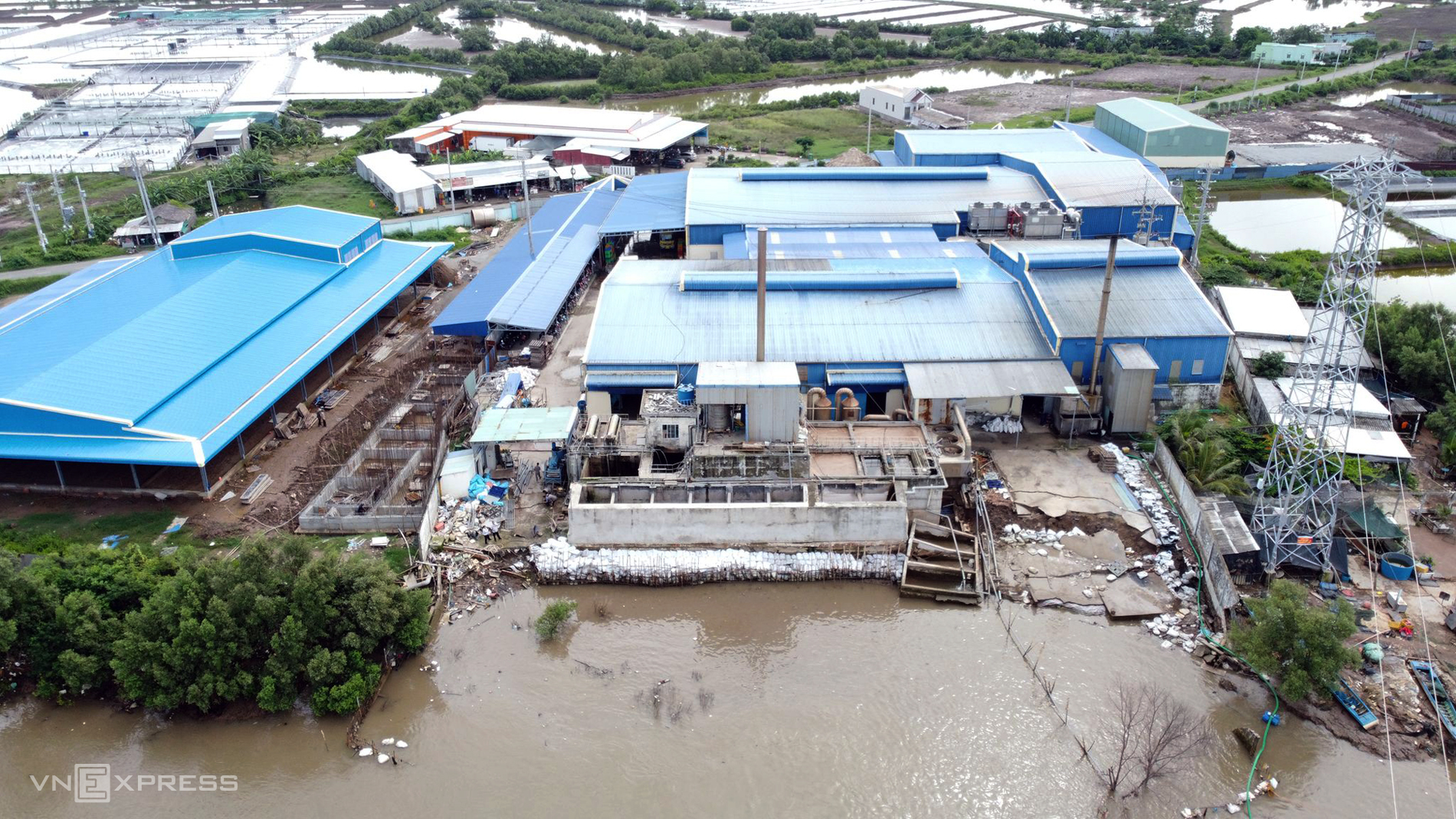
Located more than 200 km downstream from An Giang province, Truong Phuc Aquatic Products Co., Ltd. (Canh Dien hamlet, Long Dien Tay commune, Dong Hai district, Bac Lieu province) is facing the same situation.
"In just six years, we've suffered two landslides," Deputy Director Hua Hong'an said while busy clearing the debris at the factory after a landslide earlier in the rainy season.
In just seven months, the number of landslides in Bac Lieu has doubled compared to the same period last year, causing 119 houses to collapse and damaging thousands of hectares of shrimp and fish ponds.
As a native of Bac Lieu with 37 years of experience in aquaculture, Mr. An recounts that in the 1990s, the alluvial plain along the riverbank extended so far that when the tide receded, a large open space was revealed, big enough for the village boys to play football. The section of the river passing by the factory was then only 100 meters wide and peaceful. Now, the river is twice as wide, with a turbulent flow.
When he bought the land to build the factory, he carefully constructed an embankment about 50 meters from the riverbank to protect against strong waves and winds. Unexpectedly, the landslide on the night of June 9th swallowed up the entire embankment and retaining wall, covering an area of 1,200 square meters. The prefabricated factory and the backup wastewater treatment pond were also damaged.
Mr. Vinh and Mr. An are typical examples of a class of entrepreneurs in the Mekong Delta region who are struggling to live with the unpredictable changes brought about by natural disasters. Having spent billions of dong building embankments, yet facing the constant threat of disaster, these businesses are preoccupied with survival and have no time to think about development.
"Doing business in the Mekong Delta is difficult in every way; there's no escaping disaster," Mr. Vinh said, "we have to face so many paradoxes."
According to Mr. Vinh, despite being surrounded by waterways, transporting goods is not easy. Businesses wanting convenient trade with large ships have to build warehouses and factories along the riverbanks, but they worry about erosion. The river and canal system spans nearly 28,000 km, but the infrastructure on both banks is inadequate, and excessive activity will create large waves, accelerating the erosion process.
While businesses struggle to live with erosion, many communities that have lived along the river their whole lives are now displaced, scattered, and scrambling to find livelihoods after the river erodes their banks.
Life is precarious, a constant struggle.
In his old house nestled beside the Cai Vung River – a small tributary of the Tien River – Mr. Nguyen Van Thom (45 years old, from An Giang province) looks at the numerous cracks on the walls, trying to distinguish which ones are newly appeared. The 100-square-meter house, the result of over 20 years of hard work, is now abandoned. On the old wall, the words "hundred years of happiness" are covered by a thick layer of dust, reminding the 45-year-old man of the happy days his family spent living by the river.
For generations, his family had made a living fishing on the river, but for the past two decades, their lives had become increasingly difficult. From a time when simply casting a net would yield a bountiful harvest of several dozen kilograms of fish and shrimp, the trawler now had to travel further and further. Some days, he would return with an empty net. Having lost money on fuel, he decided to sell the trawler, buy a wooden boat, and switch to transporting rice for hire for the locals.
In 2001, the house began to erode. The hamlets along the Cai Vung River (Long Son Ward, Tan Chau Town) became dangerous erosion hotspots, requiring annual monitoring. Neighbors gradually thinned out. Mr. Tran's family, lacking land for relocation, remained in their home for six years. Every day, they lived in fear, watching the water lap against the base of their house.
In 2007, his family left the riverfront for the first time, relocating under a government program nearly 2 kilometers from their old home. Though saddened, he knew he had to say goodbye to the place he had been attached to for decades.
Since moving to a new place far from the riverbank, he had to sell his rice-carrying boat and switch to selling pottery and porcelain to make a living. His older brother also left the area to seek work in Ho Chi Minh City. The Thơm family's life on the river came to an end. He didn't want to leave, but he had no other choice.
"To let go is painful, but to hold on... is death," he said.
Mr. Thom is just one of millions of people facing an uncertain future as they search for a new place to live and a new source of livelihood.
According to incomplete statistics, the Mekong Delta has nearly 500,000 households that need to be relocated to avoid landslides, of which tens of thousands are in urgent need of relocation. From 2015 to the present, the government has only resettled about 4% - more than 21,606 households - with a total cost of 1,773 billion VND.
Relocating entire areas at risk of landslides remains challenging for local authorities due to a lack of funding, land, and solutions to the livelihood problem, while the number of landslide-prone areas continues to increase.
For example, An Giang province has been requesting 1,400 billion VND from the central government for many years to urgently relocate 5,300 households. In the distant future, this number is expected to reach approximately 20,000 households, meaning around 7,000 billion VND will be needed, equivalent to the province's domestic revenue in 2022.
Having served as Vice Chairman of An Giang province for over four years, in charge of agriculture, Mr. Tran Anh Thu has become accustomed to signing decisions declaring a state of emergency whenever the rainy season arrives.
As a master of soil science and having served for a long time as Director of the Department of Agriculture and Rural Development of the province, Mr. Thu is well aware of the increasing severity of landslides in upstream provinces such as An Giang and Dong Thap.
"The number and scale of landslides have increased significantly compared to 20 years ago, spreading to smaller canals where many households live, causing ever greater damage," he said.
Erosion
Landslides are the final and most visible manifestation of a preceding process of destruction, as the Mekong Delta suffers from a lack of alluvial deposits.
This delta region bears the heavy responsibility of ensuring national food security, supplying 50% of rice production and 70% of seafood. However, this "rice pot" is dwindling. Landslides not only erode the soil but also "erode" the economy of the Mekong Delta.
"In a large river basin like the Mekong, everything is interconnected. Losses in this sector can have ripple effects on many other sectors," said Marc Goichot, Freshwater Program Manager for WWF Asia Pacific.
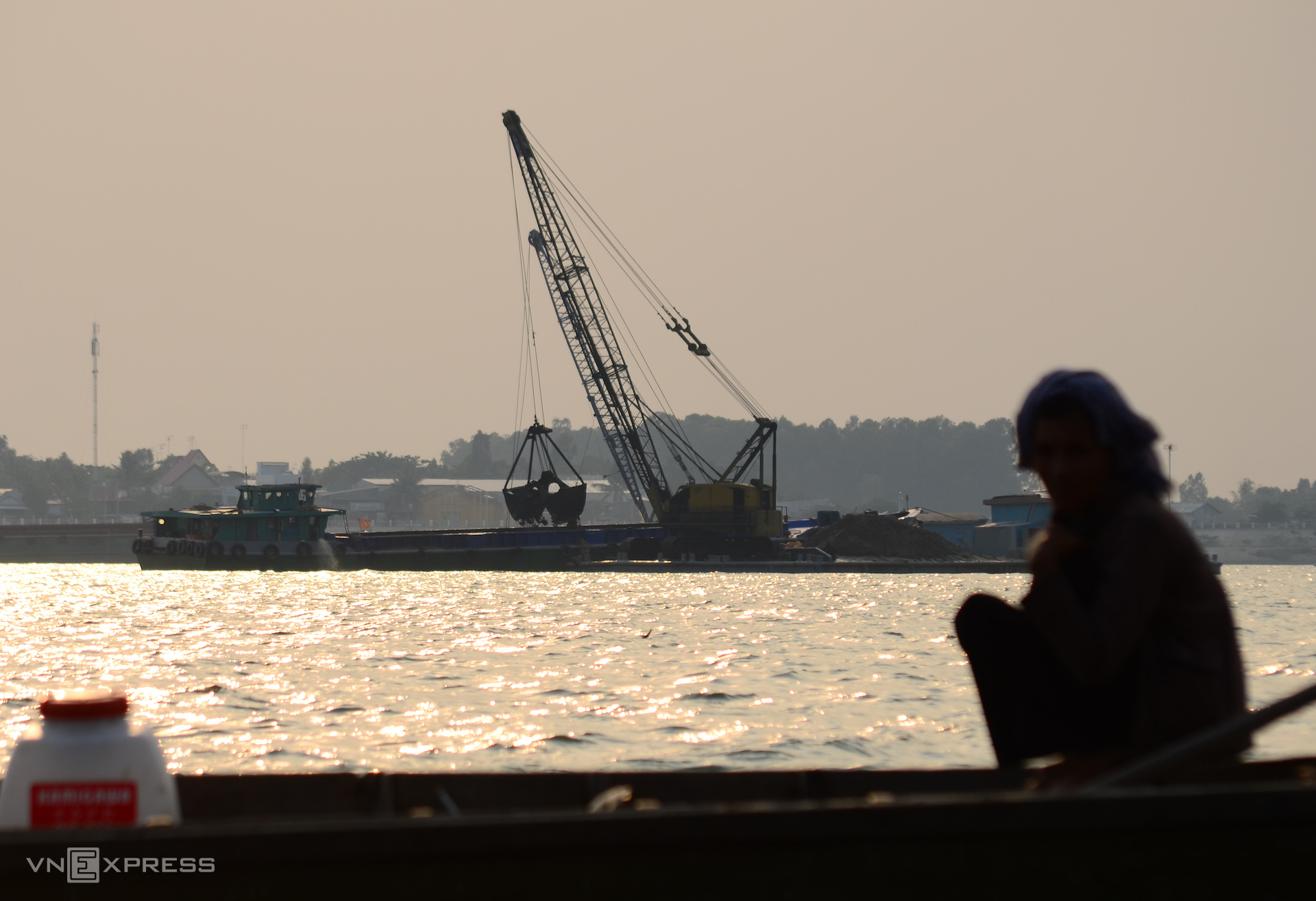
According to this expert, all economic sectors are somewhat dependent on the river. Deepening of the riverbed affects agriculture, fisheries, water quality, and infrastructure. Reduced silt, or sand and gravel, also causes riverbank erosion, leading to land loss, house collapses, and infrastructure damage.
The 2020 and 2022 annual reports on the Mekong Delta by VCCI Can Tho and the Fulbright School of Public Policy and Management indicate that, three decades since the Doi Moi (Renovation) period, the economic role of the Mekong Delta compared to the rest of the country is gradually declining, being the lowest among the four key economic regions.
Looking back to 1990, Ho Chi Minh City's gross domestic product (GDP) was only two-thirds that of the Mekong Delta. Two decades later, this ratio has reversed, despite the fact that the Mekong Delta's population is nearly double that of Ho Chi Minh City, along with its abundant resources.
Dr. Vu Thanh Tu Anh, head of the research team, noted that while the region faces economic difficulties, investment resources are also very modest. The Mekong Delta is the region with the lowest foreign investment attraction in the country. Public investment resources have also been neglected in the Mekong Delta for many years, especially in the construction of transportation infrastructure. As a result, intra-regional road networks, as well as inter-regional connectivity, are very weak, thus making it unattractive to investors.
Struggling to adapt to natural disasters and lacking external capital incentives, businesses are facing even greater difficulties. In 2021, the density of businesses in the Mekong Delta was only 3.53 per 1,000 working-age people, while the national average was 8.32 businesses.
"The only way for people and businesses to adapt to climate change and natural disasters is to address the core issue causing the delta's decline in resilience," said Goichot, emphasizing the importance of sand in rivers and coastlines as a protective shield for the delta against water and climate hazards.
However, how to adapt remains a question for Mr. Vinh, owner of Hoa Binh Food Processing Enterprise (An Giang).
More than three months have passed since the landslide, and the business remains in a dilemma. The river continues to erode the banks, but the owner cannot construct an embankment because the flood season is approaching and they will have to wait until the dry season – the following year. Relocating the factory is also impossible as most of the equipment is bulky and cannot be moved via the provincial road because the bridge system cannot withstand the load. Meanwhile, the riverbank is eroding, preventing ships from entering.
"All we can do is wait and hope the river's anger subsides," said the director of Hoa Binh Enterprise.
Hoang Nam - Thu Hang - Ngoc Tai

Source link



![[Photo] General Secretary and President To Lam works with the Party Committee of the Ministry of Health on the work of Vietnamese traditional medicine.](https://vphoto.vietnam.vn/thumb/1200x675/vietnam/resource/IMAGE/2026/05/20/1779294323718_a1-bnd-2978-3319-jpg.webp)
![[Image] "Journey of Hope" promotes the organ and tissue donation movement in Vietnam.](https://vphoto.vietnam.vn/thumb/1200x675/vietnam/resource/IMAGE/2026/05/20/1779294400833_1-8910-jpg.webp)




























![[Photo] National Assembly Chairman Tran Thanh Man working with the Standing Committee of the National Assembly's Delegation Affairs Committee.](https://vphoto.vietnam.vn/thumb/1200x675/vietnam/resource/IMAGE/2026/05/20/1779294340023_ndo_br_1-1691-jpg.webp)
































































Comment (0)