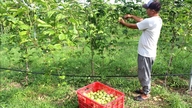
These days, the melon fields in Ban Ven village, Bat Xat commune, Lao Cai province are in the midst of harvest. These low-lying, acidic fields, once abandoned due to poor rice yields, now provide a stable income for many households.

Cantaloupe cultivation yields 3-4 times more income than rice farming in the past. Photo: Luu Hoa.
Previously, the people of Bản Vền mainly grew rice, but due to the acidic, low-lying soil that was frequently flooded, the yield was low. Based on this reality, the local government and agricultural officials persistently encouraged the villagers to switch to crops with higher economic value. After several surveys, cantaloupe was chosen as the crop.


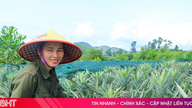
The crop conversion in Ban Ven village did not happen haphazardly. From the beginning, the villagers received guidance from technical staff who came directly to their fields, instructing them on every step from soil preparation, furrowing, seed selection, to fertilization and care.
During cultivation, many new techniques were applied locally for the first time, such as using plastic mulch to retain moisture, controlling weeds, pruning at the right time to increase fruit set, and early detection of pests and diseases for timely treatment. On-site training sessions not only helped farmers apply the correct techniques but also gradually shifted their production mindset from traditional experience to a systematic approach with calculated economic efficiency.
Cantaloupe is well-suited to the climate and soil conditions of Ban Ven, with a short growing season, easy to care for, and significantly higher economic efficiency compared to rice cultivation. With selling prices ranging from 25,000 to 40,000 VND/kg and relatively stable demand, farmers earn an average profit of 7 to 10 million VND per sao (approximately 1000 square meters) of cantaloupe, 3-4 times higher than before.
In addition to providing technical support, the local agricultural sector also works alongside farmers in connecting with markets and orienting production according to consumer demand. In the coming time, Bat Xat commune will continue to expand the area for growing cantaloupe, strengthen technical training, and build linkages for product consumption.
Source: https://nongnghiepmoitruong.vn/doi-doi-nho-trong-dua-le-d815959.html

![[Photo] The 13th National Congress of the Youth Union conducts personnel work.](https://vphoto.vietnam.vn/thumb/1200x675/vietnam/resource/IMAGE/2026/06/24/1782299943080_ndo_br_1-6868-jpg.webp)
![[Photo] Opening Ceremony of the 13th National Congress of the Ho Chi Minh Communist Youth Union](https://vphoto.vietnam.vn/thumb/1200x675/vietnam/resource/IMAGE/2026/06/24/1782286753905_ndo_br_1-8510-jpg.webp)
![[Photo] General Secretary and President To Lam attends the Central Public Security Party Committee Conference](https://vphoto.vietnam.vn/thumb/1200x675/vietnam/resource/IMAGE/2026/06/24/1782302063612_a1-bnd-9302-9166-jpg.webp)