

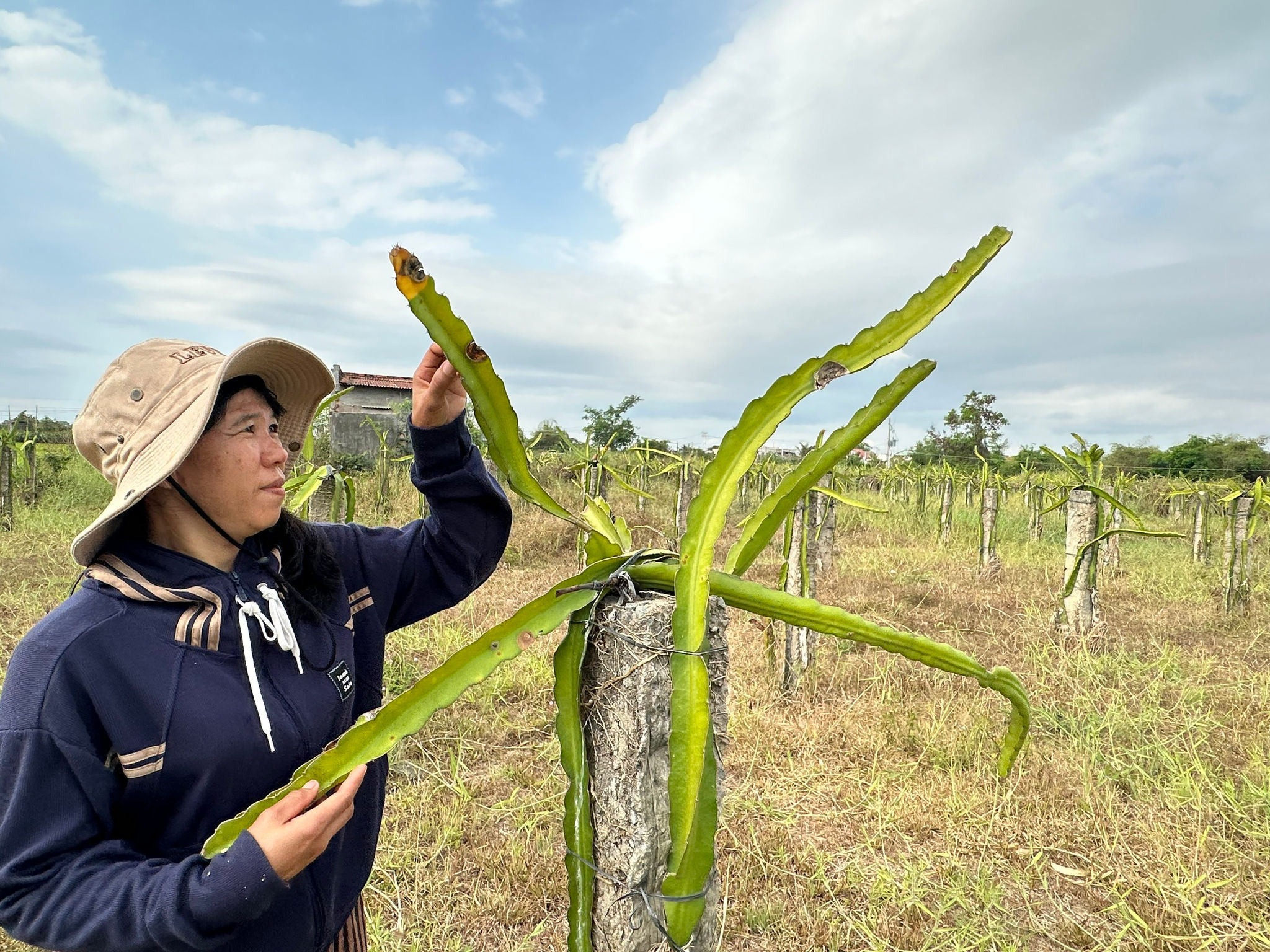
Farmers are guided in choosing crops.
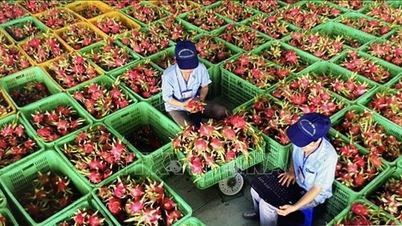
Dragon fruit currently covers an area of 26,000 hectares, concentrated in the southeastern part of the province. In recent years, producers have applied many scientific and technical advancements, gradually improving productivity and product quality. However, there is still a situation of spontaneous expansion of cultivation area, lacking synchronized planning. This leads to oversupply at certain times, putting significant pressure on market prices. In addition, dependence on traditional export markets makes the output of dragon fruit unstable; many dragon fruit plantations are barren and have low yields.
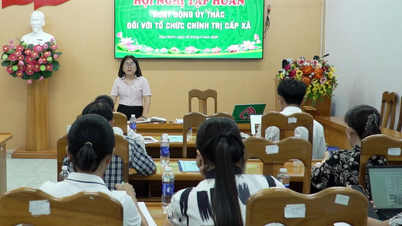
In response to this situation, the Lam Dong agricultural sector organized a seminar on "Solutions for converting inefficient dragon fruit cultivation land to other crops such as passion fruit, pineapple, and apples..." in the southeastern region of the province. The event attracted hundreds of farmers from communes and wards such as Ham Liem, Hong Son, Ham Thuan, Ham Thuan Bac, and Tuyen Quang to receive advice and apply it.
To guide farmers in crop diversification, the provincial agricultural sector has introduced technical solutions. Simultaneously, effective conversion models to crops such as passion fruit, pineapple, and apples have been presented. These crops are suitable for the local soil conditions and market demand.
Mr. Nguyen Huu Nhan, from Hamlet 4, Hong Son Commune, one of the households participating in the discussion, said: “My family is currently collaborating with EDEN farm (Ham Thuan Bac Commune) in production and has a guaranteed market for our yellow passion fruit, which is highly effective. In fact, yellow passion fruit is a nutritious, delicious fruit that is popular in the international market. The southeastern region of the province, with its sunny climate, well-drained sandy soil, and the advantage of large-scale production, is ideal for developing high-quality yellow passion fruit to serve both the domestic and export markets.”
According to the provincial agricultural department, the total area of passion fruit cultivation in Lam Dong province is currently about 4,800 hectares, concentrated in the central and western areas of the province. In the southeastern region, it is a new crop chosen by farmers to replace aging dragon fruit orchards. The current replacement area is about 30 hectares, concentrated in Tan Thanh commune, Ham Thuan Bac district, and Ham Thuan Nam district.
Enhancing the competitiveness of agricultural products.
Drawing a prime example from passion fruit cultivation, the issue of concern for the provincial agricultural sector and farmers is market trends. In addition, the role of production-consumption linkages, value chain development, and the promotion of safe production standards are crucial to enhancing the competitiveness of agricultural products. Ms. Mai Thi Thuy Kieu, an official from the Provincial Department of Crop Production and Plant Protection, emphasized that converting less efficient dragon fruit crops faces many difficulties. This is due to some farmers not yet identifying truly effective alternative crops. Furthermore, the lack of consumption linkages with businesses leads to unstable prices, easily resulting in situations of "bumper harvests but low prices." Therefore, before conversion, it is necessary to implement production models linked to effective consumption chains. This allows farmers to visit, learn, and choose suitable models, thereby improving production efficiency and stabilizing output. Furthermore, coconut trees are also a crop that generates supplementary income for households, contributing to improved nutrition and creating jobs for rural workers. According to representatives from the Provincial Department of Crop Production and Plant Protection, the area of coconut cultivation in the southeastern part of the province is over 1,400 hectares, mainly concentrated in Mui Ne, Hong Son, Bac Binh, and Ham Tan. Coconut trees adapt well to many different soil types. Coconut products exported mainly include coconut oil, coconut oil cake, coconut flesh, coconut fiber, etc. High value-added products include coconut milk, coconut ice cream, and coconut milk powder. From 2025, fresh coconuts will not only be consumed domestically but also exported to China, South Korea, and Middle Eastern countries.
According to the Provincial Agricultural Extension Center, converting old dragon fruit orchards to other crops such as passion fruit, custard apple, coconut, etc., is a promising direction for many farmers in the southeastern part of the province. If implemented comprehensively in terms of technology, market access, and production organization, this will be an important solution for sustainable agricultural restructuring, increasing people's income, and reducing dependence on dragon fruit.
Source: https://baolamdong.vn/dinh-huong-chuyen-doi-thanh-long-kem-hieu-qua-441273.html
![[Image] Close-up view of the interchange connecting the two expressways and Long Thanh Airport.](https://vphoto.vietnam.vn/thumb/1200x675/vietnam/resource/IMAGE/2026/05/25/1779703378210_ndo_br_z7863716673926-224453a31600126cce10622af6290afd-4549-jpg.webp)

![[Image] Hanoi's urban life under the challenge of a "scorching hot" environment](https://vphoto.vietnam.vn/thumb/1200x675/vietnam/resource/IMAGE/2026/05/25/1779706979265_nang-nong-t5-2026-minh-duy-7-4636-jpg.webp)
















































































Comment (0)