

In the context of increasingly deep international integration and the rapid growth in the number of businesses, workers, and union members, the tasks of trade unions have become more specific and demanding; however, the staffing of trade unions is very low, only about one-third compared to other socio- political organizations.
According to reports from provincial and city labor federations, as of March 31, 2024, the total number of local trade union positions allocated by local Party committees in 2024 was 5,119. Meanwhile, according to calculations by the Vietnam General Confederation of Labor , based on the number of union members and grassroots trade unions, the minimum number of positions required for local trade unions is 5,899. Thus, the total number of positions allocated by local Party committees to trade unions is currently 780 positions lower than the minimum needs of the trade union organization.
The current mechanism for managing trade union officials, which is based on the staffing quota allocated by higher authorities to the Party, the Fatherland Front , and socio-political organizations, has revealed several shortcomings. One of these inadequacies is the inconsistency in staffing within the same level of the trade union. In areas with a large number of union members and workers, the number of staff is sometimes lower than in areas with fewer members.
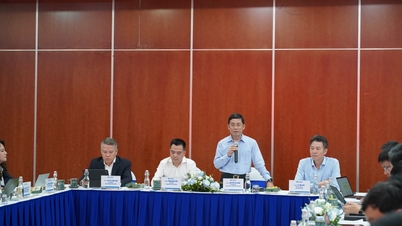
At a press conference providing information on the situation of workers, trade unions, and the draft Law on Trade Unions (amended), Vice President of the Vietnam General Confederation of Labor Ngo Duy Hieu cited an example: Tan Uyen City, Binh Duong province, has approximately 96,000 union members and 554 grassroots trade unions, but only four higher-level trade union officials. This means that each trade union official is responsible for more than 100 grassroots organizations and nearly 25,000 union members. This is a huge workload placed on the shoulders of trade union officials.
Labor and trade union experts argue that the number of union staff should not depend on the population of a province, city, or industry, but rather on the number of union members, workers, businesses, and the economic development of each industry and locality. Furthermore, the allocation of staff is decided by local Party committees while financial resources are secured by higher-level trade unions, leading to a lack of coordination in the distribution of human and financial resources; it fails to regulate the flow of surplus to shortages nationwide as well as within provinces and cities.
On the other hand, the majority of grassroots trade union officials work on a part-time basis and are subject to the control of the business owner because they are employees hired and paid by the business owner. This is a major obstacle that limits the independent and strong voice of grassroots trade union officials in enterprises, affecting the protection of the rights and interests of union members and workers, especially in enterprises with a large number of employees.
This revised draft Law on Trade Unions includes several changes compared to the 2012 Law on Trade Unions, aiming to improve regulations on the organization of trade union structures, the management mechanism of trade union officials, and to strengthen the role of the Vietnam Trade Union in the new context. To institutionalize the spirit of Resolution No. 02-NQ/TW, dated June 12, 2021, of the Politburo on reforming the organization and operation of the Vietnam Trade Union in the new situation, the draft law adds and proposes granting more autonomy to trade union organizations in personnel matters as follows: The Vietnam General Confederation of Labor will develop norms and criteria to determine the number of full-time trade union officials who are civil servants and public employees, based on the number of trade union organizations, trade union members, and workers in each locality and the requirements of trade union activities, to be submitted to the competent authority for decision.
The regulations also stipulate that the Vietnam General Confederation of Labor will decide on the number of full-time trade union officials who are employed under labor contracts in specialized trade union agencies and grassroots trade unions in each period, in accordance with the requirements of the tasks, the number of trade union members and workers, and the financial capacity of the trade union organization.
The structuring of full-time trade union officials in enterprises with a large workforce, managed and paid by the trade union, aims to ensure the independent and strong voice of trade union officials in representing and protecting the rights of workers. The amendment and supplementation of regulations granting the Vietnam General Confederation of Labor the authority to proactively propose the number of trade union officials who are civil servants and public employees throughout the system is expected to create uniformity in staffing within the trade union system.
Many experts, grassroots officials, and trade union members believe that granting the Vietnam General Confederation of Labor the autonomy to decide on the number of contract workers in specialized agencies and grassroots trade unions ensures proactive and flexible personnel allocation, meeting the requirements for membership growth at each stage and contributing to enhancing the operational capacity of trade union organizations in the new context.
Source: https://nhandan.vn/tang-bien-che-cong-doan-doi-hoi-cap-thiet-tu-thuc-tien-post838726.html
![[Image] The appearance of the Bien Hoa-Vung Tau expressway before its opening.](https://vphoto.vietnam.vn/thumb/1200x675/vietnam/resource/IMAGE/2026/03/25/1774430324663_ndo_br_2-resize-6064-jpg.webp)



















































































Comment (0)