Effective economic models
Chieng Vang village is located about 20 km from the center of Nam Ty commune. With 188 households and nearly 900 inhabitants, the people's lives previously depended mainly on growing corn and cassava, resulting in low income and a high poverty rate. In recent years, implementing the policy of restructuring crop and livestock production, the commune's Party committee and government have intensified propaganda and mobilization efforts to encourage people to change their methods, introducing high-value crops and livestock, and applying science and technology to production.

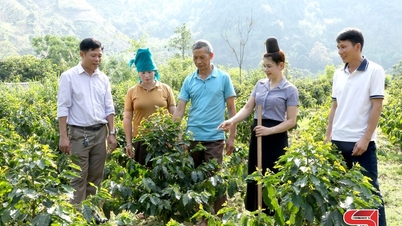
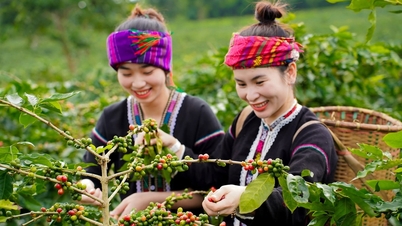
Our first destination was the lush green coffee plantation of Mr. Luong Van Dinh's family. Few would imagine that these hillsides were once covered with low-yielding corn and cassava fields. Thanks to their bold shift in crop structure, his family has transformed the sloping land into a production model that provides a stable income. Mr. Dinh shared: "In 2018, after visiting and learning from experiences in several localities, and recognizing the suitable climate and soil, my family planted 1,000 coffee trees as a trial. After two years of care, the trees grew well, yielding promising productivity and quality. In 2020, the family expanded the area to over 2 hectares. By 2025, the coffee plantation will yield over 6 tons of fresh fruit, with an average selling price of over 20,000 VND/kg, bringing the family over 120 million VND."
Not only Mr. Luong Van Dinh's family, but many households in Chieng Vang have also boldly switched their crop structure towards commercial production. Ms. Luong Thi Duyen's family is one of the pioneering households that converted their low-yield rice fields to Catimor coffee plantations. Ms. Duyen shared: After visiting and learning from Mr. Dinh's coffee farming model, in 2023, her family converted their rice fields to planting 3,000 Catimor coffee trees. To date, the coffee plantation is growing and developing well. The family hopes that this year's harvest will continue to maintain stable coffee prices to increase income and provide opportunities for investment in expanding production.

Along with coffee cultivation, many households in Chieng Vang have boldly sought new directions in livestock farming to increase their income. Mr. Luong Van Tom's family is one such example, with their model of raising bamboo rats for both commercial and breeding purposes. In 2021, he started experimenting with raising a few pairs of local bamboo rats and pink-cheeked bamboo rats, learning as he went through books, newspapers, and practical models. After more than four years, his family's bamboo rat herd has grown to nearly 100 animals.
Mr. Tom shared: Raising bamboo rats isn't too complicated; their main food consists of bamboo, reeds, sugarcane, corn, and potatoes, all readily available locally. The cages are simple, require little space, and don't require much care. Bamboo rats grow quickly and can be sold commercially after 5-9 months. Currently, both meat and breeding bamboo rats fetch good prices, with the pink-cheeked variety reaching up to 500,000 VND/kg.
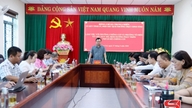
The success of coffee cultivation and bamboo rat farming models has not only provided a stable income for households in Chieng Vang but also created a ripple effect. From being accustomed to traditional production methods, people have changed their mindset, boldly transforming the structure of crops and livestock, proactively learning techniques, and developing production towards a commodity-based approach. This is a crucial foundation for the locality to gradually build an efficient production area, increase income, and move towards sustainable development.

Working together to build a bright, green, clean, and beautiful village.
Chieng Vang is a shining example in implementing the "All people unite to build new rural areas and civilized urban areas" movement in Nam Ty. Mr. Luong Van Chau, Deputy Head of Chieng Vang village, said: Right from the time the village was selected by the commune to build a model village, the village management board organized many meetings with the people to disseminate information so that they understood the purpose and significance and actively participated.

To build Chieng Vang village into an increasingly bright, green, clean, and beautiful place, the commune's mass organizations have played a core role in disseminating information and mobilizing the people. The Farmers' Association guides people in cleaning their houses, moving livestock pens away from living areas, building hygienic toilets and bathrooms, and properly disposing of livestock waste. The Women's Union and the Youth Union maintain "Green Sunday" and "Volunteer Saturday" activities, regularly cleaning village roads and alleys, clearing drainage ditches, and collecting waste; contributing to creating a clean and beautiful rural landscape.
Maintaining environmental hygiene in Chieng Vang has been incorporated into the village's customs and regulations, and is one of the criteria for evaluating the title of "Culturally Advanced Family" annually. As a result, people's awareness has been increasingly raised, creating a clear transformation in building a civilized way of life.
Ms. Luong Thi Dung, Head of the Women's Association of Chieng Vang village, said: "Through propaganda and mobilization, the villagers have actively responded. Regularly, households work together to clean the village roads and alleys, take care of the trees and flower-lined roads. From the funds paid for forest environmental services and contributions from the people, the village has planted 500m of flower-lined roads, 100 trees, built a welcome gate and installed nearly 100 solar-powered streetlights along the village roads with a total cost of over 150 million VND."




Implementing the policy of developing the economy in conjunction with building a "bright, green, clean, and beautiful" village, Chieng Vang continues to encourage its people to transform the structure of crops and livestock to suit the local natural conditions. What is noteworthy is not only the figures regarding area or income, but also the transformation in the people's awareness. From waiting and relying on others, the people have proactively sought out and learned, boldly applying new production models, working together to build a beautiful environment and preserve a civilized way of life.

With the attention and support of the local Party committee and government, and the unity and solidarity of the people, Chieng Vang is gradually building a comprehensively developed village with a thriving economy, a bright, green, clean, and beautiful environment, contributing to improving the quality of life and building a sustainable new rural area.
Source: https://baosonla.vn/xa-hoi/doi-thay-o-chieng-vang-RopVQVBDg.html


![[Photo] Thousands of people participate in a run to show their support for the campaign "Sharing a common determination to build drug-free communes, wards, and special zones".](https://vphoto.vietnam.vn/thumb/1200x675/vietnam/resource/IMAGE/2026/06/27/1782554475933_0673e2a3df7b5e25076a-8283-jpg.webp)

![[Photo] A phone-free summer afternoon at the village library](https://vphoto.vietnam.vn/thumb/1200x675/vietnam/resource/IMAGE/2026/06/27/1782551770949_anh-1-jpg.webp)