

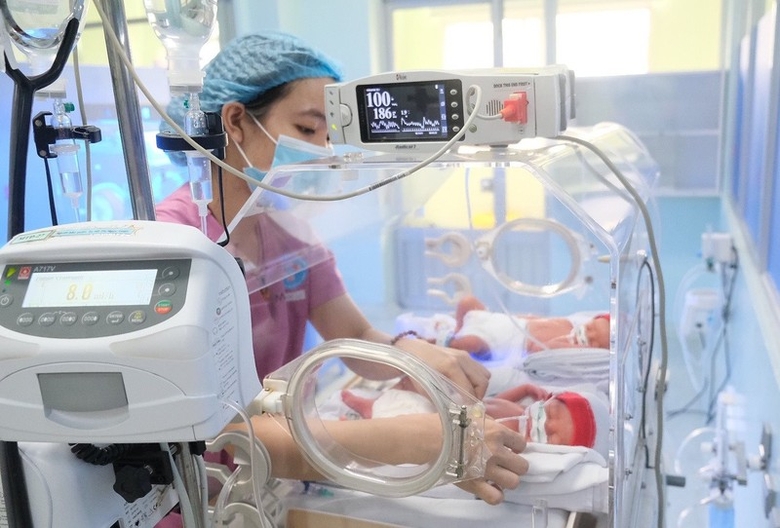
Risk of negative population growth
The Ministry of Health has recently proposed intervention measures to maintain the replacement fertility rate in Vietnam and prevent negative population growth.
In Vietnam, the average population growth rate during the 2017-2020 period was 1.07%. However, due to a slight downward trend in birth rates, the population growth rate has gradually decreased in recent years (average population growth rate in 2022 was 0.98%, in 2023 was 0.84%) and is projected to continue decreasing in subsequent years. According to the Vietnam Population Forecast 2019-2069 by the General Statistics Office, in the case of a sharp decline in birth rates as in the low scenario, after 2054, the population of Vietnam will begin to experience negative growth, and the rate of population decline will become increasingly large. During the 2054-2059 period, the population will decrease by an average of 0.04% per year, reaching 0.18% at the end of the forecast period (2064-2069), equivalent to an average decrease of 200,000 people per year. Conversely, if the replacement fertility rate remains stable, Vietnam's population will increase slightly, averaging 0.17% per year during the period 2064-2069, equivalent to 200,000 people per year.
According to the Population Department (Ministry of Health ), Vietnam's birth pattern is shifting from the highest birth rate in the 20-24 age group to the 25-29 age group. Simultaneously, the age of marriage is increasing, while the marriage rate is decreasing. This indicates a growing trend of late marriages, reluctance to marry, unwillingness to have children, late births, fewer births, and spaced-out births.
According to Mr. Le Thanh Dung, Director of the Population Department, studies and forecasts show a declining birth rate trend in Vietnam. This trend, in addition to impacting population size, also leads to a decrease in the proportion of children under 15 years old and an increase in the proportion of the elderly. Vietnam is still in the process of population aging and is one of the countries with the fastest aging rate in the world. It is predicted that by 2038, in just 15 years, Vietnam will enter the period of an aging population, meaning that one in five people will be over 60 years old.
Policy leverage is needed.
According to Dr. Bui Chi Thuong of Gia Dinh People's Hospital (Ho Chi Minh City), the recent proposal by the Ministry of Health to allow couples to decide how many children they want is entirely reasonable given Vietnam's rapidly aging population. This proposal should even have been implemented sooner, as the current situation shows that the population is aging before it gets rich. Furthermore, the birth rate in urban areas is alarmingly low, particularly in Ho Chi Minh City, where the birth rate in 2023 was only 1.32 children.
According to financial expert Associate Professor Dr. Ngo Tri Long, the government needs more supportive policies to encourage having two children, such as housing rental assistance, social housing purchase (with preferential interest rates), and policies on education and healthcare to reduce pressure on young people and prepare them psychologically and financially to proactively have children. Without solutions soon, we risk losing our abundant young workforce, failing to attract FDI businesses and large global corporations. This would lead to a labor crisis in the economy.
According to Professor Giang Thanh Long, from the Faculty of Economics, National Economics University (Hanoi), although the current replacement fertility rate nationwide is not yet at an alarming level, policies are still needed to "anticipate" the situation. The important thing is that social security policies must ensure the upbringing of children so that couples can feel secure in having children.
Professor Giang Thanh Long argues that as we are gradually implementing strategies and policies to adapt to population aging, the elderly will naturally be the focus of these strategies and policies. When discussing the elderly, it's important to note that there are two groups: the current elderly and the future elderly (or the young and middle-aged people of today). Adapting to an aging population means preparing for both groups. On the other hand, for the younger population – the future elderly – we need to seize the "golden opportunity" as their proportion and number will continue to increase over the next two decades. We need to prepare economically/financially, health-wise, and community-based activities to ensure both current and future income security, and to prepare for the "three pillars" of active aging – economic security, health-wise, and community activities.
The Ministry of Health is also proposing policies for training and career chuyển đổi for the elderly to adapt to population aging and an aging population. This is one of the notable points in the draft Population Law being developed by the Ministry of Health and currently open for public comment. According to the draft, there are currently over 4 million elderly people working in the economy nationwide, but most are in vulnerable and low-income jobs, with nearly 80% of elderly workers being self-employed or working in households. The average salary of the elderly is nearly 3.8 million VND/month, only 34% of the average market salary. The Ministry of Health proposes developing solutions to adapt to the aging population and an aging population; meeting the basic needs for elderly care and other rapidly increasing basic needs of the elderly. However, to implement this solution, the Ministry of Health believes that the State needs to ensure the budget for public awareness campaigns and for developing and issuing detailed regulations and guidelines for implementation.
It is important to emphasize that the elderly are not a "burden" on society; they continue to contribute – silently and often unacknowledged – to their families, communities, and society. Appropriately utilizing the knowledge and experience of the elderly will bring immense value to society. Conversely, failing to properly care for and prepare for a rapidly aging population at the right time will lead to missing the current demographic "golden opportunity" and creating a real "burden" in the future with nearly 30 million elderly people by the middle of this century.
Source







































































































Comment (0)