

But what about Ha Long Bay? For centuries, Ha Long was a transit point for ceramics from inland areas to overseas markets. Of the thousands upon thousands of ships that sailed in and out back then, were there any unfortunate vessels that ended up at the bottom of the bay?
To date, archaeologists have verified and cataloged dozens of ancient wharves within the Van Don trading port system, dating from the 11th to the 17th centuries. These wharves are not only distributed on the outer islands and along the coast, but also scattered among several coves and islands within the core area of the Ha Long Bay heritage site. Over the decades, numerous surveys have been conducted along the coast, at river mouths, and on the islands by archaeologists both domestically and internationally. However, archaeological research on the seabed of Ha Long Bay has been almost entirely neglected.
|
Earthenware jars from the Mac Dynasty (16th - 17th centuries) were recovered from the bottom of Ha Long Bay in 2009 by fishermen from Vung Vieng fishing village. |
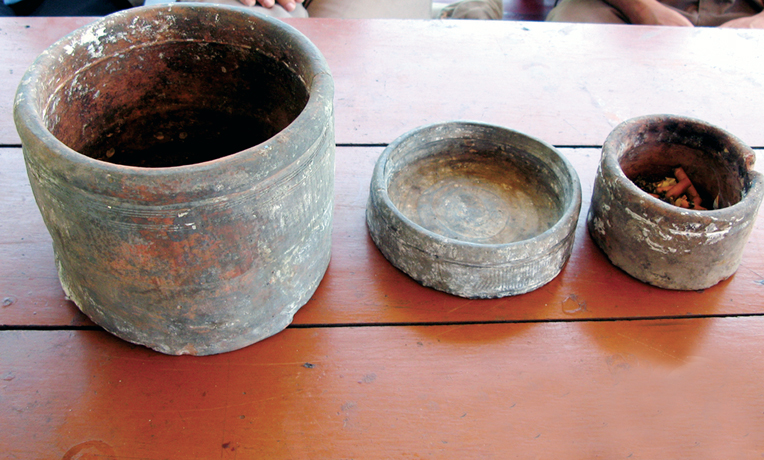
A few years ago, some fishermen in Van Don who worked as divers unearthed ancient artifacts in a channel in Bai Tu Long Bay. In the fishing villages of Ba Hang and Vung Vieng, fishermen still often find earthenware jars, bowls, and plates dating back to the Mac Dynasty (16th-17th centuries) while diving for seafood. These traces suggest that the hypothesis of ancient shipwrecks in Ha Long Bay is plausible. However, some argue that, given the current density and speed of trawling nets used by fishermen in Ha Long Bay, it is difficult for any shipwreck at the bottom of the bay to go undetected.
I recall that in the July 2007 issue of the magazine "Past and Present" published by the Vietnam Historical Science Association, there was an article by author Ho Dac Duy discussing the event of Truong Van Ho's supply fleet being destroyed by the Tran Dynasty's army and people in Ha Long Bay in 1288. The author questioned where the wrecks of the ships and the accompanying equipment are now located. Based on historical documents from both Vietnam and China, and considering the actual geography and topography of Ha Long Bay, the author believes that this naval battle took place between January 3rd and January 6th, 1288. The decisive battle took place at approximately 107 degrees 23 minutes east longitude and 20 degrees 44 minutes north latitude, roughly between the islands of Thuong Mai, Ha Mai, Phuong Hoang, and Nac Dat. The author concludes that if one searches the seabed, they will surely find shipwrecks, at least a few cups, bowls, jars, vases, swords, spears, and copper coins from the Mongol-Yuan army in the 13th century… What author Ho Dac Duy presents is quite interesting. It's not new, but no one, no agency, has ever raised the issue or investigated it.
During the French occupation of the Quang Ninh mining area, despite having advanced iron ships and good maritime equipment, the French still allowed shipwrecks to occur in Ha Long Bay. Near Con Coc Island and Cua Van fishing village, there is a French-era iron ship that sank. For several years, even until recently, a group of people from Hai Phong have been using diving equipment to cut up the wreckage and sell the scrap metal.
It is known that underwater archaeology is still a relatively new science in Vietnam, due to a lack of modern equipment and facilities. Almost no underwater archaeological surveys have been conducted in Ha Long Bay to date, partly for this reason. Behind the questions surrounding the shipwrecks of the Mongol army, these unsolved mysteries contribute to the enigmatic stories of Ha Long Bay, increasing the attractiveness of this heritage site and wonder.
Source: https://baoquangninh.vn/day-vinh-ha-long-co-gi-bi-mat-2177264.html









































































































Comment (0)