

Located in the harsh Taklamakan Desert of Xinjiang (northwest China), the Hotan River is considered one of the most valuable rivers in the world , as its riverbed is filled with jade – a type of stone revered for thousands of years in the country's culture.
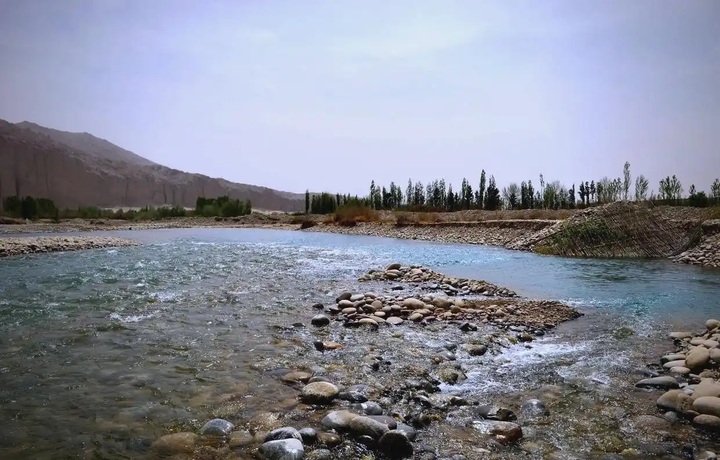
The Hotan Riverbed contains many types of natural gemstones. (Photo: Baidu)
The Xinjiang Uygur Autonomous Region is a land with a distinct appearance from the rest of China. Mosques, Arabic script, and the Uyghur language are common alongside traditional architecture and Chinese characters.
This vast landmass is larger than the combined area of France, Germany, and Spain. More than one-fifth of its area is covered by the Taklamakan Desert—China's largest desert.
Amidst the arid landscape, the White Jade River and the Black Jade River flow through and merge to form the Hotan River. Their names originate from the rare gemstones found at the riverbed.
In Chinese culture, jade holds special significance, associated with nobility, good fortune, and virtue. "The Chinese believe jade has the ability to ward off evil spirits and bring peace," says Juliette Hibou, a gem expert at the Gem & Gem Society of the United Kingdom.
Jade artifacts in China date back to the third millennium BC. During the feudal era, jade became a symbol of royalty and the aristocracy. Currently, the jade market in China alone is estimated to be worth approximately $30 billion.
The Hotan River is famous for its abundance of natural jade stones. Local people can wade along the riverbed to search for these valuable gems.
"Normally we find around 10 pearls, but some days we don't find any," Mehmet Misrah, a pearl hunter in Hotan, told The Telegraph.
The most beautiful stones can fetch up to one million yuan (over 3.8 billion VND). "Anyone who finds such a stone usually quits their job and goes on a pilgrimage to Mecca (the holiest city in Islam in Saudi Arabia)," he said.
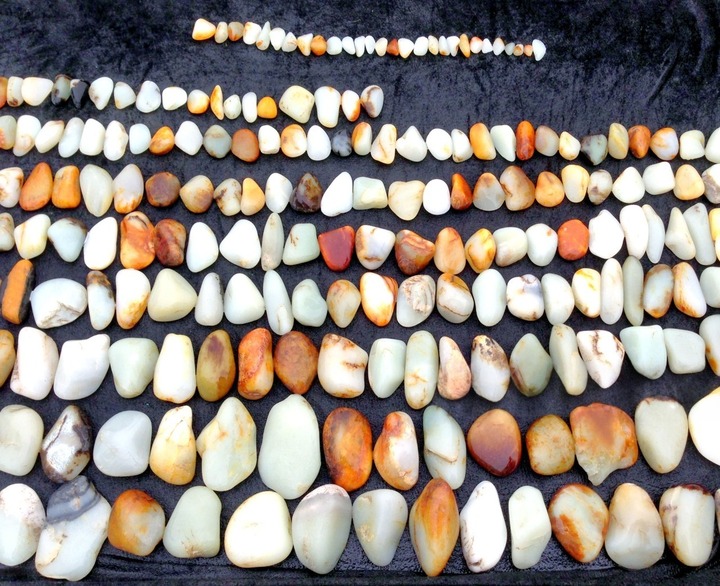
Jadeite stones are displayed for sale at the Hotan jade market in Xinjiang, China. (Photo: Getty Images)
The indigenous Uyghurs don't value jade as much as the Han Chinese. "Jade doesn't have much significance in our culture, but we're grateful that the Chinese are so obsessed with it," Yacen Ahmat, a trader at the Hotan market, told the New York Times .
About 40 years ago, the pearls at the bottom of the Hotan River were considered just ordinary pebbles. But when traders from eastern China flocked to the area, it quickly became the site of a "pearl craze."
The price of jade has surged, at times exceeding the price of gold by weight. Digging activities have become increasingly large-scale, ranging from manual searching to the use of heavy machinery to excavate riverbeds and mountain slopes around the area.
Hotan was originally an oasis in the Taklamakan Desert and once held an important position on the ancient Silk Road connecting Europe and Asia. Thanks to its water resources and surrounding mineral-rich mountain ranges, it became a center of trade for centuries.
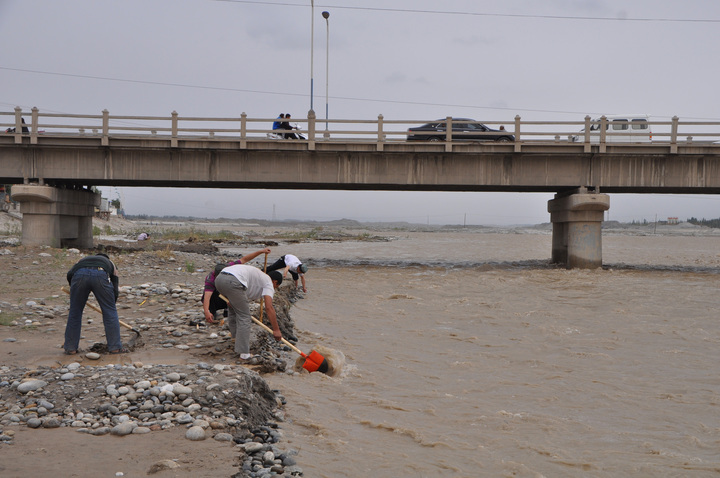
A group of people mine jade on the banks of the Hotan River, near the G315 highway bridge in Xinjiang, China. (Photo: Yoshi Canopus/Wikipedia)
The type of jade found in Hotan is mainly jadeite, a type of jade with a dense, durable structure that was used by the Chinese thousands of years ago, before jadeite from Myanmar was introduced to the country in the 18th century.
However, the mining frenzy that lasted for many years gradually depleted natural jade resources. Large jade blocks disappeared first, followed by smaller pieces. Many large-scale mining teams also returned empty-handed.
In 2007, the Xinjiang authorities revoked all mining licenses and banned commercial jade mining along the Hotan River to protect the environment and natural resources.
Local officials said mining operations can only resume when the environment recovers and must be conducted in a more "legal and orderly" manner.
"Hotan River jade is unlike coal or oil. It's a unique resource that has existed alongside Chinese culture for thousands of years," warned Wang Shiqi, a geology professor at Peking University. "If we continue to exploit it without limits, we could cause irreparable damage to Chinese culture."
Source: https://vtcnews.vn/dong-song-dat-gia-nhat-the-gioi-o-trung-quoc-ar1019234.html














![[GALLERY] The super-cheap Claude AI API turns out to be selling user data.](https://vphoto.vietnam.vn/thumb/402x226/vietnam/resource/IMAGE/2026/05/25/1779691077049_cl-6-png.webp)


![[GALLERY] A completely different iPhone for the 20th anniversary edition](https://vphoto.vietnam.vn/thumb/402x226/vietnam/resource/IMAGE/2026/05/25/1779686871893_212-jpg.webp)




























































Comment (0)