

Scientists at Russia's state-owned nuclear energy corporation recently announced the development of a plasma-electric rocket engine that they claim could launch spacecraft to Mars in just 1-2 months.
Unlike traditional rocket engines used in spacecraft that rely on fuel combustion, the improved propulsion system uses a magnetic plasma accelerator and promises to significantly reduce interplanetary travel times, according to Interesting Engineering on February 10, citing information from the Russian newspaper Izvestia .
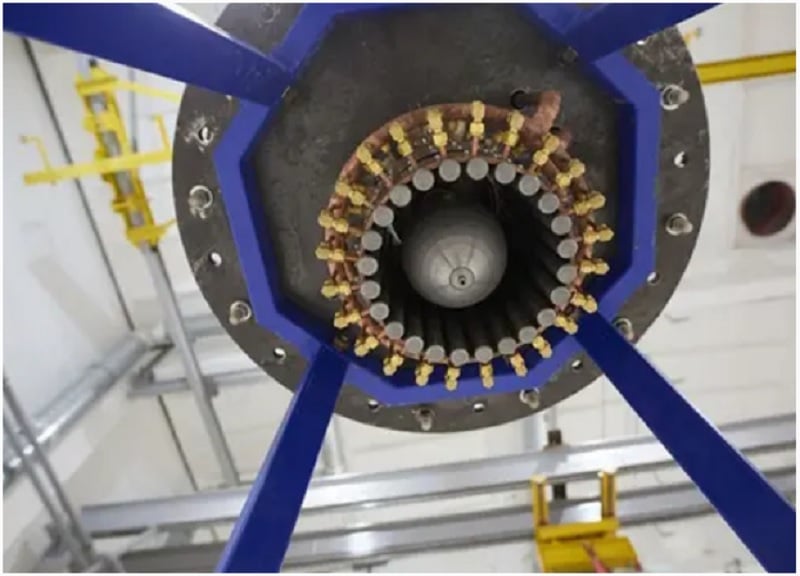
Rosatom scientists have created a first laboratory prototype of a plasma-electric rocket engine based on a magnetic plasma accelerator.
Image: Screenshot from Interestingengineering.com
"A plasma rocket engine is a type of electric motor, based on two electrodes. Charged particles are transferred between them, and at the same time, a high voltage is applied to the electrodes. As a result, the current creates a magnetic field that pushes the particles away from the engine. Accordingly, the plasma receives directed motion and generates thrust," researcher Egor Biriulin at the Troitsk Institute of Russia's state nuclear energy corporation (Rosatom) told Izvestia .
According to this approach, hydrogen is used as fuel, and the engine accelerates charged particles, electrons and protons, to speeds of 100 km/second. "In traditional energy units, the maximum velocity of the material flow is about 4.5 km/second, which is due to the conditions of fuel combustion. In contrast, in our engine, the working objects are charged particles accelerated by an electromagnetic field," explains Alexei Voronov, first deputy general director of science at the Troitsk Institute, according to Izvestia .
A faster journey to Mars would not only increase efficiency but also minimize the risks associated with prolonged exposure to cosmic radiation for astronauts.
A first laboratory-developed plasma engine prototype has been developed at the Troitsk Institute. This prototype will undergo extensive ground testing to fine-tune its operating modes and pave the way for the creation of a flight model, expected to be ready by 2030.
Source: https://thanhnien.vn/dot-pha-dong-co-tau-vu-tru-cua-nga-185250211091447218.htm



![[Photo] General Secretary and President To Lam receives Amazon's Senior Vice President David Zapolsky](https://vphoto.vietnam.vn/thumb/1200x675/vietnam/resource/IMAGE/2026/05/22/1779466547770_a1-bnd-3513-6601-jpg.webp)
























































































Comment (0)