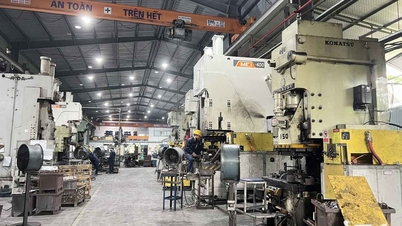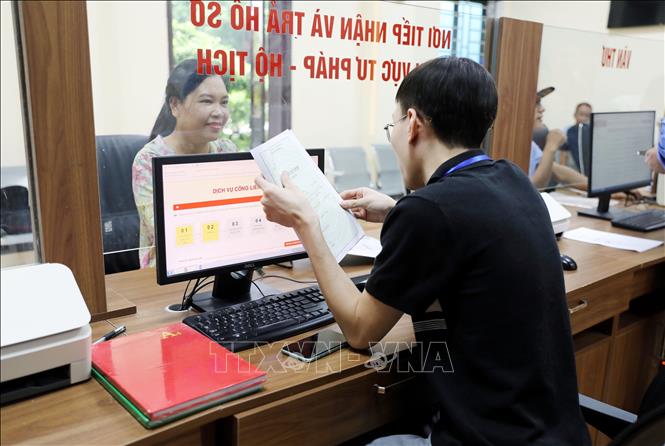
The comprehensive improvement of the legal system, tightening discipline coupled with procedural reforms and promoting innovation have expanded the development space, created a transparent and open investment and business environment, and propelled the economy forward more rapidly and sustainably.
Removing obstacles and unlocking resources.
Contributing to the effective implementation of the strategic breakthrough in institutional reform in the spirit of the Party's 13th National Congress Resolution, during the past term, the Ministry of Interior has promptly institutionalized the Party's guidelines, resolved difficulties, obstacles, and inadequacies in the implementation of mechanisms and policies in the field of internal affairs, creating uniformity and smooth implementation.
From 2021 to 2025, the Party Committee of the Ministry of Interior led the development of 12 laws and ordinances, 14 resolutions of the National Assembly, numerous resolutions of the Standing Committee of the National Assembly, decrees and decisions of the Government and the Prime Minister, promptly institutionalizing the Party's policies and practical issues arising in the areas of state management under the Ministry's purview. In 2025 alone, the Ministry of Interior advised and submitted 19 documents and projects to the Politburo , the Secretariat, and the Central Committee; submitted 6 laws and 6 resolutions to the National Assembly for approval; submitted 42 resolutions to the Standing Committee of the National Assembly; submitted 41 decrees and 31 resolutions to the Government; submitted 75 decisions and 1 directive to the Prime Minister. The Minister of Interior issued 31 circulars and 3 consolidated documents within his/her authority.
In particular, the Ministry focuses on building groundbreaking institutions to implement a revolution in streamlining the administrative apparatus, reorganizing administrative units, and establishing a two-tiered local government system linked to the interconnection of cadres and civil servants throughout the entire political system; building a civil service system and restructuring and improving the quality of cadres, civil servants, and public employees. The Ministry advises on perfecting the two-tiered local government model towards being closer to the people, serving them better, and meeting the requirements for quality and progress of tasks assigned by the Central Party Committee, the Politburo , the Secretariat, and the Government Party Committee.
In addition, the Ministry of Interior reviewed all existing and non-essential legal documents in the field of internal affairs. The review identified 43 provisions in laws, decrees, and circulars that were contradictory, overlapping, unclear, subject to different interpretations, unreasonable, impractical, and hindered application, innovation, and the development of new growth drivers, particularly in areas such as employment, occupational safety, social insurance, management of Vietnamese workers abroad, and document management and archiving. Based on this, the Ministry of Interior promptly amended, supplemented, and rectified the overlaps in legal documents within its authority.
Deputy Minister of Home Affairs Truong Hai Long stated that the work of building and perfecting institutions has seen a strong shift in thinking, promoting strategic breakthroughs, and improving the drafting and implementation of laws in the field of home affairs. Difficulties have been promptly addressed, and inadequacies, contradictions, and overlaps in legal regulations related to the operation of the new apparatus, especially at the grassroots level, have been rectified. Simultaneously, emphasis has been placed on improving the quality and efficiency of the two-tiered local government system; promoting decentralization and delegation of power; and implementing a revolution in the restructuring of the state apparatus towards a streamlined, strong, efficient, and effective system. The goal is to build a state administration that serves the people, a modern national governance system, and a driving force for socio-economic development.
Institutional breakthroughs – a highlight of the Government's term.




The results of the Ministry of Interior's work in building and perfecting institutions reflect the Government's efforts in implementing one of the three strategic breakthroughs in the spirit of the Party's 13th National Congress Resolution. Identifying institutions as the "breakthrough of breakthroughs," the Party Committee of the Government has comprehensively led and directed the work of building and perfecting institutions and laws, closely adhering to reality, "standing on the practical ground of Vietnam," ensuring systematicity, seizing all opportunities, paving the way, and unlocking all resources. The Government has accelerated administrative procedure reform, reduced business conditions and regulations, eliminated the "request-and-grant" mechanism, and improved the investment and business environment; directed the acceleration of the construction and completion of planning work; and developed pilot and specific mechanisms and policies for some localities.
The Party Committee has focused on developing and submitting to the Politburo many breakthrough resolutions; and submitting to the National Assembly for consideration and approval the largest number of draft laws and resolutions in a single term to date. In 2025, the Government will submit 99 draft laws and resolutions to the National Assembly for approval. The Government will issue 377 decrees and 6 resolutions to address difficulties and obstacles in legal regulations. During this term, the Government has directed the development and submission to the National Assembly for approval of over 178 laws, ordinances, and resolutions; and issued 936 decrees within its authority.
Many legal documents related to perfecting the legal framework of the market economy, creating an equal competitive environment, fostering development in the digital space, and fully institutionalizing the property rights of the State, organizations, and individuals... have been researched, supplemented, and amended, such as regulations on transactions and management of digital assets; new business models applying high technology; the sharing economy model; venture capital... The quality of legal documents has improved. The review and elimination of contradictions, overlaps, conflicts, and outdated administrative procedures in investment and business law have been largely completed. The quality of the investment and business environment has improved significantly.
Various types of markets continue to be formed synchronously and develop rapidly, linked to regional and global markets. Regulations governing the gold market have been perfected, officially abolishing the state monopoly on gold bar production. Several new types of markets have been and are being developed, such as the carbon credit market, green credit, and green finance.
In addition, the Party Committee of the Government leads and directs the acceleration of decentralization and delegation of power between central agencies and local governments, and between different levels of local governments; it also researches, develops, and implements pilot mechanisms and policies for specific decentralization to some localities and gradually expands the scope of application.
Speaking with a reporter from the Vietnam News Agency (TTXVN), Politburo member, Standing Deputy Secretary of the Government Party Committee, and Standing Deputy Prime Minister Nguyen Hoa Binh shared that breakthroughs in institutional building are a highlight of the Government's term. A prominent feature is the unprecedented number of legal documents issued. Not only in terms of quantity, but also in quality, this is noteworthy. We have amended key laws such as the Land Law, the Housing Law, the Real Estate Business Law, and the Public Investment Law, and through these amendments, we have removed existing legal bottlenecks that hindered development.
"The process of lawmaking has shifted significantly from a managerial mindset to a constructive one, removing bottlenecks and abandoning the mindset of prohibiting what cannot be managed. From laws that were solely focused on management, the laws we now enact have opened up bottlenecks, fostered development, and supported growth, making the legal system a true resource for growth," the Deputy Prime Minister stated.
The decentralization, delegation of power, and delineation of authority have also been thoroughly implemented in the spirit of "local decision-making, local action, local responsibility." Nearly 3,000 business regulations have been reduced and simplified, placing Vietnam among the countries with the most open, transparent, and attractive investment and business environments in the region.



Source: https://baotintuc.vn/thoi-su/dot-pha-the-che-mo-duong-khoi-thong-nguon-luc-20260114164010482.htm