

Canada is expected to reinstate the 20-hour work-per-week limit for international students after December 31, raising concerns about their ability to pay for tuition and living expenses.
Due to a labor shortage, the Canadian government allowed international students to work part-time without time limits, starting in November 2022. Thanks to this, Krunal Chavda, 20, an international student at the University of Saskatchewan, was able to pay off 10,000 CAD of her 40,000 CAD (720 million VND) student loan.
"I can work an extra 40 hours a week. Thanks to that, my finances are much more abundant," Krunal shared.
For international students like Domenici Medina from Ecuador, who still receive financial support from their families, part-time work remains essential because her tuition fees have tripled. Additionally, the extra income helps Demoenici pay for dental check-ups, which are not covered by the university's insurance.
However, this regulation will expire after December 31st, meaning that from 2024, international students will be limited to working only 20 hours per week.
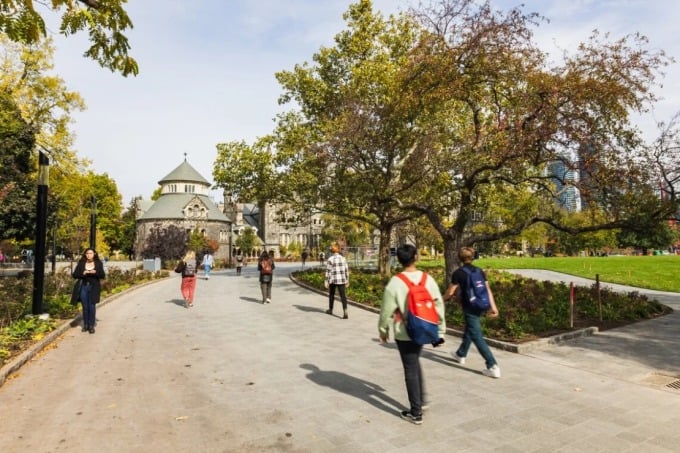
The University of Toronto campus, Canada. Photo: University of Toronto
Krunal is worried about the reintroduction of the previous regulations. Due to inflation, his grocery expenses alone are now 300 CAD per month, three times higher than before.
"The feelings of uncertainty and anxiety were palpable. Maintaining daily life was becoming increasingly difficult," shared Meghal, Krunal's classmate.
Additionally, in 2023, the average tuition fee for international students was CAD 38,000 (VND 685 million) per year, 6% higher than last year and five times the CAD 7,000 for domestic students, according to Statistics Canada.
"Most international students currently have to work for the minimum wage of 16 CAD an hour. Therefore, we can't make ends meet if we're only allowed to work 20 hours a week," said Karandeep Singh Sanghera, president of the student union at Capilano University in Vancouver.
In addition, many employers require students to work longer hours. Doris Yim, a pharmacy student, is applying for a cashier position at a pharmacy. However, the employer says they want to hire someone who can work full-time during the holidays. With a limit of 20 hours of overtime, Doris cannot get the job.
According to James Casey, a policy analyst at the Canadian Federation of Students (CFS), international students receive no support other than tuition loans. To cope with the cost of living and housing, many students have to turn to free food distributions, as well as find shared accommodation, or even live without a place to stay.
Therefore, not only international students, but also many organizations are calling on the government to change its policies regarding part-time work hours.
Responding to CBC News via email on November 27, the Canadian Immigration Department said it is assessing the impact and the number of international students who would benefit from the policy of not limiting part-time work hours, before making a final decision.
Last year, Canada had 807,750 international students, an increase of nearly 30% compared to 2021. However, their rights are not being adequately protected, ranging from the processing of admission offers to the lack of suitable accommodation and the problem of work permit fraud.
Huy Quan (Based on CBC News, CTV News, Canadian Immigration News)
Source link
![[Photo] General Secretary and President visit the China-ASEAN AI Application Cooperation Center](https://vphoto.vietnam.vn/thumb/1200x675/vietnam/resource/IMAGE/2026/04/17/1776404277677_vna-potal-tong-bi-thu-chu-tich-nuoc-tham-trung-tam-hop-tac-ung-dung-ai-trung-quoc-asean-8706616-2286-jpg.webp)



























![[Photo] Speaker of the National Assembly meets with the Vietnamese community in Türkiye](https://vphoto.vietnam.vn/thumb/1200x675/vietnam/resource/IMAGE/2026/04/18/1776483346102_1-8136-jpg.webp)
















































![[Podcast Essay] On the Street in April](https://vphoto.vietnam.vn/thumb/402x226/vietnam/resource/IMAGE/2026/04/18/1776483290439_nhipsonghanoi-hanoimoi-com-vn-uploads-images-phananh-2021-04-15-_minh-hoa-3.jpeg)












Comment (0)