

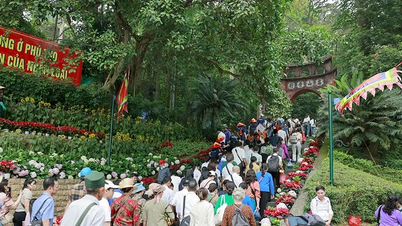
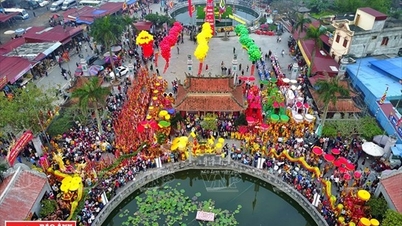
In the Vietnamese consciousness, Phu Tho is considered the ancestral land, home to the sacred Hung Temple and unique cultural and religious values recognized by UNESCO. Every year, the Hung Kings Commemoration Day on the 10th day of the 3rd lunar month is a major cultural event, attracting millions of visitors from all over the country. However, the tourism landscape remains largely seasonal, concentrated around the festival period, with other months generally experiencing low visitor numbers.
After July 1st, 2025, when the three provinces of Phu Tho , Vinh Phuc, and Hoa Binh merge, Phu Tho province will enter a new phase of development with a completely different appearance. Its larger space, richer natural resources, and more diverse cultural identity have opened up opportunities to transform the ancestral land into a year-round tourist destination, but also present numerous challenges.

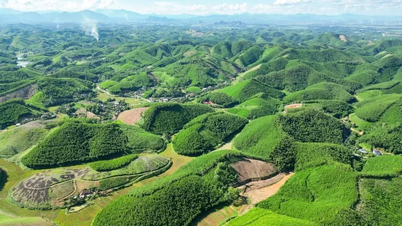
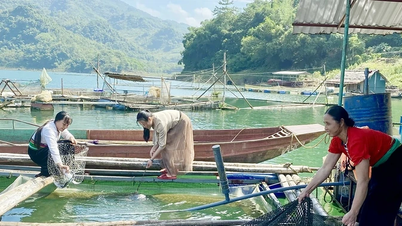
Canh Tang Lake in Phu Tho province possesses a captivating beauty that attracts tourists.
The first noteworthy point is that the scale and resources of tourism are now combined from three regions. Old Phu Tho was already famous for its heritage associated with the Hung Kings worship, Xoan singing, and hundreds of traditional festivals.
The former Vinh Phuc province boasts the advantages of a dynamic economic region, strong urbanization, modern tourism infrastructure, and the well-established Tam Dao and Dai Lai resorts.
The old Hoa Binh province boasts a magnificent system of rivers, lakes, and mountains, along with the distinctive cultural identities of the Muong, Thai, and Dao ethnic groups.
This combination makes Phu Tho not only a land of festivals, but also a place where tourists can find all kinds of tourism, from spiritual tourism, ecotourism, resort tourism, community tourism, experiential agriculture to adventure sports activities, conferences, and seminars.
The latest statistics show strong growth. By July 2025, the province had 2,778 historical sites, of which nearly 1,000 were classified, including 6 special national historical sites and 6 national treasures. Regarding intangible heritage, the province possesses nearly 2,000 heritage items, including 5 recognized by UNESCO.
In the first six months of 2025, the province welcomed approximately 14.5 million tourists, generating revenue of over 14,800 billion VND, with an average growth rate of over 10% per year.
The accommodation system has also been upgraded with over 1,500 establishments and more than 20,000 rooms, including many 4-5 star hotels capable of accommodating high-end tourists. This is an important foundation for developing large-scale, sustainable tourism.

Thanh Lanh Golf Course in Phu Tho is renowned as one of the most beautiful golf courses in Northern Vietnam, consistently attracting a large number of domestic and international tourists to compete and experience its beauty.
Beyond just numbers, geographical location is also a strategic advantage. Viet Tri city – the administrative center of the province – is located less than 80 km from Hanoi, with convenient connections via the Noi Bai – Lao Cai expressway, National Highways 2 and 32.
This is the gateway to the midland region, an ideal transit point for tourists traveling from Hanoi to the Northwestern provinces. With this advantage, Phu Tho can certainly become the first stop on the journey of international tourists when exploring Northern Vietnam.
However, behind that potential lie many challenges. First is seasonality. Tourists usually only flock to Hung Temple and Tay Thien during festivals, or to Tam Dao during the hot summer months, while for many months of the year, many tourist destinations are deserted.
Infrastructure in mountainous and remote areas is still underdeveloped, roads are difficult to access, and essential services such as electricity, water, and internet are not adequately provided. Tourism personnel lack foreign language skills and professional tour guiding abilities, while international tourism is becoming increasingly important.
Another weakness is the inadequate promotion; the tourism brand of the Ancestral Land is not strong enough to create a distinct identity compared to neighboring localities.
To retain tourists year-round, Phu Tho first needs to diversify its products. It cannot rely solely on the Ancestor Commemoration Day and the Tay Thien Festival; it must create reasons for tourists to visit at any time.
"Four-season" tours need to be clearly defined. In spring, tourists can admire flowers and participate in festivals; in summer, they can explore waterfalls, lakes, and streams, and relax at Thanh Thuy hot springs; in autumn, they can experience agricultural tourism and traditional crafts; and in winter, they can travel to the highlands to chase clouds and enjoy local cuisine.
In parallel, cultural, artistic, and sporting events should also be organized regularly throughout the year, such as food festivals, music festivals, mountain sports competitions, and OCOP product fairs, to continuously attract tourists.
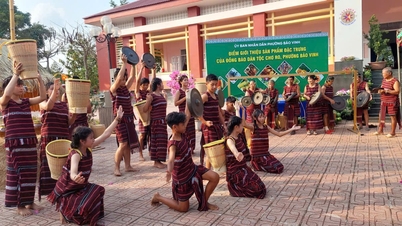
Another approach is to more strongly promote community-based tourism. The former Hoa Binh region, with its Muong, Thai, and Dao villages, has a rare advantage for developing homestays and experiential tourism. Today's tourists not only want to visit but also want to "live like the locals," eating, staying, and working alongside them. If done well, this will be a product that keeps tourists coming back for longer, while also bringing direct benefits to the local community.
Infrastructure is a key factor. To retain tourists, transportation must be convenient and services must be comprehensive. The province needs to prioritize investment in upgrading roads to tourist destinations, improving internal transportation, and ensuring basic services from electricity, water, and telecommunications to waste management. A clean environment, preserved landscapes, and a complete experience are the key to retaining tourists in the long term. In addition, planning needs to be rigorous to avoid spontaneous development that could lead to overcrowding or damage to the landscape and historical sites.
Human resources are a crucial factor. A destination may be beautiful, and services may be abundant, but if the staff lack skills, foreign language proficiency, and friendliness, tourists are unlikely to return.
The province needs to strengthen training, collaborate with major tourism schools, open professional training courses, and encourage community participation in on-site training. When local people themselves become "tourism ambassadors," they not only welcome guests with smiles but also share stories of the culture and history associated with their homeland.
Promotional efforts need to be revamped. In the digital age, a compelling video on social media can reach a tourist destination far beyond thousands of brochures. Phu Tho needs to build a brand identity "Ancestral Land Tourism – Four Seasons of Experience," boost digital communication, and collaborate with major travel agencies, bloggers, and KOLs both domestically and internationally to spread its image. More importantly, each destination must have its own "story," linked to its history, culture, and people, to create differentiation.
Another factor is regional connectivity. Tourists rarely visit just one province, but usually choose a continuous itinerary. Therefore, Phu Tho needs to strengthen coordination with Hanoi and the northern mountainous provinces to build integrated tours, such as: Hanoi – Viet Tri – Hoa Binh Lake – Tam Dao Tourist Area – Sa Pa. When placed within an attractive itinerary, Phu Tho will both benefit from the influx of tourists and affirm its position on the regional tourism map.
For these solutions to become a reality, the roles of the government and businesses are extremely important. The government needs to create a transparent and preferential mechanism for tourism investment, while strengthening management, conservation, and ensuring sustainable development. Businesses need to boldly invest in new products, improve service quality, and engage with the community for mutual development. The Phu Tho Tourism Association, established from the merger of three former associations, needs to truly become a bridge, a place to gather the common will and actions of the entire industry.
Phu Tho, the ancestral land of the Hung Kings, is a place where unique historical, cultural, and natural values converge. After the merger, the new province is facing a great opportunity to transform these values into a driving force for development. However, to attract tourists year-round, it cannot rely solely on its "historical cradle" but requires a breakthrough in thinking and decisive action.
When advantages are transformed into experiences, when each season offers a reason for visitors to return, and when every citizen becomes a "friendly ambassador," then the ancestral land will not only be a place to remember, but a place to return to...
Quang Nam
Source: https://baophutho.vn/du-lich-dat-to-lam-gi-de-giu-khach-quanh-nam-240520.htm


![[Image] National Assembly discusses the implementation of the socio-economic development plan.](https://vphoto.vietnam.vn/thumb/1200x675/vietnam/resource/IMAGE/2026/04/20/1776696707422_ndo_br_img-20260420-185419-jpg.webp)
![[Photo] General Secretary and President To Lam meets with National Assembly delegates from ethnic minorities.](https://vphoto.vietnam.vn/thumb/1200x675/vietnam/resource/IMAGE/2026/04/20/1776696701056_a1-bnd-8331-3342-jpg.webp)





























































Comment (0)