

Information about Ho Chi Minh City expanding its administrative boundaries after officially merging Binh Duong and Ba Ria - Vung Tau has attracted the attention of tourists. Dr. Duong Duc Minh, Deputy Director of the Institute for Economic and Tourism Development Research of Ho Chi Minh City, said that the city is facing the opportunity to elevate itself into a creative tourism megacity after the merger.
Maximize the use of the main pillars to welcome guests.
According to the Ho Chi Minh City Department of Tourism , in the new urban space, the city integrates three pillars: urban-industrial and coastal-resort tourism, linked to the potential, advantages, and tourism resources of the localities. Specifically, Ho Chi Minh City is a city with strong development in MICE tourism, urban heritage, and urban culture. Binh Duong has industrial tourism, riverside eco-tourism, and traditional craft villages. Ba Ria - Vung Tau has strengths in high-end beach resorts, golf tourism, and wellness tourism.
At the conference summarizing the "One Unique Tourism Product Per District" program, recently organized by the Ho Chi Minh City Department of Tourism, many opinions assessed the city's outstanding tourism development potential in the coming time thanks to its expanded administrative boundaries, creating opportunities for product diversification. To achieve this, Ho Chi Minh City needs to innovate, exploit, and connect its unique tourism products.
Ms. Nguyen Thi Thanh Thao, Head of the Tourism Resource Development Planning Department of the Ho Chi Minh City Department of Tourism, said that in nearly five years of implementing the "One Unique Tourism Product for Each District" program, more than 60 unique tour and route products have been developed in various districts and communes across the city. At the same time, Ho Chi Minh City currently has 366 destinations assessed as having the potential to attract tourists. In this new context, the tourism industry will review and upgrade tourism products in a way that connects and links existing advantages.
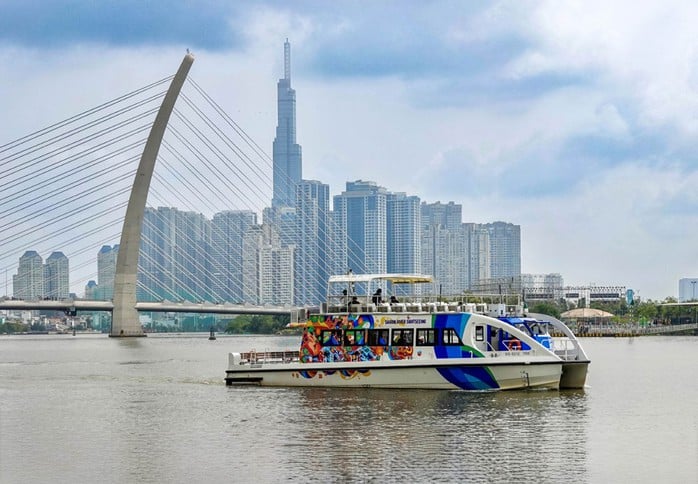
Ho Chi Minh City's tourism sector has the opportunity to thrive after the merger of Binh Duong and Ba Ria - Vung Tau provinces. Photo: HOANG TRIEU
"We have consulted with Ba Ria - Vung Tau and Binh Duong provinces and are updating the historical and cultural relics of the wards/communes, publishing them on the new administrative destination map. After the merger, the number of local tourism agencies in Ho Chi Minh City that will directly coordinate is expected to reach 168 wards/communes. To continue to leverage strengths and contribute to the city's economic development, wards and communes need to proactively review and upgrade their destinations and historical and cultural relics to meet the standards for serving tourists," Ms. Thao said.
Many travel companies are researching and developing new products and tours in Ho Chi Minh City, not only focusing on city tours but also adding unique products that reflect the city's characteristics, such as beach and island tourism, and resort tourism.
Mr. Tran The Dung, General Director of Vietluxtour Travel Joint Stock Company, believes that close connections between the newly established wards and communes are necessary. The opportunities for the city's tourism industry on this new scale are immense, as domestic and international tourists will not only take half-day city tours but can also experience 2-3 day tours.
"Binh Duong has rarely appeared on international tourist maps. Now, with its merger into Ho Chi Minh City, when developing new tourism products, companies can include attractive destinations in Binh Duong in their itineraries, along with the coastal city of Vung Tau, to create diverse and novel itineraries for tourists. We need to continue selecting new attractive destinations, allowing tourists to explore from Cu Chi and Can Gio to Binh Duong and Vung Tau," Mr. Dung said.
Tourism Innovation and Coordination Center
At the recent conference summarizing business activities in the first six months and outlining business plans for the last six months of 2025 of Saigontourist Group, Vice Chairman of the Ho Chi Minh City People's Committee Nguyen Van Dung also raised the issue of the need to calculate development potential in the context of the city's expansion.
According to Mr. Nguyen Van Dung, Saigontourist Group needs to adjust its operational strategy accordingly; restructure and recalculate its operations in the new context. It needs to review its system so that member units can improve business efficiency and contribute to the overall development of the city. A clear strategic direction for the 2025-2030 period needs to be established so that the corporation can continue to play a leading role in connecting localities, expanding markets, and promoting the image of Ho Chi Minh City and Vietnam internationally.
According to Dr. Duong Duc Minh, one of the key breakthrough solutions to transform Ho Chi Minh City into a tourism megacity is to establish the city as a center for innovation and coordination of creative tourism in the Southeast region. This would not only be a place to preserve and showcase tourism products, but also a continuous source of new models, platforms, and behaviors for the industry.
"To achieve that, the city needs to invest in innovative tourism laboratories that combine technology, art, sociology, and artificial intelligence. From there, it can build immersive experiential models, virtual reality, open data, and automated journeys. It should design tourism value chains linked to the creative industries, green agriculture, and urban logistics. Tourism shouldn't be limited to traditional destinations, but should be expanded to encompass the entire ecosystem of living, producing, and moving within the megacity," said Dr. Duong Duc Minh.
For example, the city could pioneer a "green logistics tourism" model – where international visitors can tour organic food distribution systems and experience the operation of carbon-free smart warehouses. They could even participate in testing AI applications in the cold chain. In Binh Duong, the tourism industry could develop "high-tech agricultural tourism on weekends" to serve the market of over 14 million people in the inner city, creating a green learning, playing, and living experience in line with a multi-value integrated model. Tourism would not be isolated within the service industry but would become a tool for shaping lifestyles and promoting a circular economy model.
"The merged city should not be limited to its role as a transportation hub or consumer center; it needs to rise to become a launching pad for ideas, a network of values, and a creative living space for the entire region. At this point, tourism is no longer a supporting industry but the primary means of building communities, connecting people, and spreading regional identity in the most sustainable and vibrant way," Mr. Minh suggested.
Tourist attractions need to be upgraded.
Ms. Bui Thi Ngoc Hieu, Deputy Director of the Ho Chi Minh City Department of Tourism, said that wards/communes need to prioritize investment in, renovation, repair, and upgrading of tourist attractions to meet standards for serving tourists and maintain the products that have been developed over time. Specific surveys and a roadmap should be developed to promote investment in the construction of technical infrastructure connecting road, waterway, and public transport, as well as wharves, linked to the goal of exploiting tours and tourist destinations. Coordination with businesses, destinations, and services is needed to develop inter-ward/commune products linked to the historical and cultural stories of the newly established administrative units.
Source: https://nld.com.vn/du-lich-tp-hcm-don-co-hoi-moi-196250613221222258.htm


![[Photo] Standing Committee member of the Party Central Committee Tran Cam Tu presents the Decision appointing the Secretary of the Party Committee of the Ho Chi Minh National Academy of Politics.](/_next/image?url=https%3A%2F%2Fvphoto.vietnam.vn%2Fthumb%2F1200x675%2Fvietnam%2Fresource%2FIMAGE%2F2026%2F02%2F02%2F1770039902160_le-cong-bo-bt-hvctqg-11-7880-jpg.webp&w=3840&q=75)





Comment (0)