

Celebrating Tet (Vietnamese Lunar New Year) across three borders.
In early spring 2026, we traveled along the Quyet Thang Highway 20 to reach the villages of Thuong Trach border commune. At this time of year, the wildflowers were budding and blooming in a multitude of colors.
According to the elders of Thuong Trach commune, in the past, due to the difficult living conditions of the people in the border area, the celebration of the traditional Lunar New Year was only done in a perfunctory manner, not as grand as in the lowlands or coastal areas. The "lucky" villages would have the Border Guard Post stationed in the area organize an early New Year celebration called "Border Guard Spring, Warming the Hearts of the Villagers" at a designated location, after which everyone would return home.
In recent years, thanks to the Party, the State, and philanthropists regularly providing rice, cash, and essential goods during the Lunar New Year, people in many villages have set aside some of their resources to celebrate the New Year right in their own villages. Generally, the lives of the people are improving, and as a result, the celebration of the Lunar New Year has become more significant and solemn. The Lunar New Year has become an important event, like the traditional New Year celebrations of the indigenous people; everyone is eager and looking forward to it...
 |
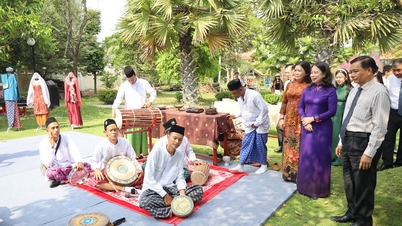
| The drum-beating festival of the Ma Coong people in Ca Roong 1 village, Thuong Trach commune - Photo: VM |
Pouring a cup of tea brewed with forest leaves to offer to guests, village elder Dinh Xon (the festival organizer), residing in Ca Roong 1 village, Thuong Trach commune, said: “Half a month after the traditional Lunar New Year is the Ma Coong people's Drum-Beating Festival, usually held collectively in Ca Roong 1 village. To prepare the offerings for the 2026 Drum-Beating Festival (on the 16th day of the first lunar month), including sticky rice, chicken, and various local products, I have already arranged for people to take care of everything. As for the festival itself, it depends on the contributions of those attending the ceremony and the support from the commune's People's Committee and units stationed in the area.”
Since 2019, when the Ma Coong people's drum-beating festival was included in the National Intangible Cultural Heritage list, the number of visitors from all over the country has increased significantly. Therefore, despite the difficulties, the people encourage each other to organize the festival meticulously, unitedly, preserving the beauty of traditional culture, showing respect to the deities and ancestors, and expressing warmth and hospitality…”.
Lieutenant Colonel Pham Duy Bao, Political Officer of the Ca Roong Border Guard Station, shared that along the Vietnam-Laos border, passing through Thuong Trach commune in Quang Tri province, many people and ethnic groups on both sides of the border have had close, blood-related relationships such as grandparents, parents, husbands and wives, and siblings for many generations.
Therefore, every time the traditional Vietnamese New Year or the Ma Coong people's drum-beating festival arrives, people of various ethnic groups and many agencies and units located near the border in neighboring Laos come here to offer congratulations and share in the festivities. Similarly, at the end of spring, on the other side of the border, neighboring Laos usually celebrates the Bunpimay New Year, and the Ma Coong, Van Kieu, and A Rem people, along with many agencies and units located in Thuong Trach commune, go over to offer congratulations and share in the festivities as a way of reciprocating the tradition...
“It is also from this solidarity and close fraternal relationship that at the end of 2024, the Noong Ma cluster of villages in Bua La Pha district, Khammouane province (Laos) signed a twinning agreement with Thuong Trach commune, Bo Trach district, Quang Binh province (formerly) to further promote twinning activities between the border protection forces of both sides, jointly protecting territorial sovereignty , national border security, and environmental resources… Thus, this is also the first year that Thuong Trach commune, after the merger, has been able to celebrate three Tet holidays “across the border,” a very warm display of friendship, cooperation, and development,” Lieutenant Colonel Pham Duy Bao revealed.
A warm Tet holiday in the border region.
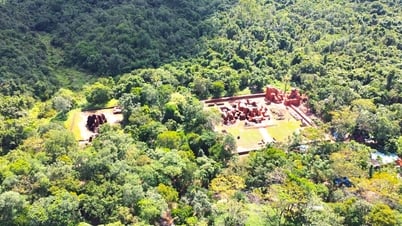
The present-day Thuong Trach commune was formed by merging the two former communes of Tan Trach and Thuong Trach, expanding its area to nearly 1,100 square kilometers and housing nearly 900 households/over 3,750 people (of which the Bru-Van Kieu and Chut ethnic groups account for over 95%), living in 20 villages. All the villages are situated within the old-growth forests of the Phong Nha-Ke Bang National Park, a World Natural Heritage site.
 |
| A view of Con Roang village, Thuong Trach commune today - Photo: VM |
Leading us on a tour through the villages of the Van Kieu, Ma Coong, and A Rem ethnic groups in the hamlets of Km39, Con Roang, Ca Roong 1 and 2, But, Ban, Troi, Tuoc, A Ki, Co Do… to learn more about the unique cultural features of this mountainous border region, Vice Chairman of the People's Committee of Thuong Trach commune, Nguyen Van Dai, shared: “From a remote border area with many villages almost completely isolated from the outside world, one of the highest poverty rates in the province, a backward level of education, and a severe lack of infrastructure and material resources…, Thuong Trach commune has truly transformed rapidly. Currently, most villages in the commune have solid roads allowing motorbikes and cars to reach the village centers.”
“According to the beliefs of the Ma Coong people, on the borderland of Thuong Trach, whether facing the rising sun, setting sun, on the mountaintop, in the cave, or in the stream… there are spirits residing there to govern and witness each tree and blade of grass having the right to grow and develop equally. When the people clear land to cultivate rice, corn, cassava, or go into the forest to gather bamboo shoots, banana blossoms, rattan shoots…, they inadvertently deprive and compete for the right to live of other species. Therefore, the Drum-Beating Festival is an occasion for the people to invite the spirits to attend the ceremony, apologize to the gods, and then pray for their blessings so that the ethnic groups living in this border area will always be safe, united, healthy, and have abundant harvests, with barns full of rice and corn full of corn, avoiding misfortune in life…”, said village elder Dinh Xon.
“This spring of 2026, the ethnic minority people in Thuong Trach commune will celebrate three consecutive Tet holidays under very ‘special’ conditions: all ethnic groups living in the two former communes have now been reunited as one family to celebrate Tet together; this is the first year that 100% of the villages in the commune have electricity and telecommunications coverage; most households in the 20 villages have solid houses to celebrate Tet thanks to national target programs and the Party and Government’s program to eliminate temporary and dilapidated houses…”, the Vice Chairman of the People's Committee of Thuong Trach commune excitedly added.
Civilized
Source: https://baoquangtri.vn/du-lich/202602/du-xuan-don-tet-noi-bien-thuy-1876440/

![[Photo] General Secretary and President visit the China-ASEAN AI Application Cooperation Center](https://vphoto.vietnam.vn/thumb/1200x675/vietnam/resource/IMAGE/2026/04/17/1776404277677_vna-potal-tong-bi-thu-chu-tich-nuoc-tham-trung-tam-hop-tac-ung-dung-ai-trung-quoc-asean-8706616-2286-jpg.webp)











![[Photo] National Assembly Chairman Tran Thanh Man attends the policy seminar to promote Vietnam-Türkiye cooperation.](https://vphoto.vietnam.vn/thumb/1200x675/vietnam/resource/IMAGE/2026/04/16/1776351415367_vna-potal-chu-tich-quoc-hoi-tran-thanh-man-du-toa-dam-chinh-sach-thuc-day-hop-tac-viet-nam-tho-nhi-ky-8705791-jpg.webp)











































Comment (0)