

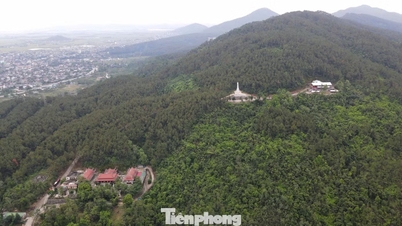
Located within the Lam Kinh National Special Historical Site, Tep Temple is situated in the ancient and sacred Kien Tho commune (Ngoc Lac district), a place of worship for the founding national hero Trung Tuc King Le Lai. During your spring excursion, visit Tep Temple and immerse yourself in the traditional festival atmosphere to experience the cultural beauty of this land and its people.
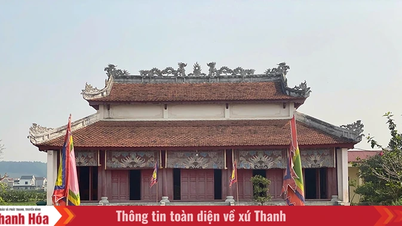
 Tép Temple is a place of worship dedicated to Trung Túc King Lê Lai.
Nestled within the ancient land of Dựng Tú, Tép village (now Thành Sơn hamlet, Kiên Thọ commune) resembles a picturesque landscape painting. This is the birthplace of Lê Lai, a founding national hero who has entered history and folk legends for his courageous act of selflessly saving the king.
According to historical records, Le Lai was known for his upright character and valiant spirit. He was one of the generals who participated in the Lung Nhai Oath, vowing to fight against foreign invaders together. Le Lai was entrusted by General Le Loi with the task of managing logistics. In the early days of the Lam Son Uprising, the rebel army faced countless difficulties. On one occasion, the rebel army was besieged by the Ming invaders, blocking a strategic point, a critical situation like "a thousand pounds hanging by a thread." To break the siege, King Le Loi asked his generals: "Who dares to change clothes, take my place, lead the army to fight the enemy, and use my name, imitating Ji Xin of the Han dynasty, so that I can conceal my identity, create a diversion, gather my generals, and plan the uprising later?"
Amidst the silence of the generals and soldiers, Le Lai then spoke up: "I volunteer to go. After the country is conquered, remember my contributions, so that my descendants will forever remember my gratitude to the nation. That is my wish." Moved by the valiant act of his subordinate general, King Le Loi of Binh Dinh bowed to heaven and earth and prayed: "Le Lai's sacrifice in exchanging his clothes is invaluable. If, in the future, I and my descendants, along with the descendants of all the generals and meritorious officials, fail to remember his contributions, then may the palace be turned into mountains and forests, the precious seal into a lump of copper, and the divine sword into a blunt knife."
Thanks to Le Lai, riding an elephant, and several other officers charging straight into the enemy's besieged positions, the enemy believed they had captured the leader of the Lam Son rebellion. As a result, the enemy withdrew their troops to Tay Do citadel, and consequently, their defenses became lax. This also gave the Lam Son rebels an opportunity to restore their morale, consolidate their forces, and reverse the situation, achieving successive victories afterward.
Not forgetting the courageous act of self-sacrifice for a great cause of his subordinate general, after ascending the throne, Emperor Lê Thái Tổ bestowed upon Lê Lai the title of first-class meritorious official, posthumously awarding him the rank of Lieutenant and the posthumous name "Toàn Nghĩa". He then ordered the scholar Nguyễn Trãi to write an oath, pledging to remember Lê Lai's contributions, and placed it in a golden chest. He further bestowed upon him the title of Grand Marshal. In the first year of Thái Hòa (1443), Lê Lai was granted the title of Bình chương quân quốc trọng sự...; at the beginning of the Hồng Đức era, he was granted the title of Diên Phúc hầu, and in 1484 he was posthumously awarded the title of Grand Marshal Phúc Quốc công, and later granted the title of Trung Túc vương.
Le Lai's noble act of selflessly saving the king is not only recorded in historical texts but has also entered folklore, passed down to this day. Every year, on the anniversary of King Le Thai To's death - the Lam Kinh Festival, not only the people of Thanh Hoa province, but the people of the whole country, remind each other: "Twenty-first Le Lai, twenty-second Le Loi, twenty-third the anniversary of the death of Mrs. Hang Dau."
To commemorate the founding national hero Le Lai, a temple dedicated to him was built in the ancient land of Dung Tu, and the locals still commonly call it the Tep Temple. The site is located about 5km from the Lam Kinh National Special Historical Site. According to preserved documents, the Tep Temple was first built during the Thai Hoa era of King Le Nhan Tong. Over time, in 1971, on the old foundation, the people of Tep village rebuilt the temple with an eight-roofed structure and thatched roof.
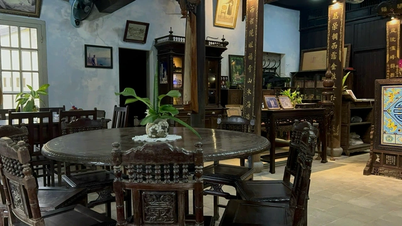
In 1997, as part of the Lam Kinh Restoration Project, the Tep Temple was renovated by the State on its original foundation using ironwood in the traditional architectural style, including a front hall and a rear hall. Within the temple complex, to the left, there is also a temple dedicated to Lady Nuong A Thien (wife of Le Lai), which the locals often call the Mother Goddess Temple.
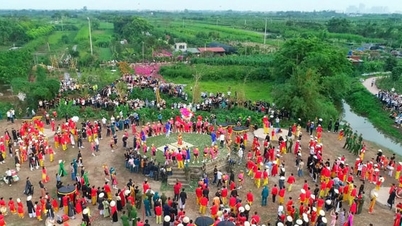
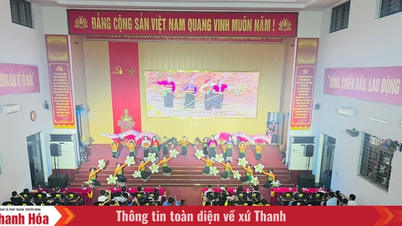
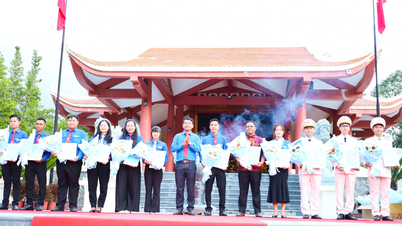
 Locals perform the Pồn Pôông dance during the spring festival held at Tép Temple.
Tép Temple is situated on a high, flat, and airy area, still praised as a place of "dragon bowing and tiger crouching." "To the north, behind the temple, is a mountain range stretching up to Nan Mountain in Phung Giao commune... To the south, in front of the temple, is a wide field extending to the Ho Chi Minh Highway. To the east is a nine-bend stream flowing through, with fertile fields on both banks." (History of the Kien Tho Commune Party Committee). Today, in front of Tép Temple is a large crescent-shaped lake. Tép Temple possesses both an ancient and solemn beauty, yet remains remarkably gentle, adorned with intricate and exquisite carvings.
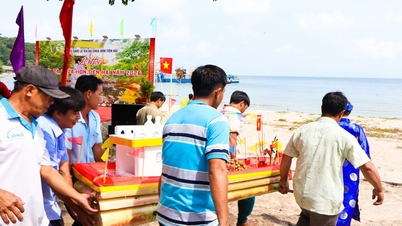
In particular, the traditional festival honoring King Le Lai Trung Tuc takes place at Tep Temple during the early spring. According to Nguyen Thi Thien, Vice Chairman of the People's Committee of Kien Tho commune: “Tep village is home to the majority of the Muong ethnic minority. Every year, two major festivals are held at Tep Temple: one in the 8th lunar month (Lam Kinh Festival) and the other on the 7th and 8th of the first lunar month. The spring festival, in addition to solemn traditional rituals (announcement, procession, sacrifice), features lively folk games and performances such as wearing traditional costumes and performing gong music; Pon Poong dance; volleyball... With its unique cultural values preserved, the traditional spring festival at Tep Temple attracts a large number of locals and tourists.”
The sacred Tép Temple, nestled beneath ancient trees hundreds of years old, evokes a sense of antiquity and sacredness in visitors, yet also a feeling of closeness. Visiting Tép Temple in the early spring and immersing oneself in its beautiful natural surroundings will undoubtedly provide a meaningful springtime experience.
Text and photos: Khánh Lộc
(This article references and uses material from the books: 35 founding heroes of Lam Son; Lam Kinh historical site).
Source
![[Photo] General Secretary and President To Lam works with the Party Committee of the Ministry of Health on the work of Vietnamese traditional medicine.](https://vphoto.vietnam.vn/thumb/1200x675/vietnam/resource/IMAGE/2026/05/20/1779294323718_a1-bnd-2978-3319-jpg.webp)
![[Image] "Journey of Hope" promotes the organ and tissue donation movement in Vietnam.](https://vphoto.vietnam.vn/thumb/1200x675/vietnam/resource/IMAGE/2026/05/20/1779294400833_1-8910-jpg.webp)





















































Comment (0)